
Segmenting Forex traders by demographics helps platforms target specific needs, improve marketing, and boost engagement. Key factors like age, income, occupation, and education influence trading behavior and preferences. For example:
- Age: Younger traders may prefer high-risk strategies, while older ones focus on capital preservation.
- Income: Higher earners lean toward regulated platforms and diversified investments.
- Occupation: Engineers may prioritize API tools; executives might value wealth management options.
- Education: Advanced degree holders often prefer data-driven tools, while beginners need simplified resources.
Key Demographic Variables to Segment Forex Traders
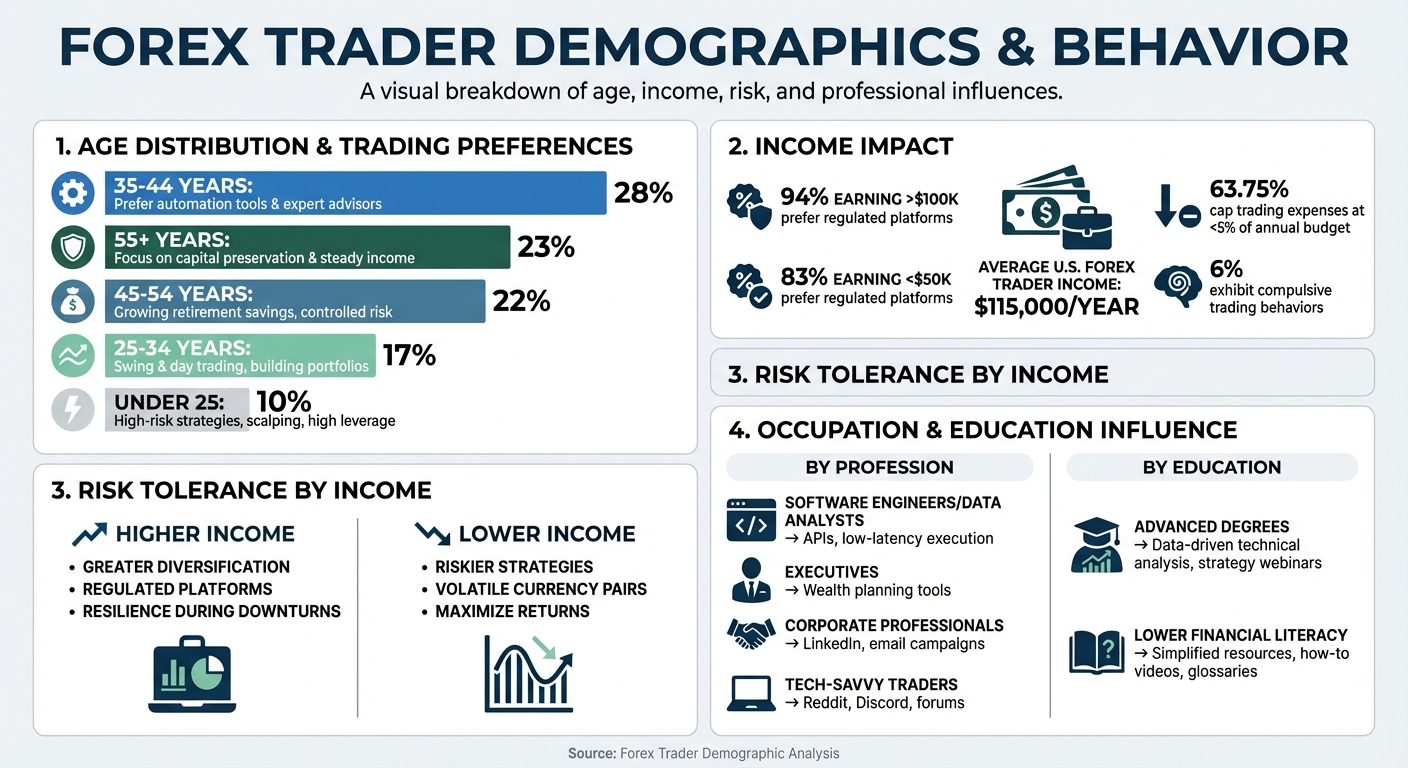
Forex Trader Demographics: Age, Income, and Trading Behavior Statistics
Demographics like age, income, and occupation significantly influence how Forex traders behave and what they need. Let’s break down how each factor shapes trader segmentation.
Age Groups and Trading Preferences
Age plays a major role in determining trading habits, risk tolerance, and even platform preferences. For example:
- Traders aged 35–44 (28% of the market) often juggle trading with professional responsibilities. They lean toward automation tools and expert advisors to save time.
- Under-25 traders (10%) are drawn to high-risk strategies like scalping and using high leverage, often influenced by social media trends.
- Traders aged 55+ (23%) focus on protecting their capital and generating steady income. They rely heavily on thorough research and strict risk management.
- Traders aged 25–34 (17%) tend to explore swing and day trading as they build their initial portfolios.
- Traders aged 45–54 (22%) concentrate on growing their retirement savings while maintaining controlled risk levels.
Income and Risk Tolerance
Income levels directly affect a trader’s ability to take risks and diversify their investments. Higher income provides more flexibility, allowing for greater diversification and resilience during market downturns.
- Forex traders in the U.S. have an average annual income of $115,000, with higher earnings often linked to advanced degrees.
- Research shows that 94% of traders earning over $100,000 prefer regulated platforms, compared to 83% of those earning less than $50,000.
- Traders with smaller budgets often turn to riskier strategies, like scalping volatile currency pairs, in an attempt to maximize returns.
- Most traders (63.75%) cap their trading expenses at less than 5% of their annual budget, but around 6% exhibit compulsive trading behaviors, driven by either fear of losses or the lure of quick profits.
Occupation and Education Level
A trader’s profession and education level further shape their technical requirements and preferred content.
- Profession: Software engineers and data analysts often prioritize access to APIs and low-latency execution, while executives look for tools tailored to wealth planning.
- Education: Traders with advanced degrees are more likely to engage with data-driven technical analysis, while those with lower financial literacy benefit from simplified resources like glossaries and how-to videos.
- Content Preferences: Corporate professionals respond well to LinkedIn and email campaigns, whereas tech-savvy traders gravitate toward platforms like Reddit, Discord, and niche forums. For example, highly educated traders often prefer advanced strategy webinars or developer documentation, while beginners appreciate step-by-step guides.
These insights allow for precise tailoring of campaigns on platforms like InTrading, ensuring that traders’ diverse needs and preferences are met effectively.
Step-by-Step Guide to Segmenting Forex Traders Using Demographics
Here’s how to turn demographic data into actionable trader segments.
Step 1: Collect Demographic Data
Start by gathering demographic details during the KYC account registration process. This is where you’ll capture key information like age, nationality, occupation, and income level. To go deeper, follow up with post-registration surveys to learn about education level, family status, and trading goals. For sensitive questions, always include a "Prefer not to say" option to maintain trust.
Leverage tools like Google Analytics 4 (GA4) to track additional insights, such as geographic location, device preferences, and engagement with educational content. Use event tracking to monitor actions like demo vs. live account signups or first deposits, which can reveal trading intent and financial capacity. Analyzing transaction history can also help estimate monthly income and spending patterns. Throughout this process, make sure you comply with data privacy laws like GDPR and CCPA – after all, 81% of customers prefer personalized experiences (Forbes).
Once you’ve gathered this data, organize it into clear and actionable segments.
Step 2: Analyze Data and Create Segments
After collecting the data, use tools like InTrading’s CRM to sort traders into meaningful categories. Create custom fields to group leads by demographics, such as age brackets (under 25, 25–34, 35–44, 45–54, 55+) or income levels (under $50,000, $50,000–$100,000, over $100,000). With InTrading’s User Segmentation feature, you can combine these variables to define highly specific groups, like "high-income professionals aged 35–44" or "tech-savvy traders under 25."
To make these segments even more useful, integrate behavioral data like trading frequency, deposit patterns, and platform activity. For example, a 28-year-old software engineer using APIs will likely need a different approach than a 28-year-old retail worker making their first trades. InTrading’s AI tools can assist by predicting the "next-best offer" for each trader, helping you distinguish between beginners, experienced traders, and high-risk individuals.
Step 3: Implement Targeted Campaigns
With your segments ready, launch targeted campaigns tailored to each group. Use Lifecycle Marketing Automation to deliver personalized messages at the right time. For instance, set up triggers to send an educational email series to beginners using demo accounts, or a demo-to-live upgrade notification for younger traders completing their first practice trades.
Customize your messaging style and delivery channels based on the audience. Younger traders (under 25) may respond better to animated explainer videos on Instagram or TikTok, while high-net-worth clients over 45 might prefer exclusive insights shared via LinkedIn or email. Tools like InTrading’s push notifications, SMS, and email marketing can help you maintain consistent, personalized communication across all platforms.
Best Practices for Effective Demographic Segmentation
Combine Demographics with Behavioral Data
Demographics can tell you who your traders are, but behavioral data reveals what they actually do on your platform. When you combine the two, you get a much sharper understanding of each trader’s needs and potential value. For instance, knowing someone is a 32-year-old software engineer is helpful. But knowing that they trade during Asian market hours, prefer crypto pairs, and use APIs? That’s the kind of detail that allows for highly targeted messaging.
To achieve this, integrate your CRM with your trading platform (like MT4/MT5) to track real-time actions such as trading frequency, asset preferences, deposit patterns, and session timing. Tools like InTrading’s integration features let you tag clients by both demographic traits and live trading behaviors. This approach helps uncover patterns that standalone demographics might miss. For example, a 45-year-old with a high income who only uses demo accounts requires a completely different strategy than someone of the same age who frequently makes major deposits.
"A mix of behavioural and psychographic segmentation usually yields the best marketing results, as it captures both what traders do and why they do it." – Priya, QAnalysis
The most effective segments meet four key criteria: they’re measurable (you can quantify their spending), accessible (you can reach them through specific channels), substantial (their purchasing power matters), and actionable (they respond uniquely to your marketing efforts). Companies that use detailed segmentation are 130% more likely to understand customer motivations, which directly improves both conversion rates and customer lifetime value.
These strategies also help set the stage for sidestepping common segmentation mistakes.
Avoid Common Pitfalls
Using integrated data is a great start, but it’s equally important to avoid these common segmentation errors:
- Relying on a single variable: Focusing on just one demographic factor, like age or income, often leads to stereotyping and ineffective communication. For example, a 28-year-old retail worker making their first trades has very different needs compared to a 28-year-old quantitative analyst creating algorithms. Always combine multiple demographic factors with behavioral insights to create meaningful, actionable segments.
- Treating segments as static: Markets and customer behaviors change, so your segments need regular updates. Revisit and refine them quarterly or semi-annually to ensure they still reflect current trends and motivations. Use A/B testing and performance metrics to fine-tune your approach. Segmented email campaigns can boost revenue by up to 760%, but only if the segments are accurate and relevant.
- Over-segmentation: Breaking your audience into overly small groups can dilute your efforts. If a segment represents less than 2–3% of your base and doesn’t display distinct behaviors, consider merging it with a larger group. Focus your resources on segments that are both large enough to impact your bottom line and distinct enough to justify tailored messaging.
Conclusion
Demographic segmentation is a strong starting point for understanding trader profiles and crafting more focused campaigns. But when you layer in behavioral insights – like trading habits and motivations – you can take your targeting to the next level. Imagine this: instead of sending out generic promotions, you know that a 35-year-old engineer in California prefers algorithmic trading during Asian market hours. With that knowledge, you can create messaging that feels personal and relevant, which not only improves engagement but also builds loyalty to your platform.
The numbers back this up. Studies show that 91% of consumers prefer brands that recognize and remember them. This makes smart segmentation a must if you want to stay ahead in an increasingly competitive market.
And here’s the good news: you don’t have to start from scratch. Tools like InTrading make the process easier by centralizing demographic data and automating personalized campaigns based on real-time trading behavior. With these platforms, you can quickly move from collecting data to launching targeted email flows, push notifications, and SMS campaigns. This kind of automation ensures that your segmentation strategies are not just theoretical but actively driving results.
One key takeaway: segmentation isn’t a one-and-done task. You’ll need to keep updating your segments and testing campaigns to stay aligned with evolving market trends. By combining demographic details with behavioral data, you can focus your resources on the areas that matter most, leading to higher conversion rates and happier traders.
Keep testing, refining, and zeroing in on the segments that boost retention and results.
FAQs
What are the best ways to gather demographic data from Forex traders?
Platforms have several ways to gather demographic data from Forex traders. One straightforward method is through the registration or onboarding process, where traders share essential details like their age, location, gender, and trading experience. Beyond that, platforms can analyze user activity – such as trading habits, favorite currency pairs, and the times they are most active – to uncover additional insights.
To take it a step further, platforms can leverage CRM and marketing automation tools. These tools not only collect data in real time but also analyze it to segment users based on both the information they provide and their behavior. This segmentation makes it easier to tailor marketing efforts and communication to specific groups. By combining these approaches, platforms can gain a deeper understanding of their audience and design campaigns that connect with various trader profiles.
What are the advantages of using both demographic and behavioral data for segmenting Forex traders?
Combining demographic data – like age, location, and income – with behavioral insights, such as trading frequency and risk tolerance, opens the door to highly focused and personalized marketing strategies. This approach helps you understand not just who your traders are, but also how they interact with your platform.
With these insights, you can:
- Craft campaigns that speak directly to specific trader segments.
- Align messaging with individual preferences to deepen client engagement.
- Offer tools and resources tailored to trading habits, increasing retention.
Bringing these elements together sharpens your marketing efforts and builds stronger connections with your traders, ensuring their needs are met more effectively.
How can trading platforms keep their segmentation strategies up to date?
To keep segmentation strategies sharp and effective, trading platforms need to regularly dive into demographic data and keep an eye on market trends. This helps uncover shifts in trader profiles – whether it’s changes in age groups, income brackets, trading habits, or preferences. Staying on top of these changes ensures that marketing efforts stay relevant and connect with the right audience.
Incorporating tools like real-time data tracking and AI-powered insights can take segmentation to the next level. These technologies make it possible to spot new behavior patterns or fine-tune existing segments on the fly. By continuously updating their approach, platforms can target traders more precisely, boost engagement, and improve conversions, all while staying in sync with what traders are looking for.