
Trading CRMs help brokers make better decisions by analyzing user behavior and turning raw data into actionable insights. These systems centralize data from trading platforms (like MT4/MT5), payment gateways, and compliance tools, giving brokers a complete view of each trader’s journey. With AI and machine learning, CRMs predict user actions, improve retention, and personalize communication to boost conversions. Key takeaways:
- FTD Conversions: Automation increases first-time depositor rates by up to 40%.
- Retention: Traders logging 10+ sessions in their first month are 3x more likely to stay.
- Personalization: Tailored messages improve engagement and lifetime value (up to 60%).
- Real-Time Insights: AI tools flag risky behavior, reduce churn, and optimize outreach.
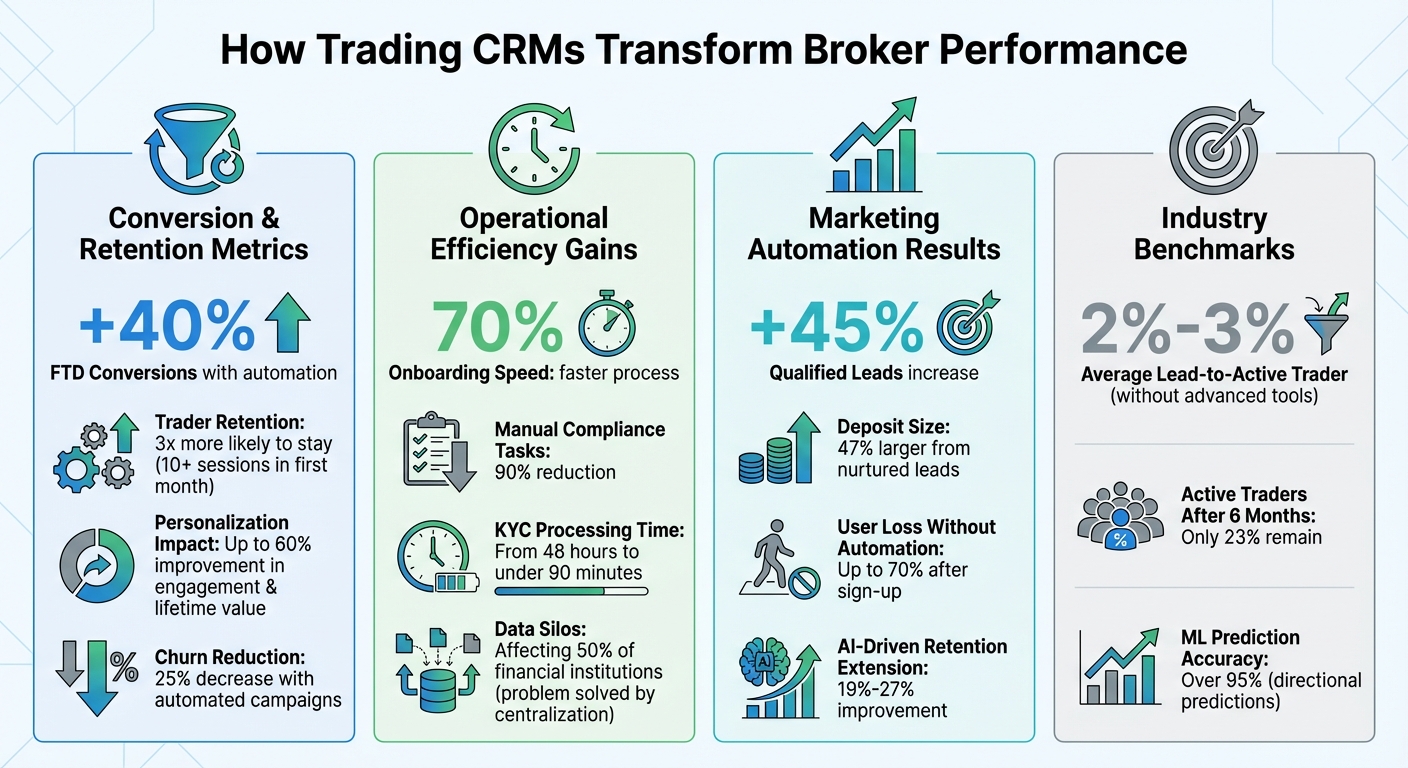
Trading CRM Impact: Key Performance Metrics and ROI Statistics
How Trading CRMs Collect and Manage Data
Where Trading Data Comes From
Trading CRMs pull data from a variety of sources to build a well-rounded profile of each trader. The trading platform – whether it’s MT4, MT5, or cTrader – feeds critical information like real-time account details, trade history, profit and loss (P&L), balances, and lot sizes into the CRM using APIs and webhooks. This seamless two-way connection ensures that every trade, deposit, and withdrawal is recorded automatically.
CRMs also connect with payment gateways to track financial transactions, including deposits, withdrawals, and bonus allocations. Additionally, KYC and AML tools provide compliance data, such as identity verification statuses and related documentation. Behavioral insights come from system logs, capturing details like login frequency, session length, and overall engagement with the platform. With Single Sign-On (SSO) functionality, CRMs can also monitor user activity as they move between the client portal and trading app, providing real-time data on actions like registrations and deposits.
Beyond the numbers, CRMs analyze shifts in trading behavior – such as larger lot sizes after a winning streak or inactivity following losses. These behavioral patterns can offer a glimpse into a trader’s mindset. Compiling all these data points is key to effective analysis and decision-making.
Why Centralized Data Management Matters
After gathering data from multiple sources, centralizing it is the next critical step for turning raw information into actionable insights. Data silos – where information is isolated in separate systems – are a common issue, affecting nearly 50% of financial institutions. A centralized CRM solves this by combining data from trading platforms, payment gateways, liquidity bridges, KYC providers, and even VOIP systems into one unified dashboard.
"The CRM must have a direct, real‑time connection to the trading platform (MT4/MT5), liquidity bridge, and payment gateways." – Rotex IT Solutions
Centralization reduces errors by automating updates for account balances, trade histories, and compliance statuses, eliminating the need for manual data entry. Real-time access to this consolidated data allows teams to quickly analyze lead activity, deposits, and individual trading patterns – all without jumping between systems. For instance, in October 2025, a mid-sized Forex brokerage in Asia adopted a centralized CRM system. This integration sped up their onboarding process by 70% and cut manual compliance tasks by 90%, thanks to automated KYC checks and role-based access controls.
With all data in one place, brokers gain a complete view of trader behavior, helping them identify trends, assess which marketing efforts drive the most value, and make faster, more informed decisions. A great example is InTrading‘s CRM, which merges multiple data streams into a single platform. This unified approach turns raw trading data into strategic insights that brokers can act on effectively.
Segmenting Users by Trading Behavior
Grouping Users by Behavior Patterns
After consolidating trading data in a CRM, the next logical step is to group users based on their actual trading behaviors, rather than relying solely on basic KYC (Know Your Customer) details. Modern CRMs often use machine learning techniques like K-means clustering or decision trees to uncover patterns in metrics such as trade frequency, trade volume, profit levels, ROI, account age, and holding periods.
"KYC information – such as gender, residence region, and marital status – does not explain client behaviours, whereas eight variables for trade and transaction frequency and volume are most informative." – John R. J. Thompson, Department of Mathematics, Wilfrid Laurier University
Research consistently highlights that behavioral data is far more predictive than traditional demographic variables. For instance, a 2019 study of over 23,000 clients at a Canadian investment dealer identified five distinct user segments: Active Investors (frequent trades, responsive to market changes), Systematic Savers (automated rebalancing), Younger Savers (making small, regular deposits), Older Investors (focused on dividend withdrawals), and Just-in-Time Savers (sporadic trades with no clear pattern). The study emphasized that metrics like trade frequency and volume provide a much clearer understanding of user behavior than demographic details like gender or marital status.
Some CRMs even go a step further by analyzing emotional cues from client interactions. This allows brokers to identify psychological triggers, such as impulsive buying during market rallies or panic selling during downturns. These insights help create segments that brokers can use to refine their strategies.
Using Segments to Target Brokers’ Strategies
Segmentation turns raw data into actionable strategies for brokers. For example:
- High-frequency traders can be offered VIP perks, early access to market insights, or personalized account management.
- New traders might benefit from automated educational content, step-by-step onboarding, or nudges to encourage their first trade and reduce churn.
- Dormant accounts (inactive for three to seven days) can trigger re-engagement campaigns featuring tailored promotions or strategy guides.
In September 2024, Eightcap introduced FlashTrader, a tool designed to segment clients by their trading activity and risk tolerance. The system enables brokers to automatically suggest aggressive strategies to high-frequency traders while offering conservative options to clients with lower risk appetites. The result? A noticeable improvement in client management efficiency.
Similarly, Evest used Solitics’ marketing automation platform to unify scattered data and create customized client journeys. Marketing Automation Manager Nicolas Evgenides reported impressive outcomes: a 20% month-over-month increase in trader retention and a 30% boost in monthly deposit volume following the platform’s implementation.
Another example is InTrading, which segments traders in real time. This allows brokers to send personalized push notifications, SMS, or emails tailored to each user group. Whether it’s sharing risk management tips for aggressive traders or steady-growth reports for more conservative investors, the messaging feels relevant and timely. This kind of targeted approach ensures precision in marketing and enhances real-time engagement with traders.
Predicting User Behavior with Machine Learning
How Machine Learning Models Predict Trader Actions
Once traders are segmented, CRMs use machine learning models to anticipate their next moves. By analyzing historical trading data, these models predict actions like the likelihood of deposits, the risk of churn, or even the chances of a trader changing strategies. They learn from patterns in past trades, account activity, and engagement trends, constantly refining their predictions.
Supervised learning methods – such as XGBoost, LightGBM, and random forests – play a key role here. For example, a model could study thousands of accounts that became inactive and identify warning signs like fewer logins, smaller trade sizes, or longer intervals between deposits. Once trained, this model assigns probability scores to current users, flagging those at high risk of churning.
A study from April 2025 showed how combining sentiment analysis with LSTM forecasting achieved over 95% accuracy in directional predictions. This underscores the impressive capabilities of machine learning in forecasting trader behavior.
Instead of binary predictions, brokers can use probabilistic outputs. For instance, a CRM might indicate, "78% probability this user will deposit within 7 days." This allows sales teams to prioritize outreach and adjust their messaging to match the user’s likelihood of action.
These predictive models pave the way for timely and effective interventions.
Getting Real-Time Insights with AI Tools
Modern CRMs take predictive analytics a step further by incorporating real-time AI tools. These systems monitor live trading activity and respond instantly to changes in trader behavior. For instance, they can trigger alerts when risky behavior is detected – like scalping or signs of bonus misuse – by continuously processing data streams and updating user profiles on the fly.
Take InTrading’s AI Data Helper as an example. This platform keeps an eye on live data, updating risk profiles and notifying brokers of sudden changes. If a trader starts focusing heavily on volatile assets, the system might flag them for a check-in or recommend risk management resources to prevent potential losses. It can even detect shifts in trading frequency for specific currencies, alerting brokers to possible "big moves" by clients.
Real-time AI tools are also vital for addressing churn. If a user logs in less often or reduces their trading volume, the CRM can automatically launch a re-engagement campaign. This might include a personalized email, a push notification highlighting market opportunities, or an SMS with a time-sensitive promotion. Acting quickly is crucial – catching behavioral changes early makes interventions far more impactful.
Turning Insights into Marketing Automation
Sending Personalized Messages Based on Behavior
When behavioral patterns are identified, the CRM steps in to send personalized messages that align with each trader’s lifecycle stage – whether they’re a new lead, first-time depositor, active trader, dormant user, or VIP. These messages are tailored to match the trader’s specific needs and actions.
Behavioral triggers power this automation. For instance, if a trader shifts their focus from EUR/USD to crypto, the CRM updates their profile and sends crypto-related reports. Similarly, frequent high-leverage usage might trigger automated messages offering risk management advice or margin call warnings. InTrading’s platform ensures these messages are delivered through multiple channels – email, SMS, WhatsApp, and push notifications – while AI determines the best times to send them.
This level of automated engagement can have a dramatic impact: First-Time Depositor (FTD) conversion rates can increase by up to 40%, and inactivity-based campaigns can cut trader churn by 25%. On the flip side, brokerages without marketing automation risk losing up to 70% of users right after sign-up due to incomplete onboarding or distractions. These automated interactions not only engage users but also pave the way for continuous improvement, backed by real-time conversion tracking.
Tracking Conversions in Real Time
Real-time conversion tracking connects marketing efforts directly to trading volume and deposit KPIs through live dashboards. This gives brokers a clear view of which campaigns are driving deposits, boosting trading activity, or engaging specific trader segments.
This instant feedback allows brokers to make quick adjustments. For example, if a reactivation bonus isn’t effective with dormant traders after three days, they can pivot to sending a "What’s Trending" market update instead. InTrading’s real-time tracking also enables brokers to filter users based on live trading activity, asset preferences, volume, and deposit behaviors. This makes it easier to identify which strategies are actually delivering results. Companies leveraging marketing automation for lead nurturing report a 45% increase in qualified leads, and these nurtured leads tend to make deposits that are 47% larger than those from non-automated efforts.
Conclusion
Trading CRMs take raw trading data and turn it into actionable insights, bringing all client interactions into one clear and unified view. By studying trading behaviors, asset preferences, risk tolerance, and lifecycle stages, these systems give brokers the tools they need to create tailored experiences, keep traders engaged, and boost their overall lifetime value. This integration strengthens the CRM’s importance at every step of the trader’s journey.
The numbers speak for themselves: AI-driven analytics can extend client retention by 19%–27%. Predictive models and automation increase first-time deposit (FTD) conversions by 40%, cut churn by 25%, and improve retention by as much as 20%. Without these advanced tools, the average lead-to-active trader conversion rate remains a low 2% to 3%.
Take InTrading as an example. Its automated KYC processes have slashed onboarding times from 48 hours to under 90 minutes. Add multi-channel messaging to the mix, and brokers can connect with traders at the exact moments they’re most likely to respond. This streamlined workflow doesn’t just save time – it drives better decision-making.
With these insights, brokers can anticipate what traders will do next. They’ll know when someone is about to stop trading, which asset classes are gaining popularity, and the best ways to guide users toward their next steps. This proactive approach transforms data into revenue and casual users into loyal, long-term clients.
Considering that only 23% of retail traders remain active after six months, having the ability to analyze and act on user behavior isn’t just helpful – it’s critical for staying competitive and growing in the trading industry.
FAQs
How do trading CRMs use AI to analyze and predict user behavior?
Trading CRMs take advantage of AI and machine learning to dig into both historical and live trading data, uncovering patterns and trends in user behavior. By analyzing traders’ past actions – like their trading habits, risk tolerance, and platform interactions – these systems can make educated guesses about future moves, such as when a trader might open or close a position or even when they may become less active.
These tools also rely on natural language processing (NLP) and behavioral analysis to pick up on subtle signals, such as trading patterns or engagement levels. This enables brokers to craft personalized communication, anticipate what users need, and fine-tune their marketing efforts. For instance, CRMs can identify the best moments to send tailored offers or educational resources, boosting user engagement and retention.
InTrading specializes in providing CRM and marketing automation solutions tailored for trading platforms. Their tools offer real-time insights, user segmentation, and lifecycle marketing automation, empowering brokers to act on these AI-driven predictions with precision.
What are the advantages of using a CRM to centralize trading data?
Centralizing trading data within a CRM offers brokers and trading platforms several clear advantages. By bringing together all customer information – like trade history, deposits, withdrawals, and account details – into a single system, brokers can break down data silos and gain a complete picture of each client. This makes it easier to deliver tailored services, run more focused marketing campaigns, and better understand client behavior.
It also boosts efficiency by automating processes such as client onboarding, KYC/AML compliance, and commission tracking. These automations cut down on manual tasks, speed up workflows, and improve risk management with real-time data insights. Plus, a centralized CRM provides brokers with powerful analytics and reporting tools, enabling them to make smart, data-backed decisions that enhance client retention and respond effectively to market changes. In short, consolidating trading data in a CRM helps brokers create a more streamlined, efficient, and growth-oriented operation.
How does segmentation help brokers keep traders engaged and loyal?
Segmentation allows brokers to connect with traders on a more personal level by adjusting their strategies to fit the needs of specific groups. By studying trading patterns, brokers can craft personalized marketing campaigns, share relevant updates, and present customized promotions that align with the preferences of each segment.
This focused approach not only improves conversion rates but also strengthens the bond between brokers and traders. When traders feel valued through tailored interactions, they’re more likely to remain loyal and satisfied – an essential factor in standing out in a competitive market.