
Forex lifecycle automation simplifies the trader journey from onboarding to retention by leveraging tools like InTrading. But without tracking the right metrics, you risk wasting resources and missing opportunities to improve performance. Here are the 7 key metrics every Forex brokerage must monitor:
- Conversion Rate: Tracks the percentage of visitors who take key actions (e.g., signing up or depositing). Higher rates mean better ROI on marketing efforts.
- Retention Rate: Measures how well you keep traders engaged. Retaining traders is 5–7 times cheaper than acquiring new ones.
- Customer Lifetime Value (CLV): Calculates the total revenue a trader generates. A 1:3 ratio of CLV to acquisition cost is ideal.
- Churn Rate: Tracks the percentage of traders who stop engaging. High churn signals inefficiencies that hurt profitability.
- Lead Scoring Effectiveness: Prioritizes high-intent prospects for better resource allocation and higher conversions.
- Trading Volume per Active Trader: Indicates revenue potential and trading activity trends.
- Engagement Rate: Measures interactions like logins, trades, and responses to campaigns, directly impacting retention and revenue.
Each metric provides actionable insights into trader behavior, campaign effectiveness, and automation performance, ensuring brokers can optimize strategies in real-time. The right data helps reduce costs, boost engagement, and achieve long-term growth.
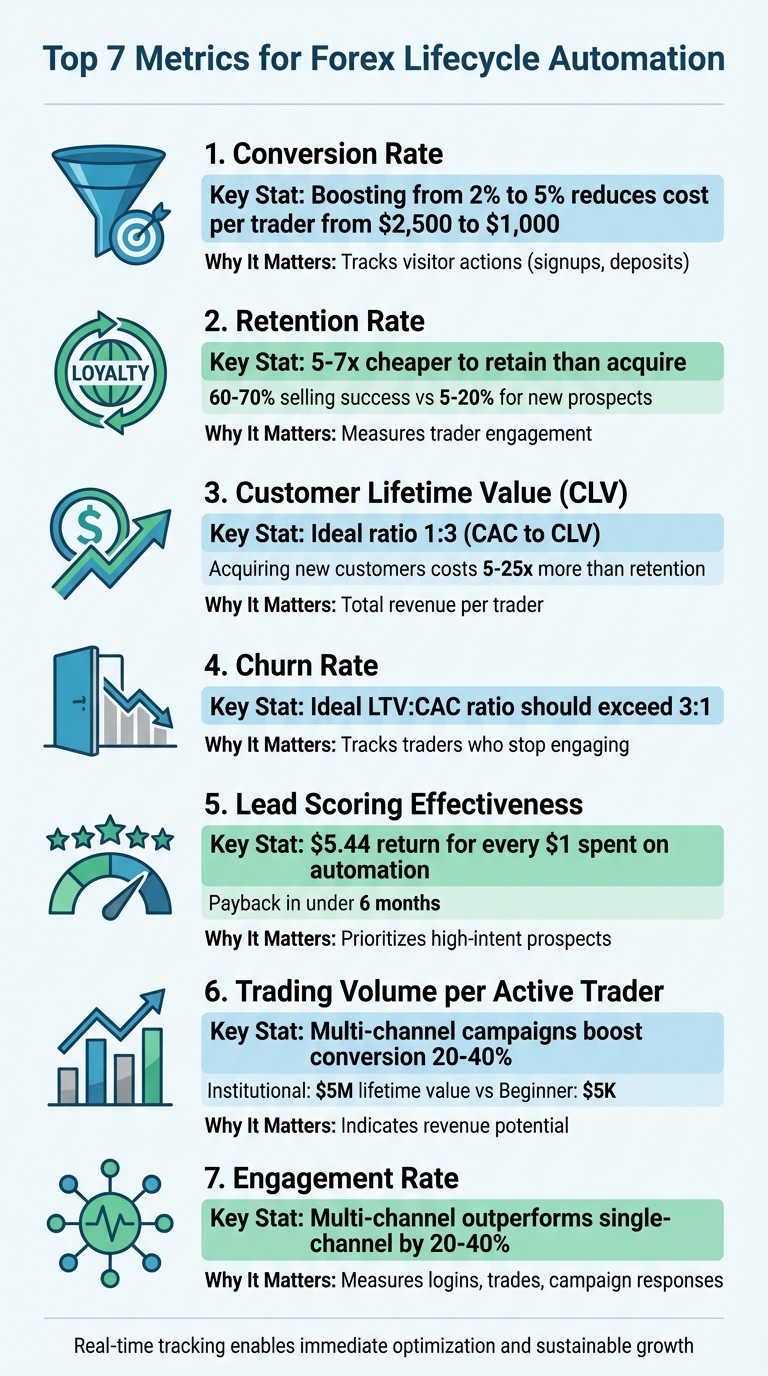
7 Essential Forex Lifecycle Automation Metrics to Track
1. Conversion Rate
Impact on Revenue Generation
Conversion rate reveals the percentage of visitors taking specific actions like signing up for a demo account, opening a live trading account, or making their first deposit. It directly connects marketing efforts to business outcomes. A high conversion rate means your messaging and onboarding process effectively remove obstacles, while a low rate signals inefficiencies that could be draining your budget.
"High conversion rates demonstrate that your marketing strategy is effective and that you are communicating with your target audience in the right way." – zForex
For example, if you spend $50 to acquire a lead and only 2% convert to funded accounts, your cost per active trader is $2,500. But boosting the conversion rate to 5% significantly lowers that cost and improves ROI without increasing your ad spend. The next step? Analyze how conversions progress through each stage of the customer lifecycle.
Ability to Track and Optimize Lifecycle Stages
Tracking conversion metrics across the Forex lifecycle is crucial for refining automation strategies. Conversion involves multiple stages – moving from lead to Marketing Qualified Lead (MQL), to Sales Qualified Lead (SQL), and finally to customer. Monitoring each stage helps pinpoint where potential traders drop off, allowing for quick adjustments.
For instance, if traders abandon registration forms or stop using demo accounts, you can tweak automation paths to address these issues. InTrading’s real-time tracking tools help identify these friction points, enabling you to act immediately. Whether it’s simplifying form fields, adjusting email timing, or sending personalized re-engagement messages, small changes can make a big difference.
Relevance to Forex Automation Tools
Automation tools leverage lead scoring to prioritize high-intent prospects. Platforms like InTrading use these insights to create personalized customer journeys. For example, if a trader opens a demo account but doesn’t make a trade soon after, they might receive an SMS highlighting key platform features. Meanwhile, a trader completing several demo trades could get an email offering a deposit bonus to encourage their first real trade.
Measurability Using Real-Time Data
In Forex, timing is everything. Real-time dashboards let you monitor conversion metrics and respond immediately to sudden changes in activity.
"Days-old data is dead data. Your customers are moving fast, and so should your insights." – Team Braze
With InTrading’s centralized CRM, you can track live metrics like form completion rates, time-to-conversion, and performance by channel. If demo signups suddenly drop from a particular ad campaign, you’ll know within minutes. This allows you to pause the campaign, investigate the issue, and reallocate your budget to better-performing channels – avoiding unnecessary overspending.
2. Retention Rate
Impact on Revenue Generation
Retention rate is a key measure of ongoing trader engagement, and it plays a massive role in profitability. Keeping an existing trader is far more cost-effective – 5 to 7 times cheaper – than acquiring a new one. Plus, the odds of selling to an existing customer are much higher, sitting at 60–70%, compared to just 5–20% for new prospects.
Loyal traders bring consistent revenue through spreads, swaps, and commissions. They also tend to invest more and trade more frequently. According to Bain & Company, boosting customer retention by just 5% can increase profitability by 75%. In Forex, where about 65% of revenue comes from existing customers, retention is a direct driver of success. Understanding and tracking retention can uncover where and why traders disengage.
Ability to Track and Optimize Lifecycle Stages
Retention metrics shine a light on critical drop-off points, such as traders abandoning their accounts after demos or becoming inactive after their first deposits. InTrading’s centralized CRM tracks every step of trader behavior, pinpointing patterns that signal potential disengagement. For example, if a high-value trader’s activity suddenly declines, automated workflows kick in with personalized SMS or email offers to re-engage them.
This approach works: automated behavioral emails achieve 86% higher open rates and drive 320% more revenue than generic promotional emails. By identifying and addressing these drop-offs, you can keep traders active and engaged.
Relevance to Forex Automation Tools
Retention data plays a critical role in powering automation tools. Instead of waiting for inactivity, platforms like InTrading use predictive analytics to anticipate trader needs. For instance, a trader who consistently takes conservative positions might receive educational resources about risk management, while an aggressive trader could get alerts about high-volatility opportunities.
High-volume traders are rewarded with VIP perks like personalized account management and early access to market insights. Meanwhile, new traders are supported with onboarding guidance and educational materials. This tailored communication ensures every trader feels valued and stays engaged.
Measurability Using Real-Time Data
Real-time data takes retention strategies to the next level by enabling immediate action. InTrading’s platform monitors trading frequency, account activity, and engagement trends in real time. If a trader’s activity suddenly changes, the system flags their account for timely intervention.
This instant feedback loop allows for quick adjustments. Marketing automation has proven its value, generating an average return of $5.44 for every $1 spent over three years. Real-time data is a big part of this success, as it helps address retention challenges before traders fully disengage while also tracking which strategies are most effective.
3. Customer Lifetime Value (CLV)
Impact on Revenue Generation
Customer Lifetime Value (CLV) measures the total revenue a trader generates, including commissions, spreads, and other earnings from their activity on your platform. A good rule of thumb is to aim for a 1:3 ratio between Customer Acquisition Cost (CAC) and CLV – essentially, for every dollar spent acquiring a trader, you should see three dollars in return. Considering that acquiring a new customer can cost 5 to 25 times more than retaining an existing one, focusing on CLV is a smart move for sustainable growth.
Tracking and Optimizing Lifecycle Stages
CLV data plays a key role in deciding where to allocate resources. For example, offering VIP perks, personalized account management, or exclusive early access to market reports can help retain your most valuable traders. InTrading’s centralized CRM takes this a step further by tagging high-value clients automatically, ensuring they receive priority attention at every interaction.
Breaking down optimization into three stages – Activation (getting traders to make their first trade), Retention (keeping them engaged), and Expansion (boosting trading volume or upgrading accounts) – makes it easier to act strategically. By aligning CLV insights with these stages, you can automate educational tools to reduce churn for at-risk traders while guiding high-value ones through tailored experiences. These segmented insights also feed predictive models, improving engagement strategies.
Connection to Forex Automation Tools
Predictive CLV models analyze historical data to forecast trading behaviors and flag potential churn risks. InTrading uses these insights to send customized hedging strategies or launch win-back campaigns for dormant high-value accounts. Automation also helps fine-tune acquisition spending by identifying which marketing channels bring in the most profitable traders.
Real-Time Data for Measurability
Real-time data is crucial for tracking CLV accurately. InTrading’s platform monitors trading activity as it happens, identifying key milestones that trigger automated actions to keep high-value traders engaged. This instant feedback loop allows you to quickly adjust strategies if an automated campaign isn’t delivering results, ensuring CLV remains a flexible and effective tool for long-term growth planning.
4. Churn Rate
Impact on Revenue Generation
Churn rate measures the percentage of traders who stop engaging with your platform, which directly impacts your revenue streams like spreads, swaps, and commissions. This drop in activity reduces the Customer Lifetime Value (CLV), calculated as:
LTV = (Average Commission Revenue per Trade × Average Trades per User) / Churn Rate.
When churn is high, marketing costs rise, and the LTV to Customer Acquisition Cost (CAC) ratio – a key metric for sustainable growth – takes a hit. Ideally, this ratio should exceed 3:1, but high churn makes that goal harder to achieve.
It’s also crucial to distinguish between customer churn and revenue churn. Losing a single high-volume institutional trader can have a much larger financial impact than losing multiple novice traders. Tracking Revenue Churn Rate, which measures the percentage of Monthly Recurring Revenue (MRR) lost, provides a clearer picture of how churn affects your bottom line.
Ability to Track and Optimize Lifecycle Stages
Churn analysis helps identify when and why traders disengage. Are they leaving after their first login? Struggling with KYC verification? Stopping after a few trades? These insights highlight weaknesses in your onboarding and engagement processes. For example, InTrading’s CRM flags dormant accounts and initiates re-engagement efforts, such as personalized market updates, before traders leave the platform.
To calculate monthly churn, divide the number of lost active traders by the total number of active traders at the start of the month. By tracking this regularly, you can test different automated strategies to determine which messaging resonates most with specific segments, whether it’s high-volume traders or beginners needing extra guidance. This targeted approach integrates seamlessly with other metrics, strengthening your overall retention strategy.
Relevance to Forex Automation Tools
Automation transforms churn management from a reactive process to a proactive one. InTrading continuously tracks metrics like trading frequency, last login times, and exposure variations, identifying at-risk traders before they disengage. For instance, if a trader hasn’t placed any trades in two weeks, the system might automatically send tailored incentives, such as lower spreads or deposit bonuses, via push notifications, SMS, or email. Acting immediately is far more effective than addressing the issue weeks later.
Measurability Using Real-Time Data
Real-time data is a game changer for managing churn. Dashboards provide instant visibility into trading activity and client performance, making it easier to spot sudden drops in engagement. InTrading’s platform uses this data to feed predictive models, which analyze historical patterns and current behavior to anticipate which traders are most likely to leave. This allows your team to focus retention efforts on high-value clients, ensuring your resources are directed where they’ll have the greatest financial impact.
5. Lead Scoring Effectiveness
Impact on Revenue Generation
Lead scoring assigns numerical values to prospects based on their behaviors and demographics, allowing you to focus your resources on traders most likely to deposit and generate revenue. By clearly defining Marketing Qualified Leads (MQLs) and Sales Qualified Leads (SQLs), your sales team can zero in on high-intent traders. Organizations using marketing automation report an average return of $5.44 for every $1 spent within the first three years, often seeing payback in under six months[1].
Personalization plays a crucial role here. High-scoring leads – such as those actively using demo accounts or completing KYC verification – receive tailored support like personalized account management or exclusive market insights. Meanwhile, lower-scoring leads are nurtured with educational content to guide them along. This approach not only enhances engagement but also protects Customer Lifetime Value (CLV) by delivering the right message at the right time, reducing the likelihood of early churn.
Ability to Track and Optimize Lifecycle Stages
Tracking MQL-to-SQL progression rates offers insights into how well your automated nurturing efforts are preparing traders for live accounts. For example, if progression rates are low, it could mean your scoring criteria need adjustment or your messaging isn’t resonating with trader intent. If webinar attendees convert more effectively than email responders, you can refine your scoring criteria to reflect this.
InTrading updates lead scores in real time based on actions like first logins, demo account trades, or deposit frequency. This allows for instant personalization. For instance, if a prospect hits their demo trade limit, the system can automatically prompt live account registration, ensuring continuous engagement. These real-time refinements feed directly into broader automation strategies, as discussed in later sections.
Relevance to Forex Automation Tools
Automation takes lead scoring from a static process to a dynamic, predictive tool. InTrading’s platform tracks trading frequency and volume, distinguishing between active, high-volume traders and dormant accounts. This enables timely re-engagement efforts before traders lose interest. Predictive analytics also come into play, analyzing past behaviors and market trends to anticipate client needs – whether that’s offering hedging strategies during market volatility or celebrating key trading milestones.
Real-time dashboards provide instant visibility into lead score trends, helping your team quickly identify where leads drop off in their journey. This enables swift adjustments to targeting or messaging strategies. With 47% of marketers leveraging automation to identify ideal customers, having a system that continuously refines its understanding of a "trade-ready" lead gives you a competitive edge[2]. This dynamic scoring process forms a strong foundation for Forex lifecycle automation.
Measurability Using Real-Time Data
Real-time data enhances lead scoring by making it measurable and actionable. InTrading tracks the entire prospect journey – from initial contact to live trading account creation. Real-time updates highlight bottlenecks, allowing for immediate course corrections. For example, if many leads stall after KYC submission, you might simplify the verification process or reassure prospects about data security.
By monitoring the average lead score, you can identify trends that signal potential issues. A declining average score might suggest your marketing efforts are attracting less qualified prospects, prompting adjustments to your targeting criteria. This feedback loop ensures your lead scoring model evolves alongside market conditions and trader behaviors, safeguarding your automation investment.
[1] RAG Source
[2] RAG Source
6. Trading Volume per Active Trader
Impact on Revenue Generation
Every trade contributes directly to commission and spread revenue. For instance, an institutional client executing a $100,000 trade 50 times a year could generate a lifetime value of $5,000,000, while a beginner trader might only contribute $5,000 over their trading history.
Gross Transaction Volume (GTV), which represents the total dollar amount of all trades conducted on your platform, serves as a key indicator of market adoption. It also strengthens your position when negotiating fees with liquidity providers. While multi-channel lifecycle campaigns can boost conversion rates by 20% to 40% compared to single-channel efforts, the real question is whether these campaigns lead to increased trading activity. Metrics like a 40% email open rate may look impressive on paper but hold little value if they don’t translate into actual trades. Ultimately, GTV not only reflects market engagement but also lays the groundwork for more targeted automation strategies.
Ability to Track and Optimize Lifecycle Stages
Tracking trading volume offers invaluable insights for segmentation, allowing you to classify traders into categories like beginners, advanced users, or VIPs. This segmentation enables tailored communication strategies. For example, declining trading volume can signal a risk of churn, prompting re-engagement campaigns, while increasing volume may reveal opportunities for account upgrades or the adoption of advanced tools. Monitoring the time it takes for a new trader to complete their first trade can also highlight potential onboarding issues.
InTrading uses real-time data to monitor trading frequency and volume patterns, helping identify traders by their activity levels. Beginners, advanced users, and VIPs are segmented based on their behavior. A drop in trading volume can trigger automated workflows to re-engage users, while an uptick may lead to personalized offers, such as account upgrades or access to premium tools.
Relevance to Forex Automation Tools
Automation makes volume tracking far more dynamic. Instead of relying on static reports, automation tools respond to live trading signals in real time. For example, when a trader reaches a specific volume threshold, the system can instantly offer perks like personalized account management or early access to market insights. Conversely, if trading activity declines, automated re-engagement campaigns can be deployed with customized incentives to bring users back.
"Connect marketing activity directly to trading volume and deposit KPIs with out-of-the-box control groups and incrementality measurement." – Optimove
Predictive analytics take this a step further by analyzing past trading behavior and market trends to anticipate traders’ needs. For instance, during volatile market conditions, the system might suggest hedging strategies to keep traders engaged and active.
Measurability Using Real-Time Data
Real-time dashboards provide immediate visibility into trading volume, allowing for quick adjustments to your strategy. By reviewing GTV daily, you can spot sudden declines and track overall market engagement trends. InTrading consolidates real-time data with historical patterns to create a comprehensive view of each trader’s activity.
To measure the true impact of automation on trading volume, use a 10-20% holdout group that does not receive automated campaigns. This control group helps you determine whether volume increases are driven by your automation efforts or external factors. Combining trading volume data with other metrics, like deposit frequency and customer support interactions, can also help build a detailed customer health score. This approach not only predicts churn risk but ensures your automation strategies lead to measurable revenue growth.
7. Engagement Rate
Impact on Revenue Generation
Engagement metrics are a direct bridge between marketing efforts and revenue. Without meaningful engagement – like opening emails, clicking on market analyses, or logging into the platform – key outcomes like conversion rates and lifetime value take a hit. In Forex automation, engagement includes activities such as trading frequency, interacting with market reports, and logging into the platform. These behaviors directly influence revenue per trader.
Automation tools leverage engagement data to create personalized workflows. For instance, high-volume traders might receive VIP perks, while newcomers get educational content tailored to their needs. The result? Engaged traders are more likely to trade frequently, deposit funds, and remain active over time.
"Engagement metrics are key to measuring marketing automation success because, without engagement, no downstream metrics like conversion or ROI can improve." – Keen
Ability to Track and Optimize Lifecycle Stages
Engagement data highlights where traders are in their journey and what they need to move forward. For example, during onboarding, tracking actions like the first login, initial deposit, or incomplete KYC can prompt immediate follow-ups, speeding up the time to the first trade. For active users, monitoring trading frequency helps identify casual participants versus high-volume traders who might benefit from VIP-level services. If engagement drops, it signals potential churn, triggering re-engagement campaigns to win back dormant accounts.
InTrading takes engagement tracking to the next level by monitoring multiple touchpoints – email, SMS, push notifications, and in-app activity. This creates a comprehensive view of each trader’s behavior, allowing brokers to segment users into specific profiles and deliver content that matches their trading styles. For example, a sudden drop in platform logins or a rise in unsubscribe rates serves as an early warning, prompting brokers to adjust their messaging strategies. This real-time segmentation feeds directly into automated campaigns, helping to sustain and enhance trader activity.
Relevance to Forex Automation Tools
Automation tools make engagement tracking a dynamic, real-time process. Modern Forex CRMs don’t just monitor engagement – they act on it. For example, if a trader clicks on a market alert but doesn’t place a trade, the system might send a follow-up SMS offering a simplified trading suggestion. Similarly, if a trader shows signs of inactivity, an automated email with personalized market insights can encourage them to re-engage.
Multi-channel campaigns – spanning email, SMS, push notifications, and in-app messages – consistently outperform single-channel efforts, often driving conversion rates 20–40% higher. Email works well for educational content and long-form nurturing, while SMS and in-app messages excel at delivering urgent market alerts. InTrading empowers brokers to coordinate these channels based on each trader’s preferred communication style and peak activity times, ensuring messages resonate when they matter most.
Measurability Using Real-Time Data
Real-time dashboards offer brokers instant visibility into engagement metrics, making it easier to catch issues early and track trends across metrics like trading frequency, open rates, click-through rates, and unsubscribe rates.
To truly measure the impact of engagement campaigns, it’s helpful to use a 10–20% holdout group that doesn’t receive automated messages. Comparing this group to engaged users reveals whether increased activity stems from automation or external factors. Tracking trends over time, rather than relying on one-off data points, ensures gradual declines – like a drop in click-through rates – are addressed quickly. Meanwhile, spikes during volatile market conditions can highlight opportunities to deliver timely, relevant content.
Metric Comparison by Channel
Communication methods like email, SMS, and push notifications each bring different strengths to the table. Knowing how these channels perform can help brokers allocate resources wisely and tailor messages to align with each channel’s strengths. This comparison highlights how to use each channel effectively as part of a multi-channel strategy.
Email is a powerhouse for delivering long-term value, particularly for nurturing relationships and sharing educational content. With an impressive 36-to-1 ROI, it’s a reliable tool for building trust. However, email isn’t perfect – it’s slower to drive conversions and can get lost in crowded inboxes, making it less ideal for urgent messages. SMS, on the other hand, is unmatched for immediate engagement, boasting a 98% open rate and response times under 3 minutes. Time-sensitive campaigns thrive here, with click-through rates often surpassing 20%. The tradeoff? SMS comes with a high risk of opt-outs if messages feel intrusive or irrelevant. Push notifications are excellent for reactivating app users and delivering real-time alerts. They offer instant engagement but come with challenges like strict iOS permissions and the risk of users disabling notifications if overused. Here’s a quick look at how these channels stack up:
| Channel | Primary Strength | Opt-Out Risk | Best Forex Use Case |
|---|---|---|---|
| High ROI (36:1), deep content | Slower conversion; easily ignored in saturated inboxes | Onboarding, newsletters, and loyalty programs | |
| SMS | 98% open rate; <3 min response | High opt-out sensitivity; perceived as intrusive if overused | Margin calls, price alerts, and time-sensitive signals |
| Push | Immediate engagement | Users can easily disable; stringent iOS permission requirements | App reactivation, trade execution alerts, and profit notifications |
By leveraging the strengths of each channel and aligning them with trader behavior, brokers can boost engagement and reduce churn. Multi-channel strategies consistently outperform single-channel efforts, often increasing conversion rates by 20–40%. InTrading makes it easier for brokers to coordinate these channels, ensuring messages are delivered through the trader’s preferred method. For instance, a trader who frequently checks email could receive detailed educational content there, while someone who responds quickly to SMS might get urgent market alerts via text.
The key is to avoid sending the same message across all platforms. Use email for in-depth storytelling and education, SMS for urgent calls to action, and push notifications to re-engage inactive traders. This thoughtful approach not only improves engagement but also helps retain traders by delivering the right message at the right time.
Conclusion
Tracking these metrics provides a clear path to uncover growth opportunities and maintain profitability. Without proper measurement, Forex platforms risk wasting resources on ineffective campaigns and missing critical chances to retain their most valuable traders.
By moving beyond basic engagement metrics to focus on measurable business outcomes – like conversion rates, customer lifetime value, and reduced churn – platforms can achieve real, sustained growth. Real-time data creates a feedback loop that allows brokers to constantly refine their strategies, shifting from cautious approaches to adaptive, data-driven models that align with actual trader behavior.
"If you can’t connect your lifecycle campaigns to business outcomes, you’re missing the story that matters." – Customer.io
Our platform’s real-time tracking and centralized CRM eliminate guesswork, enabling brokers to act swiftly. With user segmentation, platforms can deliver tailored experiences – such as VIP perks or customized educational content – that enhance retention and engagement. Automated lifecycle marketing triggers, like re-engagement campaigns for inactive accounts, help prevent traders from leaving entirely. These tools give Forex platforms the power to fine-tune every stage of the trader lifecycle.
This approach creates a continuous cycle of improvement. Retaining existing traders cuts acquisition costs, while marketing automation shows clear returns on investment. By linking these metrics to automated workflows – across email, SMS, and push notifications – brokers can allocate resources more effectively, lower operational expenses, and build loyalty that drives higher trading volumes and long-term value.
FAQs
How does real-time data enhance Forex lifecycle automation?
Real-time data plays a crucial role in automating the Forex lifecycle by offering immediate insights into customer behavior and campaign outcomes. This empowers businesses to adjust strategies quickly, boosting engagement, retention, and overall performance.
Here’s how real-time metrics make an impact:
- Spot trends instantly to fine-tune marketing campaigns on the fly.
- Tailor communications to reflect users’ most recent actions.
- Make smarter decisions with accurate, up-to-date information.
By tapping into real-time data, Forex platforms can provide more timely, relevant, and tailored experiences for their users.
Why is Customer Lifetime Value important for optimizing Forex marketing strategies?
Customer Lifetime Value (CLV) is a key metric for shaping effective Forex marketing strategies. It gives you a clear picture of the total revenue a client is likely to bring in over their time with your platform. By understanding this, you can pinpoint your most profitable clients and allocate your resources more wisely to keep them engaged and loyal.
CLV shifts the focus toward long-term success. With this insight, you can fine-tune your marketing efforts – think personalized communication or highly targeted campaigns – to encourage repeat transactions and build loyalty. In short, CLV empowers you to make smarter choices and ensures your strategies drive consistent, sustainable growth.
Why is it important for Forex brokerages to monitor churn rate?
Tracking churn rate is a key practice for Forex brokerages because it reveals how effectively they’re holding onto their clients. A high churn rate can often point to underlying problems, such as low customer satisfaction or weak engagement efforts, both of which can hurt growth and profits.
By analyzing churn, brokerages can spot patterns, tackle issues early, and prioritize strategies to boost customer retention. This not only helps create a more dependable client base but also strengthens the foundation for long-term success in an intensely competitive industry.