
Want your SMS campaigns to actually work? The secret is segmentation. Instead of sending the same message to everyone, divide your users into smaller groups based on traits like trading habits, risk levels, or experience. Why? Because personalized messages lead to higher open rates, more clicks, and better conversions. In fact, segmented SMS campaigns can generate 100% more clicks than generic ones.
Here’s how to do it:
- Collect the right data: Trading experience, deposit amounts, risk tolerance, and asset preferences are key.
- Use a centralized CRM: Avoid scattered data by syncing everything in one place for better targeting.
- Define segmentation criteria: Group users by deposit ranges, activity status, or preferences (e.g., EUR/USD).
- Send tailored messages: Personalize content to fit each group and automate sequences based on behavior.
- Track performance: Monitor delivery rates, click-throughs, and conversions to refine your approach.
Done right, segmentation ensures your SMS campaigns hit the mark every time, keeping users engaged and reducing opt-outs. Let’s dive into the details.
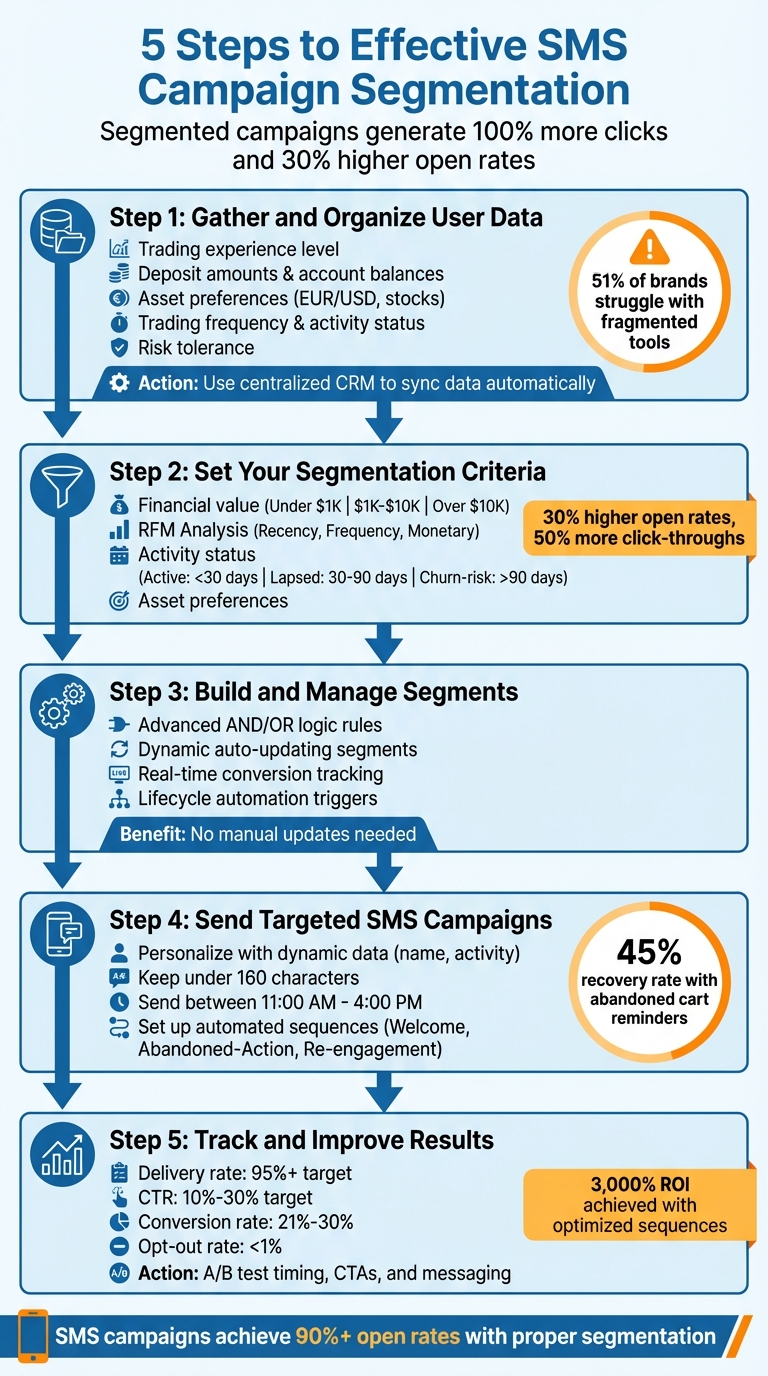
5-Step SMS Campaign Segmentation Process for Trading Platforms
Step 1: Gather and Organize User Data
What Data to Collect
To segment traders effectively, you need to start with the right data. Begin by looking at trading experience – whether someone is a beginner or a seasoned expert. This helps you create content tailored to their skill level. Keep track of deposit amounts and account balances to identify high-value traders and set up automated alerts when they hit specific thresholds. Pay attention to asset preferences as well; for example, if a trader frequently deals with EUR/USD or holds Apple stock, you can send them relevant updates about geopolitical events or earnings reports tied to those assets. Other useful data points include trading frequency and account activity status, which help you distinguish active users from those who may have gone dormant.
You’ll also want to gather details like risk tolerance, preferred currency pairs, and lifecycle stages (e.g., new sign-up, verified account, first deposit). Make sure these fields are mapped in your system to maximize the potential for personalized outreach. Use opt-in fields across various touchpoints – like account registration, webinars, or trading platform logins – and ensure phone numbers are collected in a standardized format to keep your subscriber list valid and reachable. All these data points serve as the foundation for the segmentation strategies you’ll implement in later steps.
Centralizing this information is essential for making segmentation work seamlessly.
Why Use a Centralized CRM
When data is scattered, targeting becomes a challenge. In fact, 51% of brands struggle with fragmented tools when using SMS for customer engagement. This often results in duplicate entries, outdated records, and missed opportunities. A centralized CRM, such as InTrading, solves this by syncing data between your SMS platform and your primary database automatically. This eliminates the need for manual exports, saving time and reducing errors, while ensuring your data is always up-to-date.
Step 2: Set Your Segmentation Criteria
Now that your data is centralized, it’s time to decide how to group your traders into effective segments. Choosing the right criteria can turn raw data into actionable insights. For example, segmented SMS campaigns often see 30% higher open rates and 50% more click-throughs compared to generic messages.
Standard Segmentation Categories
Start by focusing on key indicators of trading behavior. One critical factor is financial value – group users based on deposit ranges, such as:
- Under $1,000
- $1,000–$10,000
- Over $10,000
This approach allows you to tailor messages effectively. For instance, smaller depositors may benefit from educational content on risk management, while high-value traders might prefer exclusive perks like advanced market analysis or VIP webinars.
Another powerful method is RFM analysis (Recency, Frequency, Monetary). This scoring system evaluates recent trades, trading frequency, and total trading volume. It helps you identify “hot” leads for immediate follow-up and “cold” users who might need reactivation efforts.
You can also segment by activity status. For example:
- Active users: Traded within the last 30 days
- Lapsed users: Inactive for 30–90 days
- Churn-risk users: Inactive for over 90 days
Tailor your outreach accordingly – real-time market alerts for active traders, or reactivation offers for those who’ve been inactive. Additionally, consider asset preferences. If a trader focuses on tech stocks, send them earnings alerts or sector-specific insights instead of generic forex updates.
Once you’ve defined these categories, the next step is to connect them to your marketing goals.
Align Criteria with Business Goals
Effective segmentation ties directly to your business objectives. For example, if your goal is reactivating inactive users, focus on lapsed traders. Target those who haven’t logged in for 60–90 days with win-back campaigns offering incentives or highlighting new platform features.
Looking to increase deposits? Segment by account balance and trading frequency. A trader with a lower balance but frequent activity might benefit from educational content on risk management. Meanwhile, high-balance traders could respond to tiered rewards or early access to premium tools. As shown in a 2026 Infobip Case Study, behavior-based segmentation can drive quick results – one campaign generated 150 orders from just 2,000 messages sent to a carefully segmented audience.
Finally, ensure your segmentation criteria align with measurable outcomes. For instance, if retention is a priority, create a segment for users who registered within the last 14 days but haven’t made a deposit yet. Send a welcome sequence that addresses common concerns and highlights platform security features. To maximize ROI, focus on high lifetime value (LTV) traders by offering premium content and early access to new tools, ensuring your efforts are directed at your most profitable users.
Step 3: Build and Manage Segments in InTrading
Now that you’ve outlined your criteria, it’s time to bring them to life. InTrading’s segmentation tools turn your plans into actionable segments that adjust automatically as traders’ behaviors evolve. This dynamic system saves you from the hassle of constantly updating lists whenever someone deposits funds or completes a trade.
How to Use InTrading’s Segmentation Tools
To get started, head to the centralized CRM dashboard. Here, you can create custom segments using advanced rules with AND/OR logic. For example, you might set up a segment like this: "traders in New York OR California AND deposited over $5,000 AND traded within the last 14 days." This precision ensures your SMS campaigns are laser-focused on the right audience.
With dynamic segmentation, user groups update automatically as new data comes in. For instance, if a trader shifts from "lapsed" to "active" after logging in, the system reflects this immediately – no manual updates required. This prevents awkward missteps, like sending a win-back offer to someone who just resumed trading, which wastes both your time and SMS budget.
InTrading lets you segment based on a variety of data points, including demographics (like age and location), behaviors (such as link clicks or platform visits), and financial activity (like deposit amounts or trading volume). The platform also features lifecycle automation, which triggers specific actions when users enter a segment. For example, if a high-value trader surpasses $10,000 in deposits, the system can automatically send a VIP welcome SMS or alert your account manager to provide personalized outreach.
Add Real-Time Conversion Tracking
With real-time conversion tracking, your segments stay aligned with traders’ most recent actions. When someone clicks an SMS link, views an asset, or completes a trade, this data feeds directly into your segmentation logic. This ensures you’re working with up-to-date behavior rather than outdated patterns.
Here’s how it works in practice: if a trader clicks on a tech stock SMS link but doesn’t make a trade, real-time tracking can move them to a "window shopper" segment. From there, you can send a follow-up offer tailored to their interest. Without this feature, you might miss the opportunity to act while their intent is still high.
Real-time tracking also helps avoid messaging missteps that could harm your credibility. For instance, if someone just made a deposit, they’re instantly removed from the "low balance" segment and won’t receive a redundant message urging them to fund their account. This level of accuracy not only boosts engagement but also reduces opt-outs, as traders only receive messages relevant to their current situation. Armed with these insights, you can craft SMS campaigns that hit the mark every time.
Step 4: Send Targeted SMS Campaigns to Each Segment
Now that your segments are set and tracking is in place, it’s time to create messages that resonate with each group. Targeted SMS campaigns outperform generic ones, with 30% higher open rates and 50% more click-throughs. The secret? Tailoring your content to match where each trader is in their journey. Let’s break down how to craft personalized messages and automated sequences that keep your audience engaged.
Write Personalized SMS Messages
Make your messages feel personal by using dynamic data. Include details like the trader’s first name, recent activity (like a stock they viewed or a milestone they hit), or their account status. A message that says, "Hi Sarah, your tech stock watchlist just got an upgrade – see what’s new here: [link]" will always feel more engaging than a generic, "Check out our new features."
Tone matters too. Younger traders might appreciate a casual style, even with an emoji here and there, while seasoned or high-net-worth traders often prefer clear and professional communication. Also, keep your messages under 160 characters to avoid splitting them into multiple texts, which can dilute your impact and drive up costs.
Timing is critical. The best time to send SMS campaigns is between 11:00 AM and 4:00 PM, when engagement and conversions are at their peak. Messages sent during this window consistently perform better.
Set Up Automated Message Sequences
With InTrading’s lifecycle marketing automation, you can design message sequences that are triggered by specific trader actions. Start with essential flows like:
- Welcome Series: Greet new sign-ups with a warm introduction.
- Abandoned-Action Reminders: Nudge traders who leave actions incomplete, like a pending deposit.
- Re-engagement Messages: Reach out to accounts inactive for 30–90 days.
For example, an abandoned deposit sequence could send a message two hours after the trader leaves:
"Still thinking it over? Your deposit is waiting – finish here: [link]."
Abandoned cart reminders like this can boost recovery rates by up to 45%.
You could also create a VIP sequence for your top-tier traders, offering perks like early access to new features or exclusive market insights. A similar strategy in another industry delivered impressive results: a 19x ROI, a 3x jump in click-through rates, and double the conversions.
Space out your messages to avoid overwhelming your audience. For re-engagement, you might send a "We miss you" message after 30 days of inactivity, follow up with a limited-time bonus at 45 days, and send a final check-in at 60 days. InTrading’s automation ensures your segments stay updated, removing traders from inactive flows as soon as they re-engage, so every message is perfectly timed.
Step 5: Track and Improve Campaign Results
Keeping a close eye on SMS performance is essential to get the most out of your campaigns. By combining segmentation and targeted messaging strategies with detailed performance tracking, you can boost your campaign’s effectiveness. SMS campaigns often deliver conversion rates between 21% and 30%, outperforming many other marketing channels. The secret lies in focusing on the right metrics and using those insights to fine-tune your strategy.
Metrics to Monitor
To ensure your campaign is on track, aim for a delivery rate of 95% or higher, a CTR (click-through rate) of 10%–30%, and monitor your conversion rates. Start with the delivery rate, which measures how many of your messages actually reach traders’ phones. A rate below 95% could indicate issues with your contact list or carrier problems. Next, evaluate the CTR to see how many recipients are engaging with your links. Finally, track conversion rates to measure how many traders are completing the desired actions, like making a deposit, placing a trade, or upgrading their accounts.
Keep an eye on opt-out rates as well. If these exceed 1%, it could mean you’re sending too many messages or your content isn’t resonating. Tools like InTrading’s real-time conversion tracking allow you to monitor these metrics in one place, giving you the ability to address issues quickly – often within hours rather than days.
Test Different Approaches
Once you’ve identified your key metrics, experiment with different tactics to improve results. A/B testing is a great way to determine what resonates most with each segment. Change one variable at a time, such as your call-to-action wording ("Trade Now" vs. "View Opportunity"), the timing of your messages (11:00 AM vs. 2:00 PM), or even the use of emojis to engage younger audiences. Start by testing each variation on 25% of your segment for at least four hours, then roll out the best-performing option to the remaining 50%.
In January 2026, Australian electronics retailer Oz Mobiles achieved a 3,000% ROI by using automated SMS sequences and optimizing send times based on customer behavior data.
Oz Mobiles experimented with different timing windows and message formats until they found the perfect mix. For trading platforms, you could test whether high-net-worth traders prefer market analysis updates or exclusive feature announcements.
Use your performance data to refine your audience segments as well. For example, if certain traders clicked your link but didn’t complete a trade, move them into a "high-intent" segment and follow up with more focused messaging. If a segment shows increasing opt-out rates, consider reducing message frequency or adjusting your tone. Additionally, clean your contact lists monthly to remove invalid numbers – this helps maintain your sender reputation and reduces unnecessary costs.
The goal is to continually improve. Every campaign should provide insights that make the next one even better. By staying data-driven and adaptable, you’ll keep your SMS strategy sharp and effective.
Conclusion
Segmenting users transforms SMS marketing from a one-size-fits-all approach into a highly targeted and effective communication tool. By applying the five steps covered in this guide, you can create campaigns that regularly achieve open rates of over 90%.
The advantages go well beyond improved click-through rates. Segmented campaigns help reduce message fatigue, lower opt-out rates, and foster deeper connections with your traders. Whether you’re offering exclusive market insights to high-net-worth individuals or crafting personalized offers to re-engage inactive users, relevance is the key to standing out in SMS marketing.
With InTrading’s centralized CRM, this process becomes effortless. Features like real-time conversion tracking and dynamic segmentation adapt to trader behavior automatically. You can set up automated lifecycle campaigns that onboard new users, reward loyal traders, and re-engage inactive accounts – all without constant manual effort.
These techniques form the backbone of the strategy outlined here. Precision is essential in the trading industry, and your SMS marketing should reflect that. By aligning your messages with trader behaviors and preferences, you’re not just sending texts – you’re building trust and driving results. Start simple with segments like new leads, active traders, and inactive users, and refine your approach over time using performance data. Each campaign becomes an opportunity to grow and improve.
FAQs
How does segmenting users enhance SMS campaign results?
Segmenting users lets you send more precise and personalized messages, making your SMS campaigns connect better with specific groups. By crafting messages that align with user behavior, preferences, or demographics, you can improve open rates, spark engagement, and drive more conversions.
It also ensures your messages hit at the right time, making them more relevant and less likely to be ignored – or worse, lead to users opting out. This strategy strengthens your connection with your audience and amplifies the effectiveness of your SMS marketing efforts.
What data should I use to effectively segment users for SMS campaigns?
To create effective user segments for SMS campaigns, start by analyzing key data points that reveal shared traits and behaviors. Demographic data – like age, gender, and location – can help customize messages based on personal details. Meanwhile, behavioral data – such as browsing habits, response rates, or engagement with past campaigns – ensures your messages are both timely and relevant. Lastly, transactional data – including purchase history or trading activity – offers a window into user preferences and patterns.
For Forex and stock trading platforms, incorporating real-time data, such as trading activity, account status, or a user’s lifecycle stage, can take segmentation to the next level. By blending these data types, you can craft SMS campaigns that feel personal, increase engagement, and encourage conversions.
How does real-time conversion tracking improve the success of SMS campaigns?
Real-time conversion tracking transforms SMS campaigns by offering immediate insights into how customers respond. This means businesses can fine-tune their targeting, send timely follow-ups, and adjust messaging strategies to better connect with their audience.
When you monitor conversions as they occur, you can quickly spot what’s working and tweak your approach to increase engagement and improve outcomes. This constant stream of feedback helps keep your SMS campaigns sharp, relevant, and impactful.