
Managing a growing trading platform is tough without the right tools. Here’s why integrating a CRM system can make all the difference:
- The forex market processes $7.5 trillion daily, involving 10 million traders globally. Platforms must handle increasing data, compliance, and client demands efficiently.
- Without CRM integration, platforms face fragmented data, slower onboarding, compliance risks, and missed client opportunities.
- Tools like InTrading centralize data, automate workflows (e.g., KYC/AML), and personalize client engagement, cutting manual tasks by 70% and support queries by 65%.
Key Benefits of CRM Integration:
- Real-Time Data Sync: Instant updates on account balances, trades, and history with MT4/MT5 integration.
- Automation: Speeds up onboarding, automates IB commissions, and reduces errors.
- Personalized Engagement: Tailored outreach based on trading behavior boosts retention and activity.
Non-integrated systems, on the other hand, rely on manual processes and disconnected data, leading to inefficiencies, errors, and missed revenue opportunities.
Bottom Line: A CRM isn’t just a tool – it’s a critical system for scaling trading platforms, ensuring compliance, and delivering better client experiences.
1. InTrading
Customer Insights and Personalization
InTrading’s seamless integration with platforms like MT4 and MT5 ensures that data flows effortlessly between systems. This eliminates isolated data pockets, allowing teams to access a complete, real-time view of client activities. With this 360° perspective, brokers can identify key client behaviors and respond with timely, relevant outreach.
The platform takes segmentation to the next level by diving deeper than just basic demographics. Brokers can categorize clients based on trading volume, preferred asset classes (like forex, stocks, or commodities), deposit habits, and even their affiliate sources. For instance, a trader who focuses on EUR/USD during European market hours might receive targeted educational materials tailored to their trading style, while someone trading U.S. tech stocks would get content specific to that market. This kind of detailed personalization transforms broad marketing campaigns into meaningful, client-specific experiences that align with individual trading habits.
By delivering these insights, InTrading not only enhances client understanding but also streamlines operations.
Operational Efficiency and Automation
InTrading simplifies compliance and onboarding with automated KYC and AML workflows. The system handles document collection, verification, and compliance checks, flagging any discrepancies right away. This reduces the onboarding process from days to just hours, making it significantly faster and smoother.
The platform also excels in managing multi-tier IB (Introducing Broker) structures. When an IB brings in a new client who makes their first deposit, InTrading automatically calculates and tracks commissions across all partnership levels in real time. This eliminates the need for error-prone spreadsheets and ensures partners have instant access to accurate earnings data. By automating these complex commission systems, the platform not only strengthens broker-partner relationships but also reduces disputes over payments. This allows brokers to scale their operations efficiently without adding unnecessary administrative burdens.
Retention and Real-Time Engagement
InTrading goes a step further by focusing on client retention through real-time engagement. Its lifecycle automation tools send personalized messages triggered by specific client actions. For example, if a demo account user hasn’t logged in for five days, the system automatically sends a re-engagement email packed with helpful educational resources. These timely, automated interactions happen without requiring manual effort from marketing teams, making it easier to scale client engagement.
The platform’s unified communication dashboard consolidates every client interaction – emails, chat logs, phone calls, and support tickets – into one centralized view. For instance, if a trader contacts support about a withdrawal issue, the agent can immediately access their complete history, including recent trades, past support inquiries, and communication preferences. This holistic view allows for quicker issue resolution and more personalized service, fostering trust and consistency – two critical elements in financial services as client bases grow.
2. Non-Integrated Trading Systems
Customer Insights and Personalization
Trading platforms without CRM integration face a major hurdle: fragmented data. Information scattered across emails, chat logs, spreadsheets, and trading servers makes it nearly impossible to get a full picture of a trader’s activity. According to ARM Treasure Data, nearly 50% of finance institutions struggle with data silos, making it tough to consolidate and analyze information effectively. For sales, marketing, and customer service teams, this means working with incomplete data – leaving them in the dark about critical details like trading preferences, deposit history, or risk tolerance.
In an industry handling massive trading volumes and millions of users daily, fragmented data is a recipe for inefficiency. It prevents brokers from personalizing their outreach or identifying high-value leads. Instead of tailored services, traders receive generic communications, missing opportunities for meaningful engagement. On top of that, manual data handling not only eats up valuable time but also increases the risk of errors, compounding the challenges of managing customer relationships effectively.
Operational Efficiency and Automation
Scaling a brokerage with non-integrated systems can quickly turn into a logistical nightmare. Core tasks like KYC/AML processing, managing IB commissions, and tracking affiliate performance often rely on spreadsheets – an approach that’s far from scalable. Andrii Ryzhokhin from Ardas-IT sums it up perfectly: "In the fast-paced world of online trading, where mere milliseconds often dictate the difference between gains and losses, achieving optimal efficiency is not just desirable – it’s imperative."
The stats back this up: 70% of business applications don’t communicate with each other, according to Salesforce. This lack of integration forces teams to manually transfer data between systems, which not only slows things down but also increases the likelihood of errors and compliance issues. For example, calculating IB commissions manually in multi-tier partnership structures often leads to disputes and strained relationships. As the number of traders grows, the operational overhead balloons, making it nearly impossible to maintain accuracy and efficiency without automation. These challenges highlight the critical need for systems that can streamline and automate complex workflows.
Retention and Real-Time Engagement
Operational inefficiencies don’t just hurt internal processes – they also make it harder to engage traders when it matters most. Non-integrated platforms lack the real-time visibility needed to respond to key events like deposits, withdrawals, or inactivity. This delay can be costly: retaining an existing trader is 5–7 times less expensive than acquiring a new one, yet non-integrated systems make large-scale retention efforts nearly unmanageable.
For support teams, fragmented data means manually piecing together information, delaying issue resolution and eroding client trust. Without automated triggers tied to real-time trading behavior, brokers are left relying on generic email campaigns that fail to consider whether a client is actively trading, facing losses, or hasn’t logged in for weeks. As Rotex IT Solutions warns, "Without a specialized, deeply integrated forex CRM, a brokerage is operating blind." This lack of personalization is especially damaging during the critical first-day activation period, where manual KYC processes can create unnecessary friction. These gaps in engagement underscore why integrated platforms are essential for improving client retention and satisfaction.
Advantages and Disadvantages
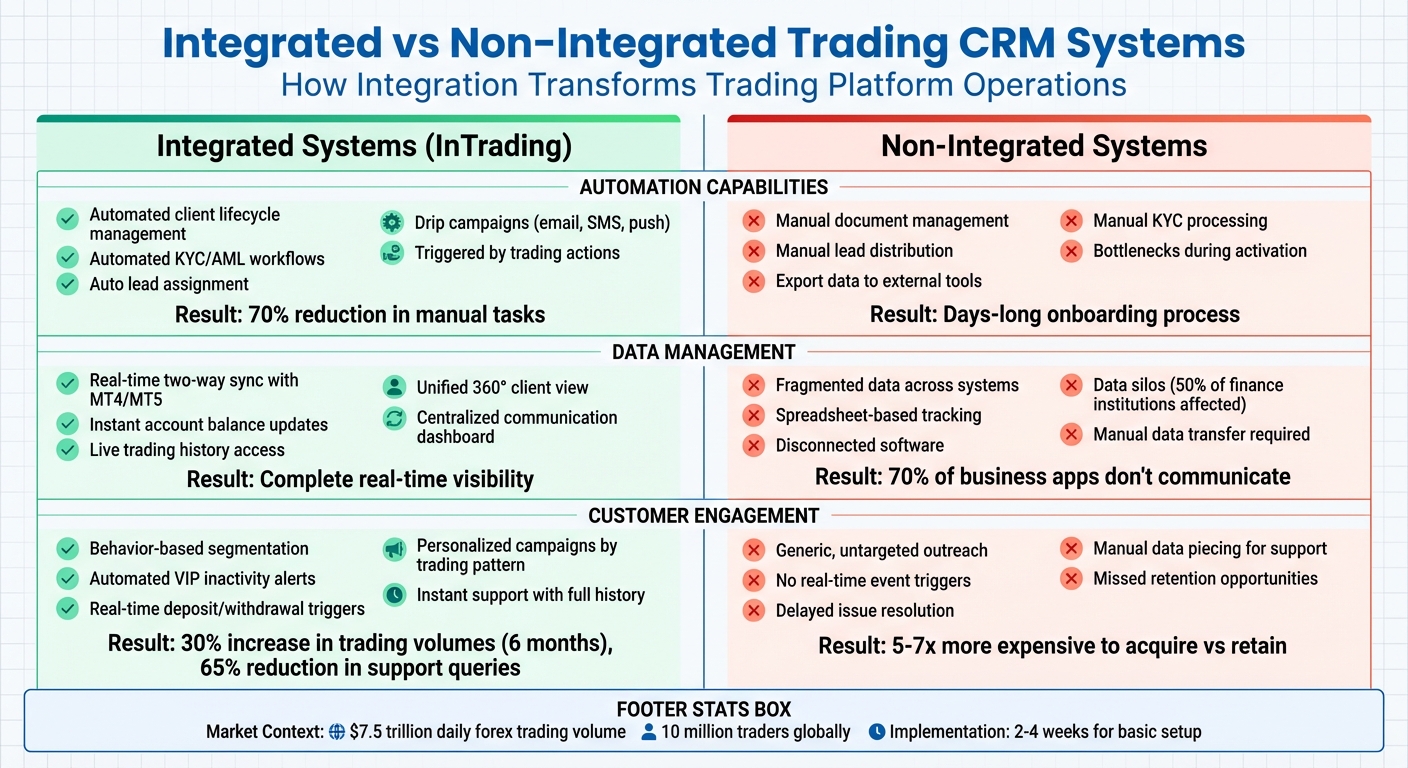
Integrated vs Non-Integrated Trading CRM Systems Comparison
Integrated trading systems, like those offered by InTrading, stand apart in areas such as automation, data management, and customer engagement.
Automation capabilities are a standout feature. InTrading takes care of the entire client lifecycle – handling registration, KYC/AML processes, lead assignment, and even running drip campaigns through email, SMS, and push notifications triggered by actions like a trader’s first deposit. On the other hand, non-integrated systems rely on manual processes for tasks like document management, lead distribution, and exporting data to external marketing tools. These manual steps can create bottlenecks, especially during critical moments like first-day activation. The seamless automation of integrated systems eliminates these hurdles, setting the stage for efficient data management.
Data management is another area where integration makes a big difference. InTrading ensures real-time, two-way synchronization with trading platforms like MT4 and MT5. This means account balances, trading history, and profit-and-loss updates are instantly accessible, giving teams a full view of trader activity. Non-integrated systems, however, often rely on spreadsheets or disconnected software, leading to fragmented data and frequent silos. With integrated systems, this unified data enables more sophisticated customer engagement strategies.
Customer engagement features highlight another advantage of integration. InTrading allows brokers to tailor interactions based on individual trading behavior. Automated alerts for VIP inactivity, campaigns targeting specific trading patterns, and real-time responses to deposits or withdrawals are just a few examples. These personalized approaches can drive higher trading volumes and engagement. In contrast, non-integrated systems typically rely on broad, untargeted outreach, which often falls short in connecting with traders effectively.
That said, integrated systems aren’t without challenges. As Andrii Ryzhokhin from Ardas-IT explains:
"The introduction of a CRM system complicates data management with intricate data flows and storage needs, increasing the vulnerability to security breaches."
Centralized data storage comes with its own set of responsibilities, including strict compliance with GDPR and CCPA regulations. Additionally, successful implementation often requires robust APIs or middleware to ensure smooth integration with existing tools. While these complexities and heightened security concerns are valid, the operational efficiency and scalability offered by integrated systems far outweigh the limitations of manual processes and scattered data management.
Conclusion
Integrating a CRM system brings everything together – streamlining onboarding, syncing data in real-time, and delivering personalized engagement that can drive trading volumes up by 30% within just six months. For platforms managing hundreds of active traders, these upgrades are more than just helpful – they’re essential for staying competitive and operationally efficient. This kind of unified setup ensures smooth and scalable operations.
The timing couldn’t be more important. Manual processes tend to buckle under the pressure of growth, making early adoption of a CRM critical. The ideal moment to implement a solution like InTrading is before operational bottlenecks start stifling growth – preferably when you’re planning for the next 3 to 5 years of expansion.
And don’t worry – implementation doesn’t mean turning your existing processes upside down. A basic setup can be operational in just 2 to 4 weeks, with more advanced features added incrementally. Plus, native two-way integrations with platforms like MT4, MT5, or cTrader eliminate data delays, ensuring everything stays in sync.
For fast-growing platforms, a tailored CRM becomes the backbone of operations, capable of handling thousands of traders without compromising performance. InTrading’s centralized approach to managing customer data, paired with automated lifecycle marketing and real-time conversion tracking, equips trading platforms with the tools they need to scale. By consolidating fragmented systems, platforms not only simplify compliance but also build stronger connections with their clients.
FAQs
How does integrating a CRM enhance data management for trading platforms?
Integrating a CRM system simplifies how data is managed by bringing together customer profiles, trading histories, deposits, and other essential details into one centralized platform. This eliminates isolated data pockets, ensuring traders and staff can access real-time insights without delays or mismatched information.
A CRM helps trading platforms run more efficiently, make smarter decisions, and offer users a tailored experience. With all critical data in one place, businesses can monitor performance, manage customer interactions, and scale their operations with ease.
What are the automation advantages of integrating a CRM into trading systems?
Integrating a CRM into trading systems brings a host of automation perks that can simplify your operations and boost efficiency. For starters, CRMs can automatically capture, score, and assign leads, ensuring your team can respond quickly and manage client relationships more effectively. They also streamline onboarding by automating KYC (Know Your Customer) documentation, cutting down on the time and effort needed for compliance tasks.
On top of that, CRMs make it easier to roll out targeted marketing campaigns via email, SMS, or push notifications, keeping your clients engaged and informed. Real-time alerts for inactive or VIP clients mean you’ll never miss an important opportunity. Plus, with centralized customer data and intelligent workflows, your team can save time on repetitive tasks and focus their energy on driving growth.
How does personalized engagement help brokers retain traders?
Personalized engagement is a game-changer when it comes to keeping traders loyal and active. By using a Forex-specific CRM, brokers can categorize traders based on factors like trading activity, risk preferences, or favored assets. This allows them to send targeted messages – whether through email, SMS, or push notifications – exactly when traders need them. The result? Traders feel valued and supported, receiving offers, educational materials, or assistance tailored to their needs. This approach helps cut down on churn and saves brokers from the hefty expense of constantly acquiring new clients.
Automating these personal touches takes things a step further. For instance, brokers can set up alerts to re-engage inactive VIP traders or offer customized bonuses to high-frequency users. These strategies not only encourage more frequent and higher-volume trading but also build stronger loyalty. The payoff? Increased revenue and a pathway to sustainable, long-term growth.