
Real-time notifications are transforming how trading platforms engage users by delivering instant, personalized alerts based on user behavior and market events. These notifications ensure traders receive critical updates – like price changes, trade confirmations, or security alerts – within seconds. By integrating these alerts into lifecycle marketing strategies, platforms improve user engagement, retention, and conversion rates.
Key Takeaways:
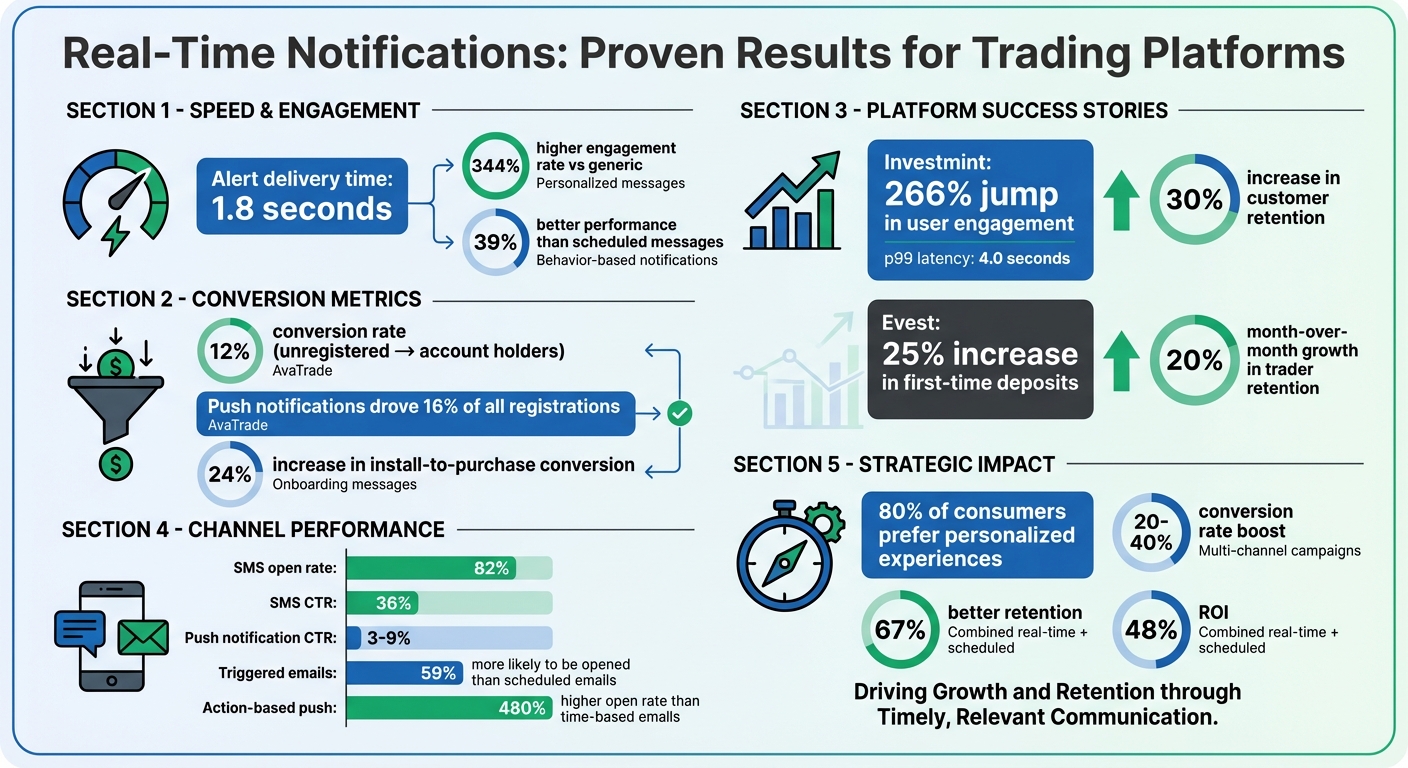
- Real-Time Alerts: Delivered via push, SMS, email, or in-app, these notifications arrive in as little as 1.8 seconds, keeping users informed of time-sensitive events.
- Lifecycle Marketing: Engages users at every stage – onboarding, activation, retention, and reactivation – with tailored messages.
- Proven Results: AvaTrade achieved a 12% conversion rate from unregistered users to account holders using behavior-based notifications.
- Channel Optimization: Push notifications for urgent updates, email for detailed info, and SMS for critical security alerts.
- Performance Metrics: Track delivery rates, open rates, CTR, and conversions to refine strategies.
Platforms like InTrading combine real-time alerts with automation, segmentation, and multi-channel communication to deliver timely, relevant updates that drive user activity and revenue. Timing and personalization are the keys to success.
Real-Time Notifications Impact on Trading Platform Performance: Key Statistics
Benefits of Real-Time Notifications for Trading Platforms
Real-time notifications have transformed how trading platforms communicate, replacing delayed mass emails with instant updates. This shift ensures users receive critical information exactly when it matters most, turning passive observers into active traders.
Better User Engagement
Timely alerts grab users’ attention by delivering updates precisely when needed. Whether it’s a price drop on a watchlisted stock, a margin call, or breaking market news, these notifications can prompt immediate action, turning casual monitoring into active trading. Personalized messages perform especially well, driving a 344% higher engagement rate compared to generic ones.
Take Investmint, for example – a systematic signal-based trading app with over 100,000 subscribers. By leveraging SuprSend’s real-time broadcast tools, the platform saw a 266% jump in user engagement and a 30% increase in customer retention between 2024 and 2025. Their system maintained a p99 latency of just 4.0 seconds, a crucial factor for trust in algorithmic trading. As CEO Aakash Goel explains:
Real-time alerts are the backbone of our algo trading platform. Any delay impacts performance and trust.
Platforms that filter notifications based on individual portfolios and watchlists avoid overwhelming users, keeping them engaged without causing fatigue. This balance ensures traders stay informed about opportunities relevant to their positions, a key element of effective lifecycle marketing.
Personalized User Experience
Real-time notifications also allow for a tailored approach, adapting messages to each trader’s actions and preferences. Instead of sending generic updates, platforms can embed dynamic details like account balances, specific asset prices, or progress toward a trading milestone directly into each notification.
Behavioral triggers further refine this process. For instance, a trader who pauses during KYC verification might receive a timely reminder, while someone completing their first trade could get instant confirmation and guidance on next steps. Research supports the impact of this personalization, showing that 80% of consumers are more likely to engage with companies that offer tailored experiences. In trading, this approach fosters platform loyalty and boosts engagement. By delivering relevant, contextual alerts, platforms enhance the user experience and improve conversion metrics.
Increased Conversion Rates
Timing is everything in trading, and real-time notifications excel at capturing users during high-intent moments – whether it’s right after registration, following a deposit, or when market conditions align with their portfolio.
Evest, for example, combined platform data with real-time market signals to automate personalized user journeys. This strategy led to a 25% increase in first-time deposits and 20% month-over-month growth in trader retention. By sending welcome messages and incentives within the first hour of registration, they capitalized on peak user interest.
Similarly, AvaTrade achieved a 12% conversion rate from unregistered visitors to real account holders by targeting anonymous users with personalized push notifications over a 7–10 day period. Push messages directly contributed to 16% of all registrations. Notifications also helped smooth out complex processes like KYC verification, reducing churn from users dropping off early in the signup process.
Real-time notifications, when delivered intelligently based on user behavior, outperform scheduled messages by 39%. Even simple onboarding messages can drive a 24% increase in install-to-purchase conversion rates. For trading platforms, these gains translate directly into higher revenue and stronger long-term user relationships throughout the marketing lifecycle.
Combining Real-Time Notifications with Marketing Automation
Real-time notifications become far more impactful when paired with marketing automation. By automating responses to user actions and market events, trading platforms can turn one-off alerts into seamless, lifecycle-driven experiences that guide traders from sign-up to long-term engagement.
User Segmentation and Targeting
Segmenting users based on their trading journey and behavior is crucial. For instance, new users might benefit from onboarding tips and deposit incentives, while seasoned traders might prefer advanced technical signals or portfolio performance updates. Risk tolerance also plays a role – traders nearing margin thresholds may need urgent alerts, whereas more conservative investors might appreciate fewer, long-term-focused updates.
InTrading’s segmentation tools pull data from CRMs, trading terminals, real-time market feeds, and user activity to create a unified view of each trader’s behavior. This approach ensures that notifications are tailored to individual needs. For example, Nicolas Evgenides, Marketing Automation Manager at Evest, implemented a segmentation strategy that led to a 20% month-over-month boost in trader retention, a 25% rise in first-time deposits, and a 30% increase in monthly deposit volume. The key? Designing campaigns that matched each trader’s lifecycle stage instead of relying on generic messaging. By aligning notifications with specific lifecycle moments – from onboarding to retention – platforms can drive higher engagement and retention.
Setting Up Trigger-Based Notifications
Once users are segmented, trigger-based notifications can take personalization to the next level. These alerts activate instantly when specific events occur, eliminating delays common with batch processing. For example, platforms can send alerts when a stock hits a target price, a technical indicator like an RSI threshold is reached, or a user hasn’t logged in for 14 days. Automation tools ensure these messages are delivered within seconds, providing traders with timely, actionable updates. Additionally, redundant alerts can be automatically canceled if the triggering event (e.g., a deposit) is resolved before the notification is sent.
To make this work, platforms can integrate event streams like Kafka, PubSub, or SQS to trigger alerts via webhooks or APIs. Triggered emails, for instance, are 59% more likely to be opened than scheduled promotional emails, while action-based push notifications boast a 480% higher open rate than time-based emails.
Using Multiple Communication Channels
Choosing the right communication channel is just as important as the content of the alert. Different types of notifications are better suited to specific channels:
- Push notifications are perfect for urgent updates like margin calls or breaking market news that require immediate attention.
- Emails are ideal for formal communications, such as trade confirmations, account statements, or educational resources.
- SMS is best for critical security updates, like two-factor authentication codes, especially when users aren’t online.
- In-app or toast notifications work well for real-time updates, such as order confirmations for active users.
| Channel | Best Use Case | Urgency |
|---|---|---|
| Push Notification | Price alerts, margin calls, position changes | High |
| Trade confirmations, account statements, educational content | Low | |
| SMS | Security codes, critical offline alerts | Critical |
| In-App/Toast | Order confirmations for active users | Medium/High |
InTrading’s multi-channel interface allows platforms to coordinate notifications based on urgency and user preferences. Real-time conversion tracking helps identify the most effective channels for different user groups, enabling continuous refinement. The ultimate goal is to keep notifications timely and relevant while avoiding alert fatigue, ensuring traders remain engaged without feeling overwhelmed.
Best Practices for Real-Time Notifications
Send Relevant Messages at the Right Time
Timing can make or break the effectiveness of a notification. For trading platforms, alerts should be tied to specific behavioral and market triggers – like price swings, volume changes, portfolio updates, or margin calls – so every message feels necessary and actionable.
Using AI for send-time personalization can significantly boost engagement. By analyzing past user behavior – such as when they open apps, click links, or are active on devices – AI predicts the optimal time to send notifications. For example, one trader might always check updates at 7:00 AM before work, while another prefers 9:00 PM. Sending alerts during these personalized windows can increase open rates by as much as 50%.
Context also plays a role. Smart platforms can detect when users are unavailable, like when they’re driving or in meetings, and delay non-urgent notifications until a better time. On the other hand, critical alerts are delivered immediately, ensuring traders get the right information at the right moment. These timing strategies are key to creating a seamless and effective multi-channel communication experience.
Use Multiple Communication Channels
Rather than bombarding users with identical messages across every channel, trading platforms should tailor communication based on urgency and the nature of the message. Push notifications work best for time-sensitive updates that demand immediate attention, while email is more suitable for detailed information like trade confirmations or monthly reports. SMS, with its 82% open rate, is ideal for critical updates, such as two-factor authentication codes.
To avoid overwhelming users, platforms can combine multiple price alerts into a single digest, keeping traders informed without notification fatigue.
Providing users with granular control over their notifications is another smart move. Instead of forcing an all-or-nothing approach, let them choose how they receive updates. For instance, a trader might want instant push notifications for margin calls but prefer daily email summaries for market news. This level of customization reduces opt-outs and ensures critical alerts always get through.
Follow Privacy and Consent Rules
Earning and maintaining user trust is just as important as perfecting timing and channel use. Compliance with privacy regulations like GDPR and CCPA is non-negotiable, especially when distinguishing between transactional messages (e.g., trade confirmations, fraud alerts) and promotional ones (e.g., marketing newsletters), which require explicit consent.
Using push primers can help increase opt-in rates. For instance, an in-app message like, “Get instant alerts when your stocks hit target prices,” clearly communicates the benefit of enabling notifications. After users opt in, offering a preference center where they can adjust notification types and frequency builds transparency and trust.
"Trust comes down to how you collect and use that data. Brands must keep data collection purposeful, tie preference asks to clear value, and manage consent by channel and region." – Madison Tiemtoré, Content Marketing Lead, Braze
To stay compliant, platforms should maintain audit logs of user consent and implement rate limiting to prevent overwhelming users. Tools like InTrading’s centralized customer data management ensure that user preferences are respected across all channels, making communication both effective and trustworthy.
Tracking Notification Performance
Metrics to Track
To understand how well your notifications are working, you need to dive into several layers of performance data. Start with engagement metrics – these give you an initial sense of how users are interacting with your messages. For example, delivery rate tells you if your notifications are reaching devices, while open rate (averaging about 4% across platforms) shows how many users are actually clicking to view them. Click-through rate (CTR) goes a step further by measuring user actions. For instance, SMS messages often hit a CTR of 36%, while push notifications typically land between 3% and 9%.
But engagement alone isn’t the full story. Business impact metrics are where the real value lies. Conversion rate is key here – it tracks how many users complete a specific action, like executing a trade, making a deposit, or upgrading their account. Revenue-related metrics, such as total revenue generated and Average Revenue Per User (ARPU), directly tie notifications to your bottom line. Then there are retention metrics, like opt-out rates and app uninstall rates. These can signal whether your messaging strategy is keeping users engaged or pushing them away. Notably, app uninstall rates across industries spiked by 70% in 2020, highlighting the importance of a well-thought-out strategy.
"If you’re only measuring push performance with open rates, you’ll never know the message was successful… conversion rates will be your go-to for performance measurement." – Customer.io
Here’s a quick overview of key metrics to track:
| Metric Category | Specific Metric | Definition |
|---|---|---|
| Engagement | Delivery Rate | (Delivered / Sent) × 100 |
| Engagement | Open Rate | (Opens / Sent) × 100 |
| Engagement | CTR | (Clicks / Impressions) × 100 |
| Impact | Conversion Rate | (Conversions / Delivered) × 100 |
| Retention | Opt-out Rate | (Opt-outs / Delivered) × 100 |
These metrics form the foundation of any effective notification strategy.
Improving Notification Strategies
Once you’ve gathered the data, the next step is using it to fine-tune your notification approach. A/B testing is your friend here – it helps you experiment with different messaging styles, visuals, and calls-to-action (CTAs) to figure out what truly drives users to take meaningful actions, not just click.
Timing is another major factor in boosting engagement. By analyzing behavioral data, you can identify when individual users are most active and schedule notifications to hit during those key moments. Segmentation is equally important. Tailor your messaging based on where users are in their lifecycle and their trading preferences. For example, new users in their first week may need more educational or onboarding-focused alerts, while seasoned traders might respond better to advanced insights or market updates.
A great case study comes from AvaTrade. In June 2024, under the leadership of CMO Ori Matarasso, they adopted behavior-based segmentation and dynamic content. The results? A CTR that was 9.4 times higher than industry averages. They also managed to convert 12% of anonymous users into real accounts and directly drove 16% of webinar registrations through push notifications.
Using InTrading‘s Real-Time Conversion Tracking
To take things further, InTrading offers real-time conversion tracking, which links every notification to specific user actions. This allows you to measure how your messages influence trades, deposits, and other key milestones. One standout feature is the ability to track influenced app sessions – instances where users return to the app within 30 minutes to 24 hours after dismissing a notification. This goes beyond immediate clicks to reveal the broader impact of your messaging.
The platform also tracks trading events, such as order executions and margin warnings, helping you refine your alerts based on their revenue impact. By providing full-funnel attribution, it shows exactly which notifications are driving meaningful conversions. Multi-channel campaigns tracked through InTrading have been shown to boost conversion rates by 20% to 40% compared to single-channel efforts. Plus, with centralized data, you can ensure user preferences are respected across push, SMS, and email, creating a seamless experience.
Conclusion
Main Points
Real-time notifications have become a game-changer for trading platforms aiming to keep users engaged. Personalized alerts significantly boost interaction, while combining real-time notifications with scheduled campaigns can improve retention rates by 67% and yield an ROI of 48%. In the fast-paced world of trading, timing is everything. Whether it’s market shifts, portfolio updates, or margin calls, traders rely on platforms that can deliver timely updates – often within seconds – to maintain a competitive edge.
The most effective strategies revolve around three key principles: deep personalization, where messages are customized to reflect individual portfolios and watchlists; omnichannel orchestration, which ensures the right channel is used for the right type of message; and lifecycle stage optimization, targeting users at moments when they’re most likely to take action. Immediate engagement is especially crucial, as many traders make pivotal decisions on their registration day. By crafting notifications tailored to each stage of the user journey – from onboarding new users to reactivating inactive ones – platforms can inspire the quick responses needed to drive results.
Getting Started with Real-Time Notifications
To harness these benefits, you can start implementing strategies that deliver instant impact. InTrading’s platform, designed specifically for Forex and stock trading systems, brings data together in one place to enable real-time, trigger-based messaging. By integrating your CRM, trading activity, and live market data, you can create unified user profiles that allow for instant, actionable notifications.
The first week after a user registers is critical for conversions, so focus on setting up trigger-based onboarding workflows. These should activate immediately based on user behavior, whether they complete an action or leave it unfinished. Leverage InTrading’s segmentation tools to send highly relevant messages based on trading preferences and lifecycle stages. Use different channels strategically: SMS for urgent alerts like margin calls, push notifications for price changes and market updates, and in-app messages for guidance during active trading sessions. With centralized customer data management, you can ensure all communication feels consistent and avoids overwhelming users, helping to build trust and loyalty.
FAQs
How do I avoid notification fatigue?
To avoid overwhelming users with notifications, it’s essential to prioritize sending relevant messages at the right times. Consider strategies like grouping notifications together, providing digest options, and respecting user preferences through detailed controls. Audience segmentation can help tailor messages for more personalized communication, ensuring they’re both timely and meaningful. Continuously test and refine your approach to keep users engaged while preventing notification fatigue.
Which triggers should I set up first?
To make an impact, begin with triggers that react instantly to key customer actions, such as signups, abandoned carts, or completed purchases. These moments are perfect for immediate engagement and can significantly improve your conversion rates.
You should also explore behavioral triggers tied to user interactions, like visiting specific pages or performing distinct actions on your site. By focusing on these event-driven or behavior-based triggers, you ensure that your messages are both timely and relevant – essential for driving effective lifecycle marketing.
How do I prove notifications drive revenue?
To demonstrate how notifications contribute to revenue, rely on measurable data that highlights their effect on engagement and conversions. For example, real-time push alerts can significantly increase re-engagement, customer loyalty, and even sales. Metrics like click-through rates, conversion rates, and revenue attribution from specific campaigns can help illustrate their value. Notifications that are both personalized and timely tend to perform even better, driving higher engagement and retention – key factors that ultimately lead to revenue growth.