
Forex brokers lose potential traders due to slow, manual onboarding processes. Automating onboarding solves this by speeding up KYC, improving communication, and personalizing user journeys. Here’s how automation drives higher conversions:
- Faster KYC: Automated identity verification cuts review time by up to 80%.
- Better Engagement: Tailored emails, SMS, and alerts keep users on track.
- Higher Activation Rates: Same-day account approvals increase first deposits.
- Improved Efficiency: Brokers reduce errors and focus on client relationships.
Platforms like InTrading integrate CRMs, KYC tools, and payment systems to streamline the journey from registration to first trade. This approach not only reduces drop-offs but also helps brokers scale operations while staying compliant.
Understanding the Forex Onboarding Journey and Where Users Drop Off
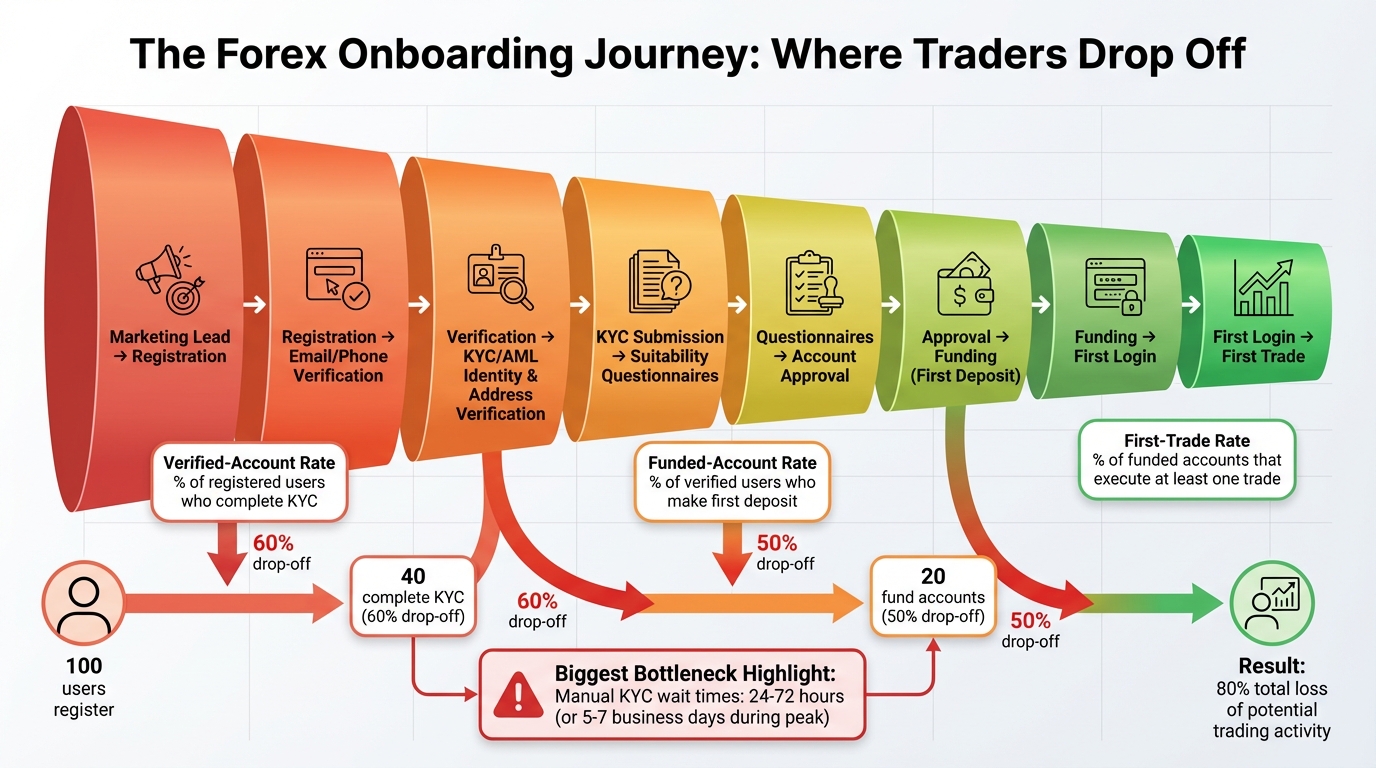
Forex Onboarding Funnel: Key Stages and Conversion Metrics
The Standard Forex Onboarding Funnel
The Forex onboarding process typically follows this path: marketing lead → registration → email/phone verification → KYC/AML identity and address verification → suitability questionnaires → account approval → funding → first login → first trade. At each step, users either move forward or drop out, making each stage a critical conversion point.
Three key metrics help brokers understand where potential traders are lost:
- Verified-account rate: The percentage of registered users who complete KYC.
- Funded-account rate: The percentage of verified users who make their first deposit.
- First-trade rate: The percentage of funded accounts that execute at least one trade.
These numbers provide a clear picture of where your platform might be losing traders – and revenue. For U.S. platforms, tracking these metrics in real time is essential. It allows brokers to pinpoint problem areas and take quick action to reduce friction before users jump to competitors.
Common Bottlenecks in the Onboarding Process
Several stages in the onboarding process tend to see significant user drop-offs: lengthy registration forms, KYC document upload and approval, initial funding, and the gap between funding and placing the first trade. Among these, manual KYC is often the biggest hurdle. Traders are required to submit documents like passports and proof of address, then wait 24-72 hours – or longer during peak times – for approval. In some cases, this delay can stretch to 5-7 business days. For U.S. traders accustomed to near-instant digital services, this wait often leads to frustration and abandonment, with many switching to platforms offering faster verification.
Poor communication adds to the problem. When platforms fail to clearly explain what documents are required or how long approval will take, users may assume their account is stuck or rejected. For example, if 100 users register but only 40 complete KYC and just 20 fund their accounts, the platform loses 80% of potential trading activity. This loss becomes even more costly when you factor in the marketing dollars spent to attract those users in the first place.
Core Components of Automated Forex Onboarding Workflows
To address common onboarding challenges, automation integrates systems designed to keep users engaged and progressing. Automated workflows rely on three key components that work together to guide traders from registration to their first trade without manual intervention. Each piece plays a distinct role while sharing data with the others, creating a smooth experience that minimizes obstacles and keeps users on track. These components – centralized CRM, automated KYC, and multi-channel engagement – work together to improve conversion rates.
Centralized CRM and Real-Time Data Tracking
A centralized CRM serves as the hub for all trader data. It consolidates contact details, behavioral insights (like demo account activity or email engagement), KYC status, and funding progress into one unified location. Each user action – such as uploading documents, clicking an email link, or abandoning a deposit – is logged in real time and triggers the next step in the workflow. Real-time tracking integrates live data from your website, trading platform, payment gateway, and KYC provider, ensuring each user’s status is always up to date. For example, InTrading offers a CRM specifically tailored for Forex and stock trading platforms, allowing U.S.-based teams to monitor metrics like registration-to-deposit conversion as they happen, enabling swift adjustments to improve performance.
Streamlined KYC and Compliance Automation
Automating identity verification significantly reduces delays in document processing. Integrated digital tools handle tasks like verifying government IDs, confirming proof of address, and conducting AML and PEP screenings. Low-risk profiles can be approved in seconds, while higher-risk cases are flagged for manual review with clear timelines. Data from registration forms is automatically pre-filled into KYC documents, and OCR technology scans uploaded files to eliminate manual errors. If documents are rejected, users receive automated messages explaining exactly what needs to be corrected, cutting down on resubmission cycles. Every check, result, and decision is logged in the CRM, creating an audit-ready trail that meets U.S. and international compliance standards – all without compromising the user experience. Faster verification translates directly into higher conversion rates.
Multi-Channel Communication and Engagement
Automated notifications through email, SMS, and push alerts keep users informed and engaged throughout the onboarding process. These messages are triggered by specific actions: a welcome email after registration, an SMS confirming account creation, in-app prompts requesting documents during KYC, or reminders when users pause their progress. Messaging is personalized based on the trader’s experience level. Beginners receive educational content about Forex basics, while seasoned traders get streamlined communication focused on verification and funding. Notifications are timed to the user’s local schedule (e.g., U.S. Eastern) and may reference current market events to stay relevant. This well-timed and tailored communication ensures users receive the right message at the right moment, encouraging them to complete their first trade and boosting overall conversion rates.
How Onboarding Automation Increases Forex Conversions
Automation transforms the often sluggish onboarding process into a swift, seamless experience by speeding up identity checks, document verification, and sanctions screening. With Know Your Customer (KYC) and Anti-Money Laundering (AML) protocols completed in mere minutes instead of hours or days, traders can hit the ground running. This speed is critical, as traders are most eager to fund and trade right after signing up. Delays in approval can kill that momentum, but brokers using automated tools frequently achieve same-day account activation. This streamlined process drives more users from registration to funding, thanks to faster verification, smoother user experiences, and proactive engagement strategies.
Faster Account Verification and Funding
Automation drastically reduces the time between signing up and making the first deposit. For instance, when a trader uploads a driver’s license, Optical Character Recognition (OCR) technology quickly verifies it against government databases. Low-risk profiles are greenlit within minutes, while higher-risk cases are flagged for manual review with clear timelines. Once approved, the system sends account activation notifications and prompts users to fund their accounts by selecting a payment method. By integrating payment processors with the CRM, deposits are reflected instantly in USD, complete with accurate local timestamps. This efficient flow – from verification to funding to trading – keeps users engaged in one session, significantly increasing day-one deposit rates.
Smoother User Experience and Lower Drop-Off Rates
Automation reduces friction by tailoring the onboarding process to request only the necessary information at each step. Pre-filled fields, drawn from centralized CRM data, eliminate the need for users to repeatedly enter the same details, improving registration-to-deposit conversions. Real-time validation catches common errors, like incorrect addresses or Social Security numbers, on the spot, cutting down on resubmissions. Features like visual progress bars and updates (e.g., letting users know verification will take 2–3 minutes) build trust and ease anxiety. For U.S. traders, who are used to fast, intuitive fintech platforms, this streamlined experience minimizes drop-offs and keeps them engaged.
Boosting Early-Stage User Engagement
Getting users to place their first trade is a key step in retaining them long-term. Automation plays a crucial role here by delivering educational content and platform walkthroughs immediately after account approval. New traders receive a concise, two-day email series that explains how to execute their first trade, set stop-loss and take-profit orders, and read an economic calendar in Eastern Time. Additionally, in-platform tooltips and guided tours activate the first time users access the trading terminal, helping them navigate the system and build confidence. A centralized CRM like InTrading can coordinate these touchpoints, sending behavior-triggered messages – such as reminders to complete pending KYC steps – that encourage engagement. This targeted approach moves users from funding their accounts to actively trading, setting the stage for long-term participation.
Steps to Implement Automated Onboarding in Forex Platforms
Auditing and Redesigning the Onboarding Process
Start by mapping out the entire onboarding journey and analyzing key metrics at every stage – like completion rates and drop-off points. For example, track the flow from when a prospect clicks an ad all the way through registration, email verification, KYC submission, account approval, funding, and their first trade. If you notice that 40% of users abandon the process after uploading their KYC documents, or that manual reviews are taking 24–48 hours, you’ve pinpointed major bottlenecks.
Once you identify where users tend to drop off, simplify the process. Collect only the essential details upfront – name, email, phone number, and country. Save questions about trading experience or preferences for later, after the account is created. Use short, step-by-step forms with visible progress indicators, and make sure the entire process works seamlessly on mobile devices since many users complete onboarding on their smartphones. After streamlining the process, move on to automating the next steps.
Configuring Automation Triggers and Logic
Set up event-based triggers to respond immediately to user actions. For instance, if a user registers but doesn’t upload their KYC documents within two hours, send a follow-up email or SMS with a direct link and clear instructions. If their KYC is approved but they haven’t made a deposit within 24 hours, initiate a drip campaign with educational content and funding incentives. And if a user deposits funds but hasn’t placed their first trade, share platform tutorials or step-by-step trading guides to encourage engagement.
Tailor the experience based on user profiles. Traders from high-risk regions might require enhanced due diligence or manual reviews, while low-risk users can receive instant approvals once their documents are verified. Beginners can benefit from educational tips and risk notifications throughout their journey, while seasoned traders might appreciate an expedited process with direct access to advanced tools. A centralized CRM like InTrading can sync live data from your website, app, and marketing tools to send the right message to the right user at the right time. These personalized triggers allow for seamless updates across all systems.
Integrating CRM, Payments, and Verification Tools
Seamless integration between your trading platform (whether it’s MT4/MT5 or a proprietary system), CRM, KYC/AML provider, and payment gateways is crucial. The CRM acts as the central hub, receiving status updates from all connected systems and automatically triggering the next actions. For example, when a KYC provider like Sumsub or ShuftiPro marks a user as "approved", the CRM can update their account status, create a trading account, and send an "Account Ready" email with deposit instructions (complete with localized timestamps and USD amounts).
Payment integration is just as important. When a deposit is confirmed through payment channels like Stripe, Skrill, or bank transfers, the CRM should instantly update the user’s balance and notify your support team if the deposit qualifies the user as high-net-worth. Tools like Zapier or Make can help connect these systems without requiring extensive custom development. By automating these workflows, you’ll eliminate data silos and ensure a seamless process from sign-up to active trading.
Conclusion
Automating onboarding transforms compliance from an operational hurdle into a competitive advantage. By speeding up account verification, reducing delays, recovering stalled applications, and automating follow-ups, you can convert more qualified leads into active, funded traders – all while ensuring consistent KYC/AML checks and maintaining auditable records.
For U.S.-based Forex platforms navigating a crowded market, a fast and seamless onboarding experience can set your brand apart when other offerings are nearly identical. Automation isn’t just a tech upgrade – it’s the backbone for scaling revenue efficiently, especially during busy periods, without the need for proportional increases in staffing.
To capitalize on these benefits, start by thoroughly reviewing your onboarding process to identify any bottlenecks. Focus on areas like KYC verification, registration, or deposit steps that might be slowing down user progress. Once you’ve pinpointed the friction points, consider Forex-specific CRMs like InTrading. These tools centralize customer data, automate lifecycle communications (via email, SMS, and push notifications), and provide real-time tracking of conversions.
Try launching a pilot program that automates KYC reminders and deposit prompts for new U.S. leads. Use metrics like verification speed, completion rates, and initial deposits to measure the impact. By upgrading your onboarding tools and processes, you’ll not only attract and convert traders more effectively but also maintain strong regulatory compliance, setting the stage for sustainable growth. This approach turns onboarding into a true strategic asset for your platform.
FAQs
How can automating the onboarding process enhance efficiency and increase conversions for Forex brokers?
Automating the onboarding process simplifies and speeds up the experience for new users. By cutting down on manual tasks, brokers can help prospective traders complete registration and verification steps without unnecessary holdups, increasing the chances of conversion.
Automation also opens the door to personalized communication, like customized emails or SMS reminders, which keep users engaged and informed throughout the process. Plus, features like real-time tracking and centralized data management give brokers the ability to monitor user progress and quickly address any potential drop-offs. This creates a smoother onboarding journey and boosts retention rates.
What Forex onboarding challenges can automation help solve?
Automation has the power to solve many of the usual hurdles in Forex onboarding, making everything run more smoothly and efficiently. For example, manual data entry errors and delays in verifying user details can drag out the process. Automated workflows step in here, ensuring tasks are completed accurately and much faster.
It also addresses inconsistent communication by sending timely, personalized updates through email, SMS, or push notifications. This keeps users in the loop and engaged throughout their onboarding experience. By streamlining these steps, automation not only enhances user satisfaction but also helps Forex platforms see better conversion rates.
How does a centralized CRM improve the Forex onboarding process?
A centralized CRM makes onboarding in the Forex world much simpler by bringing all customer information together in one place. This eliminates the need to switch between different tools, making it easier to manage communications, track user activity, and monitor performance.
By providing real-time insights and user segmentation, you can tailor experiences for traders, leading to a smoother onboarding process and better conversion rates. Plus, having all data organized in one system ensures consistency and improves customer satisfaction throughout their journey.