
Lifecycle marketing helps brokers turn leads into long-term clients by targeting each stage of the customer journey. For brokers, where only 2–3% of leads convert, this approach can improve retention, reduce churn, and increase profits. Automation plays a critical role in driving timely, personalized communication, boosting FTD conversions by 40% and cutting churn by 25%. Here’s how brokers can implement it:
- Lead Acquisition: Use targeted ads, educational content, and real-time conversion tracking to collect and manage high-quality leads. Responding to inquiries within 5 minutes increases qualification rates by 21%.
- Lead Nurturing: Automated email sequences and behavioral triggers help guide leads to their first deposit. Personalized campaigns can increase conversion rates by 23%.
- Conversion: AI tools identify where prospects get stuck (e.g., KYC or first trade) and deliver tailored follow-ups to close gaps.
- Retention: Engaging onboarding processes and multi-channel communication keep traders active. A 5% boost in retention can increase profits by 20–90%.
- Referrals: Automated referral programs incentivize loyal clients to bring in new traders, with referred clients showing 30% higher conversion rates.
Automation tools like InTrading simplify these processes with features like CRM integration, real-time tracking, and behavioral segmentation. By optimizing every stage of the lifecycle, brokers can transform leads into loyal, profitable clients.
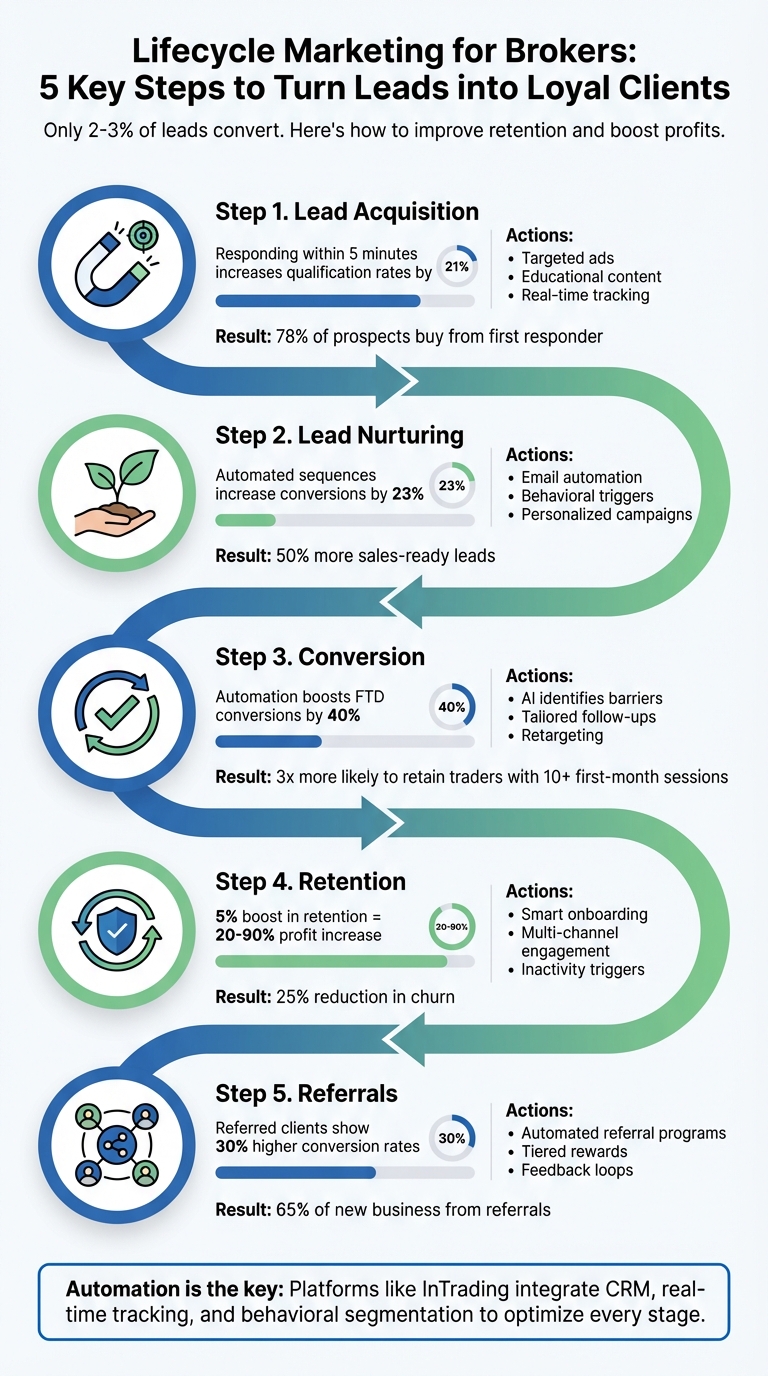
5-Step Lifecycle Marketing Framework for Brokers with Key Conversion Metrics
Step 1: Collect Leads with Targeted Acquisition Methods
The first step in lifecycle marketing is capturing the right leads. Brokers often rely on tools like educational content, market reports, webinars, and quizzes to attract quality prospects. These lead magnets help build trust before requesting a deposit. Paid ads on platforms like Google and Bing target high-intent traders searching for terms like "forex trading", while social channels such as Facebook, Instagram, and TikTok boost engagement using visual content. For reaching institutional or professional traders, LinkedIn is particularly effective.
Your website should make it simple for prospects to take action. Keep forms short – just ask for essentials like name, email, and phone number – to minimize drop-offs. Adding live chat and clear calls to action can further reduce friction. Features like exit-intent popups or scroll-triggered forms can also capture visitors who might otherwise leave without submitting their details. Most importantly, ensure all collected data syncs instantly with your CRM, as 78% of prospects tend to buy from the first company that responds. Quick CRM integration is crucial to automate the trader’s journey and stay ahead of competitors.
Using Real-Time Conversion Tracking
Speed is everything when it comes to lead conversion. Reaching out to a lead within 5 minutes can make you 100 times more likely to connect and 21 times more likely to qualify that lead. Relying on manual uploads or spreadsheets slows this process and introduces errors, with mistake rates ranging from 18% to 40%. InTrading’s real-time conversion tracking solves this by syncing leads directly from ad platforms like Meta, Google, and TikTok into your CRM the moment a form is submitted.
This instant data flow allows your sales team to focus on high-priority leads based on their behavior. For example, if someone visits your pricing page or downloads a trading guide, that activity is immediately visible in the system. Real-time tracking also helps identify which marketing channels are driving deposits – not just leads. By sending conversion data back to ad platforms via APIs, you can fine-tune their algorithms to target users more likely to convert. This approach not only improves campaign efficiency but can also lower your cost per lead by around 33%. With real-time insights, you can segment your audience more effectively and deliver more targeted follow-ups.
Segmentation for Better Lead Targeting
Segmenting your leads helps you allocate resources wisely. By grouping prospects based on factors like behavior, demographics, and trading preferences, you can deliver customized content that speaks directly to their needs. For instance, a trader focused on EUR/USD pairs might receive different updates than someone exploring cryptocurrency markets.
InTrading’s segmentation tools make this process seamless. You can assign scores to leads based on their activities, such as requesting a demo or visiting specific asset pages, and route high-priority leads to senior sales reps. Inactivity-based segmentation is another powerful feature: warm leads (inactive for 30–60 days) might receive gentle reminders, while cold leads (120–180 days inactive) could get multi-touch campaigns with stronger incentives. This kind of targeted approach can generate 50% more sales-ready leads while cutting acquisition costs. Plus, reactivating old leads is about 6–7 times cheaper than finding new ones, making segmentation a smart way to maximize your lead database.
Step 2: Nurture Leads with Automated Sequences
Once you’ve captured high-quality leads through real-time tracking and segmentation, the next step is to guide them from awareness to decision. This is where automated sequences come into play, delivering precise, timely messages that align with each prospect’s journey. Research shows that leads nurtured through automated email sequences convert 23% higher than those that aren’t, and nurtured leads overall drive a 20% higher sales conversion rate. The secret? Delivering the right content at the right time – whether they’re just starting to explore trading or are ready to make their first deposit. Let’s dive into how personalizing campaigns and leveraging behavioral triggers can make this process even more effective.
Personalizing Campaigns for Each Lifecycle Stage
Generic, one-size-fits-all messages won’t cut it anymore. Today, brokers need to tailor their communications based on where a lead is in their journey – whether they’re a new subscriber, a first-time depositor, a dormant trader, or a VIP client. Tools like InTrading’s automation system make this possible by adjusting messages in real time, based on a prospect’s current behavior and lifecycle stage.
For example:
- A new lead might receive a welcome email series with an educational eBook or a "Top 10 Strategies" guide.
- Someone who downloaded a platform guide but hasn’t deposited yet could be sent content highlighting deposit bonuses or success stories from other traders.
During the consideration stage, your goal is to build trust and credibility. This is where sending market analysis, platform tutorials, or risk management tips can make a difference. When a prospect shows high intent – like visiting your pricing page or requesting a demo – it’s time to switch gears. Decision-stage content, such as limited-time offers or testimonials, can help seal the deal. Companies using segmented campaigns have seen a 760% increase in revenue compared to those that don’t, proving that personalization isn’t just a nice-to-have – it’s a must. With InTrading’s segmentation tools, you can group leads by factors like trading experience, asset preferences (Forex vs. Crypto), or even geographic location, ensuring every message feels relevant and timely.
Behavioral Triggers for Automation
Personalized messaging is powerful, but behavioral triggers take it to the next level by ensuring your follow-ups are timely and context-specific. These triggers respond directly to what your prospects are doing – or not doing.
For instance:
- If a lead registers but hasn’t made their first deposit, an automated sequence could send a "How to Fund Your Account" guide along with testimonials from successful traders.
- If someone visits your pricing page three times in a week, the system can notify your sales team and automatically send them an ROI case study to encourage action.
Behavioral triggers are also key for retention. If a trader hasn’t logged in for 3 to 7 days, an automated check-in message or reactivation bonus could bring them back before they lose interest. Why is this so important? Clients who log over 10 sessions in their first month are 3 times more likely to stick around long-term. Catching inactivity early can make all the difference.
InTrading’s behavioral triggers work seamlessly across email, SMS, and push notifications, ensuring you reach prospects on the channels they use most. This multi-channel approach keeps your brand front and center, increasing the likelihood of conversions and long-term engagement.
Step 3: Convert Prospects into Active Traders
You’ve guided your leads through automated sequences, but now comes the crucial part – turning those leads into active traders. This is where the real action begins. Data shows that forex brokers typically convert just 2% to 3% of their leads into active trading clients, meaning every step in your process matters. Success here relies on timely, personalized outreach that reduces friction during key decision points. Since manual follow-ups often miss these critical moments, AI-powered insights and retargeting campaigns become essential tools. With proper timing and precision, AI can uncover and address the barriers keeping prospects from taking the next step.
Using AI Data to Identify Conversion Barriers
Understanding why a prospect hasn’t converted is just as important as knowing who they are. InTrading’s AI Data Helper digs into behavioral patterns to pinpoint exactly where leads are getting stuck – whether it’s during KYC verification, after making their first deposit, or while exploring a demo account. For instance, if someone has deposited funds but hasn’t executed their first trade (a common "first-trade gap"), the system can automatically send a tailored follow-up. This might include guided trade tips, a platform walkthrough video, or even a direct call from an account manager. Studies show that automated funnel engagement can boost First-Time Deposit (FTD) conversion rates by up to 40%, and traders who log more than 10 sessions in their first month are 3 times more likely to stick around as long-term clients.
AI also helps you segment leads by their specific interests. Imagine a prospect exploring crypto markets in their demo account but receiving generic forex newsletters. That mismatch can delay or even block conversion. With InTrading’s system, you can track preferences in real time and send personalized content – like crypto market updates, signals, or alerts – that aligns with their actual interests. This kind of tailored communication not only improves conversion rates but also builds trust, showing traders that your platform understands their unique journey. Once AI identifies where and why prospects are stalling, retargeting becomes the next step to re-engage them.
Keeping Prospects Engaged with Retargeting
Retargeting campaigns ensure your platform stays on a prospect’s radar, especially for those who’ve shown interest but haven’t taken the plunge yet. The secret lies in using behavioral triggers to keep your messaging relevant. For example, if someone visits your pricing page multiple times without signing up, an automated email featuring testimonials from successful traders or a limited-time deposit bonus could provide the push they need. Similarly, if a lead finishes registration but stalls during KYC verification, a simple message like “Need help with your documents?” paired with automated status tracking can turn a roadblock into a smooth onboarding experience.
InTrading’s multi-channel strategy ensures retargeting efforts reach prospects where they’re most active – whether it’s email, SMS, WhatsApp, or push notifications. The key is to avoid bombarding inactive leads with endless promotions. Instead, focus on building trust by offering educational content such as guided trade tips, market insights, or quick-start guides. Research shows that subscribers are 76% more likely to engage with content tailored to their specific interests. Pair this value-driven approach with urgency tactics, like limited-time offers or milestone-based rewards, to give prospects a compelling reason to act now rather than later.
Step 4: Retain and Engage Trading Clients
Turning leads into active traders is a big win, but the real challenge lies in keeping them engaged. Why? Because retaining clients isn’t just about loyalty – it’s about profitability. A modest 5% bump in retention can increase profits by 20% to 90%. Plus, repeat clients tend to spend 67% more than new ones. However, retention is no walk in the park. Nearly 60% of traders say they’d switch brokerages for a platform with a better interface. The key to overcoming this lies in two things: smart onboarding and effective communication.
Onboarding New Clients with Automation
The first week after a trader signs up can make or break their long-term relationship with your platform. Here’s the reality: only 8% to 12% of sign-ups typically make their first deposit (FTD). But brokers who fine-tune their onboarding processes can push that number to 25% or even 30%. That’s where automated tools, like those from InTrading, come into play.
Imagine this: registration forms pop up over the trading platform itself, letting users explore tools while completing KYC steps. This setup reduces the chances of users dropping off early. Automation doesn’t stop there. The platform can also adjust its interface based on the trader’s experience level. Beginners are greeted with a simple layout that includes just the basics – Charts, Watchlist, and Positions – so they don’t feel overwhelmed. Meanwhile, seasoned traders get advanced presets that match their expertise.
A 7-day automated sequence across email, SMS, and WhatsApp guides new users step-by-step:
- Day 1: Platform welcome tour
- Day 2: How-to guides for funding accounts
- Day 3: Educational resources to build confidence
- Day 4: Trust-building details (like license info and security measures)
- Day 5: Special deposit bonuses
- Day 6: Personalized follow-ups
- Day 7: A “last chance” offer to encourage action
This structured approach works. Traders who log more than 10 sessions in their first month are three times more likely to stick around for the long haul. Once the onboarding process is running smoothly, the next step is keeping those traders engaged through ongoing communication.
Maintaining Engagement with Communication Tools
For active traders, staying engaged often depends on how well you communicate. With InTrading’s behavioral segmentation, you can tailor messages to fit each trader’s habits, interests, and experience. For instance, if someone is diving into crypto, they’ll get updates and signals specific to that market – not generic content that might miss the mark.
Different communication channels have different strengths. SMS is perfect for urgent updates like margin calls or balance alerts. Emails are better suited for detailed market reports or educational materials. Push notifications? They’re great for real-time price alerts and reminders to stay active.
InTrading’s multi-channel strategy focuses on delivering value. Instead of bombarding traders with promotions, it prioritizes content like market analysis, educational insights, and expert advice. Automated triggers make this even easier. For example, if a trader’s balance drops below a certain level, they’ll get an alert. And if they go inactive for 3 to 7 days, the system sends a re-engagement message with fresh insights or strategic tips to draw them back in.
Step 5: Turn Clients into Advocates for Referrals
After successfully onboarding and retaining clients, the next step is converting active traders into enthusiastic advocates. Why is this important? The numbers tell the story: 65% of new business comes from referrals, and referred customers not only convert 30% more often but also stick around longer, with 16% higher retention rates. Even better, they generate 25% higher profit margins. Despite these benefits, many brokers miss the opportunity to establish systematic referral programs.
Automating Referral Programs
Creating a referral program doesn’t have to be a headache. Automation is the key to making it seamless. For instance, platforms like InTrading can automatically enroll clients into referral programs once they hit certain milestones – such as completing KYC, making their first deposit, or reaching a specific trading volume. This kind of trigger-based enrollment ensures the process is smooth and tied to real client actions.
Look at examples like PayPal and Dropbox. Both used automated, tiered incentives to achieve massive user growth. You can replicate this by implementing similar systems. For instance, use conversion pixels or postbacks to trigger rewards when a referred friend funds their account or completes their first trade.
Tiered rewards work wonders for keeping clients engaged. You might offer $10 in trading credits for account verification, a 10% deposit bonus, or $50 in cash for hitting trading goals. The more referrals they bring in, the better the rewards – think higher commissions, exclusive insights, or even VIP perks.
To keep everything running smoothly, InTrading syncs referral data, trading activity, and reward statuses with your CRM in real time. This reduces administrative errors by 37% and ensures your program operates without a hitch. Plus, automated fraud detection helps catch suspicious behavior, like self-referrals or duplicate IP addresses, before they impact your budget.
At the same time, gathering ongoing client feedback will help you refine your referral strategies and strengthen client advocacy over time.
Gathering Feedback for Continuous Improvement
Your most satisfied clients are your best advocates – but first, you need to identify who they are. Automated feedback systems can help. For example, use Net Promoter Score (NPS) surveys sent 3 to 6 months after a client opens their account. These surveys can reveal which traders are genuinely happy with your platform and most likely to recommend it.
Timing is everything here. Ask for reviews during "emotional peaks" – moments when clients feel the most positive about your service. This could be seven days after a successful milestone, like a profitable trade or a completed account funding. And instead of generic review requests, ask specific questions like: "What was your biggest worry before you started trading with us?" or "What pleasantly surprised you about our platform?" These kinds of prompts lead to detailed, relatable testimonials that resonate with potential clients.
Make the review process as easy as possible. Provide a single, clear link to your main review platform, such as Google Business Profile. And while you should never pay for five-star reviews (it’s against the rules and damages trust), you can show appreciation with thank-you messages or follow up with value-packed content like market insights or educational materials.
Once you’ve collected strong reviews, use them as social proof. Create eye-catching graphics featuring client testimonials to share on your social media channels. This not only builds credibility but also shows potential clients that your brokerage delivers on its promises.
For negative feedback, handle it privately at first. Address the issue directly, and once resolved, post a professional public response. This demonstrates accountability and shows that you genuinely care about your clients – qualities that help establish long-term trust and credibility.
Implementation with InTrading Automation Tools
Implementing InTrading’s automation tools takes your lead nurturing and conversion strategies to the next level. With seamless integration of InTrading’s CRM and MetaTrader 4/5, trading activity is auto-synced, eliminating the hassle of manual CSV uploads and reducing potential errors. Leads from marketing campaigns, webinars, or referral programs are captured in real time and assigned to dynamic funnels based on their acquisition source and asset preferences.
To streamline your process, structure your lifecycle stages as: Lead → KYC Onboarding → First Trade → Active Usage → Loyalty/VIP. This framework ensures that every trader gets the right nudge at the right time. For example, set up behavioral triggers to act on specific actions – if a prospect deposits funds but doesn’t make a trade within three days, the system can send tailored trade tips or alert an account manager to follow up. This kind of automation has the potential to increase First-Time Depositor (FTD) conversions by up to 40%.
"Lifecycle strategy without automation is just intent. It relies on people remembering to do the right thing at the right time… That does not scale." – Lea Amiri, Senior Customer Marketing Manager, Directive
Additionally, InTrading’s real-time API integration with platforms like Facebook, Google, TikTok, and LinkedIn ensures leads are imported into your CRM instantly, giving your team an edge in converting high-intent prospects.
Comparing InTrading Plans for Brokers
Selecting the right plan depends on your brokerage’s size and specific needs. Here’s a quick breakdown:
- Basic Plan: Ideal for smaller brokerages, this plan includes core features like CRM, push notifications, and email marketing.
- Professional Plan: Designed for growing brokerages, it adds behavioral segmentation, lead scoring, and SMS/WhatsApp integration for more precise targeting.
- Enterprise Plan: Built for large-scale operations, this plan includes VIP segmentation, gamification tools, advanced analytics, and full AML & audit trail integration.
| Feature | Basic Plan | Professional Plan | Enterprise Plan |
|---|---|---|---|
| Lead Management | Real-time sync & Welcome sequences | + Behavioral segmentation & Lead scoring | + VIP & High-volume segmentation |
| Communication | Automated Email sequences | + SMS & WhatsApp integration | + Push notifications & Dashboard pop-ups |
| Compliance | Basic KYC automation | + Automated doc rejection handling | + Full AML & Audit trail integration |
| Analytics | Standard performance tracking | + AI-driven personalization insights | + Advanced ROI & A/B testing analytics |
| Retention Tools | Inactivity alerts | + Personalized strategy tips | + Gamification (Missions, Badges) |
Monitoring and Optimizing Campaign Performance
Once you’ve chosen the right plan, keeping a close eye on performance is crucial. InTrading’s intelligence dashboard provides real-time insights into trader behavior. You can filter data by trading volume, deposit history, asset interest (Forex, CFDs, crypto), and experience level to evaluate how well your campaigns are performing. The AI-driven lead scoring feature helps your sales team prioritize leads that are most likely to convert.
Focus on key metrics like Activation Rate (leads becoming active traders), Time to First Value (how quickly new clients make their first trade), and Net Revenue Retention (NRR). Use inactivity triggers to engage dormant clients – send check-in messages after three days of inactivity and follow up with reactivation bonuses or strategy guides after seven days. This strategy can reduce churn by 25%.
For even better engagement, sync your trading calendar with automated flows to re-engage traders during events like Non-Farm Payrolls or central bank updates. Close the loop by feeding "won" and "lost" deal data back into the system, refining your targeting to continually improve your ideal customer profile.
Conclusion
Lifecycle marketing reshapes how brokers interact with traders, helping turn low conversion rates into meaningful, long-term relationships. By following a five-step framework – spanning targeted acquisition to advocacy – brokers can maximize lifetime value while keeping acquisition costs under control.
Here’s the truth: traders don’t come with built-in loyalty. It’s earned through consistent and personalized engagement. Quick follow-ups with new leads and ongoing activity during the critical first month can significantly boost retention rates over time.
Automation plays a key role in making this process efficient and effective. Platforms like InTrading simplify operations while ensuring every lifecycle stage delivers results. With features like real-time integration with MT4/MT5, behavioral triggers, and AI-powered segmentation, brokers can send timely, relevant messages – whether it’s a nudge to make a first trade or a re-engagement effort for an inactive client. Plus, an intelligence dashboard provides real-time performance insights, allowing brokers to adjust strategies and make data-driven decisions on the go.
"Our CRM doesn’t just convert leads; it builds lasting relationships by understanding and catering to each trader’s unique journey." – Shmulik Kordova, CCO, Leverate
As industry experts emphasize, defining and automating each stage of the lifecycle – acquisition, nurturing, conversion, retention, and advocacy – is the key to turning leads into loyal clients. Start by breaking down your lifecycle into clear stages like Lead, KYC Onboarding, First Trade, Active Usage, and Loyalty/VIP. Then, leverage automation to welcome new leads, address inactivity, and manage referrals. The most successful brokers are those who transform every lead into a lasting relationship and every relationship into consistent revenue.
FAQs
What lifecycle stages should my brokerage use?
Your brokerage can benefit from leveraging the key stages of the client lifecycle: awareness, consideration, conversion, retention, and advocacy. By aligning your marketing strategies with these stages, you can create more targeted efforts like automated email campaigns and personalized messages that resonate with clients at the right moments. This not only engages clients throughout their journey but also strengthens relationships, increases their lifetime value, and encourages loyalty – critical factors in the highly competitive brokerage industry.
Which triggers best increase first deposits and first trades?
To encourage first deposits and trades, some of the most effective strategies involve multi-channel nurturing tactics. These include:
- Reactivation campaigns aimed at re-engaging inactive leads.
- Personalized email sequences that address common concerns or hesitations potential users might have.
- Targeted offers, such as bonus incentives or limited-time deals, designed to create urgency and highlight value.
By combining these approaches, you can build trust, showcase the benefits of taking action, and motivate users to take that crucial first step.
What metrics show lifecycle automation is effective?
Key metrics to gauge how well lifecycle automation is working include conversion rates, engagement rates, lead scoring improvements, and return on investment (ROI). These metrics reveal how effectively your automated systems are nurturing leads and delivering measurable outcomes.