
Forex CRMs help brokers understand and engage with traders by analyzing behavior, tracking activity, and automating interactions. These platforms integrate with trading tools like MT4/MT5 to monitor deposits, trades, and withdrawals in real time. The result? Brokers can reduce churn, improve retention, and increase trader lifetime value (LTV).
Key takeaways:
- Retention is cost-effective: Keeping an active trader costs 5–7x less than acquiring a new one.
- Automation boosts efficiency: Onboarding time drops from 48 hours to under 90 minutes.
- Data-driven insights: Metrics like trading frequency, retention rate, and LTV guide strategy.
- Personalized communication: Tailored messages keep traders engaged and reduce inactivity.
Forex CRMs are essential for brokers aiming to streamline processes, improve user experience, and grow long-term client relationships.
Core Engagement Metrics in Forex CRMs
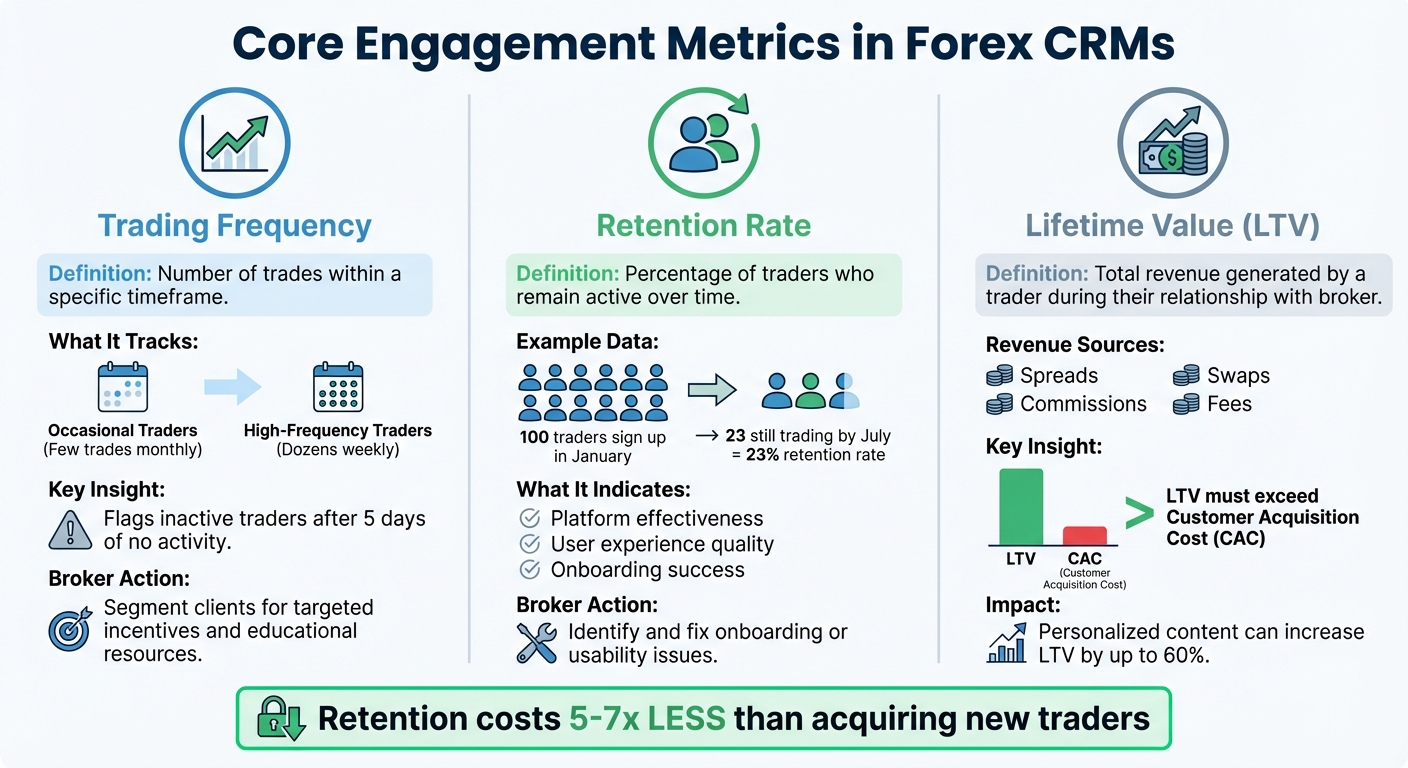
Core Forex CRM Engagement Metrics: Trading Frequency, Retention Rate, and Lifetime Value
Forex CRMs gather critical data to monitor trader activity, assess client retention, and optimize resource allocation. By integrating directly with trading platforms like MT4 and MT5, these systems provide real-time insights into customer behavior, laying the groundwork for deeper analyses.
Trading Frequency
This metric tracks how often a client places trades within a specific period. It helps distinguish between occasional traders who place a few trades monthly and high-frequency traders executing dozens of trades weekly. For example, if an active trader suddenly shows no activity for five days, the CRM can flag them for re-engagement. Brokers often use this data to segment clients, offering incentives to high-volume traders while providing educational resources to newer or less active users.
Retention Rate
Retention rate measures the percentage of traders who stay active over time. For instance, if 100 traders sign up in January but only 23 are still trading by July, the six-month retention rate is 23%. This metric reflects how well the platform meets client needs, from user experience to educational tools and customer support. A low retention rate signals potential issues in onboarding or platform usability, prompting brokers to make necessary adjustments.
Lifetime Value (LTV)
LTV represents the total revenue a trader generates during their relationship with the broker, including spreads, commissions, swaps, and fees. If the cost of acquiring a customer (CAC) exceeds their LTV, the broker risks financial losses. CRMs analyze trading volume, deposit habits, and activity duration to calculate LTV, helping brokers allocate marketing budgets effectively. Tailored rewards and personalized content based on LTV data can increase this metric significantly, sometimes by as much as 60%.
Real-Time Tracking Tools
Real-time tracking provides instant updates on client activity, enabling brokers to act quickly. For instance, if a high-value client makes a large deposit, the system can alert an account manager to offer personalized support. Similarly, unusual trading patterns, such as potential fraud or margin call risks, trigger immediate alerts, allowing brokers to intervene before minor issues escalate. This real-time responsiveness helps brokers adjust their engagement strategies swiftly.
The table below highlights the benefits of these core metrics:
| Metric | What It Measures | Why It Matters |
|---|---|---|
| Trading Frequency | Number of trades within a specific timeframe | Identifies high-value clients for rewards and flags at-risk users for follow-up. |
| Retention Rate | Percentage of users who remain active | Indicates the effectiveness of onboarding and overall satisfaction with the platform. |
| Lifetime Value (LTV) | Total revenue generated by a single trader | Guides marketing spend and ensures ROI on customer acquisition efforts. |
| Dormancy Period | Time since the last trade or login | Triggers automated campaigns to re-engage inactive users and reduce churn. |
Real-Time Tracking and Dashboard Features
Modern Forex CRMs seamlessly pull live data from trading platforms like MT4, MT5, and cTrader, giving brokers an instant window into client activity. This real-time link ensures brokers can monitor critical actions as they happen. For example, if a high-value client makes a large deposit or a trader misses a margin call, the system sends automated alerts, allowing brokers to act quickly. Below is a breakdown of key metrics tracked by these systems and their operational importance.
Comparison of Core Metrics
Here’s how CRMs track three essential engagement metrics and why they’re crucial for brokers:
| Metric | Definition | Data Source & Method | Benefit for Brokers |
|---|---|---|---|
| Trading Frequency | Tracks how often a trader places orders in a set timeframe | Real-time updates from MT4/MT5/cTrader logs | Identifies active VIPs and disengaged traders, enabling targeted outreach |
| Retention Rate | Measures the percentage of traders staying active over a given period | Continuous tracking of logins and transaction behavior | Assesses brokerage health and campaign success |
| Lifetime Value (LTV) | Calculates total revenue generated by a client during their relationship with the broker | Combines spreads, swaps, and commissions across accounts | Highlights profitable client segments and informs acquisition cost strategies |
Together, these metrics give brokers a clear picture of customer engagement. For instance, a European broker used CRM analytics in May 2025 to pinpoint traders who hadn’t placed an order in over three months. By sending tailored emails with exclusive bonus offers, they successfully reactivated 30% of these dormant accounts.
But numbers alone aren’t enough – visual tools make interpreting this data much easier.
Data Visualization Dashboards
Dashboards turn raw data into actionable insights by using charts, funnels, and heat maps. These interactive tools allow brokers to quickly spot trends, like sudden withdrawal spikes, shifts in trading preferences, or unusual activity that could flag compliance issues. For example, an Australian brokerage introduced automated workflows in May 2025 to deliver educational content based on client onboarding behavior. Within six months, this effort boosted client retention by 25%.
These dashboards also solve a common problem: fragmented data. Around 50% of financial institutions struggle with siloed information, but centralized dashboards bring everything together. By integrating website analytics, trading platform data, and customer support interactions into one view, brokers can map the entire customer journey. Platforms like InTrading provide features like real-time conversion tracking and unified customer data management, helping brokers monitor engagement at every stage – from initial contact to active trading and beyond.
User Segmentation and Behavioral Analytics
After gathering real-time dashboard data, brokers need to classify trader profiles effectively. Forex CRMs go beyond just collecting information – they automatically group clients based on their trading habits, financial characteristics, and lifecycle stages. This process transforms a large pool of individual accounts into well-defined groups, allowing brokers to engage with precision. These segments form the basis for creating targeted engagement strategies.
Behavior-Based Segmentation
Modern CRMs analyze a variety of data points, such as trading volume, frequency, preferred assets, risk levels, financial metrics, and demographic details, to build dynamic trader segments.
For example, as traders transition from traditional forex pairs to cryptocurrencies, the CRM adjusts their segmentation automatically. AI-driven insights further predict which traders might be ready for advanced products or are at risk of disengaging. Take this insight: traders who complete over 10 sessions in their first month are three times more likely to become long-term clients. CRMs flag these high-potential users for additional attention.
Here’s how segmentation categories guide broker actions:
| Segmentation Category | Data Points Tracked | Targeted Action Example |
|---|---|---|
| Trading Activity | Volume, frequency, asset types, risk tolerance | Send crypto signals to users exploring digital assets |
| Lifecycle Stage | Lead, FTD, Active, Dormant, VIP | Send "Welcome" series to leads; offer a "Reactivation" bonus to dormant accounts |
| Financial Profile | Deposit size, account balance, withdrawal history | Provide perks or priority support to high-balance VIPs |
| Demographics | Country, language, IP location | Automatically assign leads to native-speaking sales agents |
Customizing Communication Strategies
Once segments are established, brokers can fine-tune their communication to address each group’s unique needs. Instead of sending the same email to thousands of traders, CRMs like InTrading orchestrate targeted messages via push notifications, SMS, and email, tailoring content to match each segment’s behaviors and preferences.
For instance, new depositors might receive beginner trading guides, while VIP clients get personalized market analysis or strategy recommendations. If a trader goes inactive for three days, an automated check-in message is sent; after seven days, a reactivation bonus or market update follows. These inactivity-based campaigns can reduce customer churn by 25%, while personalized communication can increase a trader’s Lifetime Value by 60%.
The results speak for themselves. Proper segmentation and automated funnel engagement can boost First Time Deposit conversion rates by up to 40%. Since acquiring a new client costs 5 to 7 times more than retaining an existing one, these strategies significantly improve profitability. Brokers can also use lead scoring within segments to identify high-intent prospects, ensuring sales teams focus their efforts on the most promising opportunities – a critical approach in an industry where average conversion rates hover between 2% and 3%.
Lifecycle Automation for Tracking Engagement
Lifecycle automation takes the concept of segmented profiles and elevates it into a fully data-driven system that tracks and enhances engagement at every step of the trader’s journey. By automating interactions, Forex CRMs remove the need for manual follow-ups, responding instantly to specific trader behaviors.
Automating Customer Journeys
Lifecycle automation maps out the entire trader journey – from lead generation to VIP status. Each stage is closely monitored, and the CRM responds automatically. For example, if a lead registers but doesn’t upload their KYC documents within 24 hours, the system sends a reminder or notifies an account manager. Similarly, if a trader deposits funds but doesn’t place their first trade, the CRM can nudge them with guided tips. This seamless follow-up process helps close gaps in the journey, directly boosting conversion rates.
The onboarding process is where automation shines. Instead of manually collecting and verifying documents, CRMs handle KYC/AML checks by automatically requesting the necessary paperwork, tracking submissions, and approving accounts. Once approved, trading accounts on platforms like MT4 or MT5 are created instantly. One example comes from May 2025, when an Australian brokerage used automated educational workflows tailored to new traders’ experience levels. This approach increased client retention by 25% within six months.
As traders engage more actively, automation adapts to their behavior. If someone frequently trades EUR/USD, the CRM might send tailored market updates. Should a trader shift focus from forex to cryptocurrencies, their profile updates, and the system adjusts the content they receive. High-volume traders are automatically upgraded to VIP tiers, unlocking rewards, exclusive insights, and priority support. These automated triggers don’t just simplify onboarding – they also help keep traders engaged, reducing the risk of churn.
Reducing Customer Churn
Inactivity is a major challenge for brokerages, but lifecycle automation offers a proactive solution. By monitoring login habits and trading activity, the CRM can intervene before inactivity becomes permanent. For instance, if a trader hasn’t logged in for three days, the system sends a check-in message. After seven days, it might escalate with a reactivation bonus or a personalized market update. These timely interventions can make a big difference.
The results speak for themselves. In May 2025, a European brokerage used CRM analytics to identify traders who hadn’t been active for over three months. By sending personalized emails with exclusive bonuses, they reactivated 30% of these dormant accounts. Retaining an existing trader is far more cost-effective than acquiring a new one – typically 5 to 7 times cheaper. Automated campaigns targeting inactivity have been shown to reduce churn by 25%, while consistent, personalized communication can increase a trader’s Lifetime Value by 60%.
| Journey Stage | Automation Action | Engagement Goal |
|---|---|---|
| Lead Captured | Auto-personalized welcome email + WhatsApp ping | Initial Contact |
| Onboarding | Automated KYC/AML document requests | Speed to Activation |
| First Deposit | Guided "first trade" tips and platform walkthroughs | Conversion to Active |
| Active Trading | Behavior-based market reports and signals | Increased Frequency |
| Inactivity | Reactivation bonuses or "We Miss You" offers | Churn Reduction |
| High Volume | Promotion to VIP tier with exclusive perks | Lifetime Value (LTV) |
Platforms like InTrading demonstrate how these strategies work in practice, combining real-time tracking, user segmentation, and personalized communication. By adopting such comprehensive CRM solutions, brokerages can streamline every stage of the trader journey, improve engagement metrics, and drive long-term growth.
Centralized Data Management and Reporting
Without a unified system, brokers are left scrambling to gather data from trading terminals, payment gateways, KYC modules, and communication logs. This fragmented approach often leads to inefficiencies and missed opportunities. Nearly half of all financial institutions struggle with data silos and the inability to effectively consolidate information, which directly hampers their decision-making capabilities. A centralized CRM solves this by serving as a single, real-time repository for all customer information. This streamlined system enables precise analytics and smoother client interactions.
Unified Data Storage
With centralized storage, all customer data – such as account balances, trading history, deposit patterns, communication logs, and compliance documents – resides in one easily accessible location. This creates a complete 360-degree view of each trader, enabling account managers to quickly understand a client’s status without toggling between systems or asking repetitive questions. For example, when a trader reaches out to support, the representative can immediately access a full profile that includes recent trades, pending withdrawals, and past conversations. This level of insight fundamentally changes how brokers engage with their clients.
Additionally, a centralized back-office system can reduce administrative workloads by as much as 70%, allowing staff to focus on tasks that add more value. Real-time synchronization ensures that critical updates – like deposits or high-volume trades – are instantly reflected in the CRM. Solutions like InTrading’s centralized CRM integrate data from trading platforms, payment systems, and communication tools, empowering brokers to tailor their engagement strategies on the spot.
Customizable Reporting Tools
Turn raw data into meaningful insights with modern Forex CRMs. These platforms offer customizable reporting tools that help brokers create dashboards tailored to key metrics such as Lifetime Value (LTV), retention rates, conversion costs, and trading frequency. By automating reports, brokers can replace manual spreadsheets with daily or weekly updates on business performance. Leveraging centralized analytics for decision-making can boost brokerage revenue by up to 40%.
These tools also enable brokers to perform behavioral segmentation at scale. For instance, reports can highlight profitable traders, flag at-risk accounts, and optimize marketing budgets. A retention team could use these insights to identify accounts showing reduced activity and launch targeted reactivation campaigns. Customizable reports ensure that every department – whether sales, compliance, or marketing – gets access to the exact data they need. This focused approach ensures decisions, from crafting promotional offers to upgrading VIP tiers, are guided by accurate, real-time data instead of assumptions.
Conclusion
Forex CRMs play a key role in helping brokers better understand their clients and maintain long-term engagement. By analyzing metrics like trading frequency, retention rates, and Lifetime Value (LTV), these systems offer the insights brokers need to make smarter, data-driven decisions. Considering that industry conversion rates typically hover around 2–3% without effective lead management, the right CRM can make a world of difference.
The real strength of Forex CRMs lies in their ability to centralize and automate processes. By breaking down data silos, brokers can tailor their communication efforts and transform raw data into actionable strategies. This is where InTrading’s CRM stands out.
InTrading’s CRM seamlessly integrates with trading platforms, automates KYC/AML processes, and consolidates communication channels. It enables brokers to monitor trader activity in real time, launch reactivation campaigns for inactive accounts, and manage intricate IB structures with ease. These automation tools free up time for teams to focus on building stronger client relationships rather than getting bogged down by administrative tasks.
Beyond automation, successful brokers use CRMs to foster genuine connections with their clients. By streamlining workflows, personalizing interactions, and maintaining a comprehensive view of each trader’s journey, Forex CRMs like InTrading redefine how brokerages operate and grow. This holistic approach ensures that every stage of the client experience is optimized for success.
FAQs
How can Forex CRMs help brokers reduce trader churn?
Forex CRMs help brokers keep traders engaged by enabling personalized and timely interaction. These platforms analyze trader behavior, preferences, and risk levels using advanced data tools. With this insight, brokers can deliver customized communication, offers, and educational content that resonate with individual traders, increasing both satisfaction and loyalty.
They also help brokers spot early warning signs of disengagement, such as reduced trading activity or account balances. This allows brokers to act quickly with targeted outreach, whether through email, SMS, or push notifications, to re-engage those clients. By automating these processes, Forex CRMs make it easier for brokers to strengthen their relationships with traders, improve the overall experience, and encourage long-term loyalty.
How does automation improve the onboarding process in Forex CRMs?
Automation transforms the onboarding process in Forex CRMs by making it faster, more precise, and efficient. Traders can handle sign-ups, upload documents, and complete verification automatically – cutting out delays and minimizing errors that often occur with manual methods. This streamlined process is a game-changer in the fast-paced forex trading world, where quick account setup can make all the difference.
It also simplifies compliance tasks like KYC (Know Your Customer) and AML (Anti-Money Laundering). Automation ensures these regulatory requirements are met without causing bottlenecks, reducing the need for manual intervention. This not only lowers the risk of operational errors but also frees up staff to focus on strategic tasks. Plus, automation enhances lead management, client segmentation, and personalized communication, giving brokers the tools to engage clients effectively right from the start of their trading journey.
How do Forex CRMs use data visualization to boost client engagement?
Forex CRMs simplify complex customer data by transforming it into clear, actionable visuals. Through tools like real-time dashboards and charts, brokers can track essential metrics, including trading activity, customer behavior, and campaign outcomes. This makes spotting trends, understanding client preferences, and resolving potential issues much more straightforward.
Data visualization also plays a key role in client segmentation and lifecycle management. By displaying engagement patterns in an easy-to-digest format, brokers gain insights that help them design personalized marketing campaigns, improve onboarding processes, and boost retention efforts. These tools empower brokers to make informed decisions, build stronger client relationships, and deliver a more seamless and supportive trading experience.