
Forex brokers often lose potential clients due to slow, manual onboarding processes. A Forex CRM simplifies this by automating tasks like lead management, KYC/AML checks, and communication. Key benefits include:
- Faster onboarding: Automation reduces processing time by up to 80%.
- Centralized data: All client details, from compliance status to trading activity, are stored in one place.
- Personalized onboarding: Tailors the process based on client type, location, and experience level.
- Real-time tracking: Identifies where users drop off and allows immediate action.
- Compliance automation: Handles document verification and regulatory requirements efficiently.
- Scalability: Supports brokers managing multiple brands and regions.
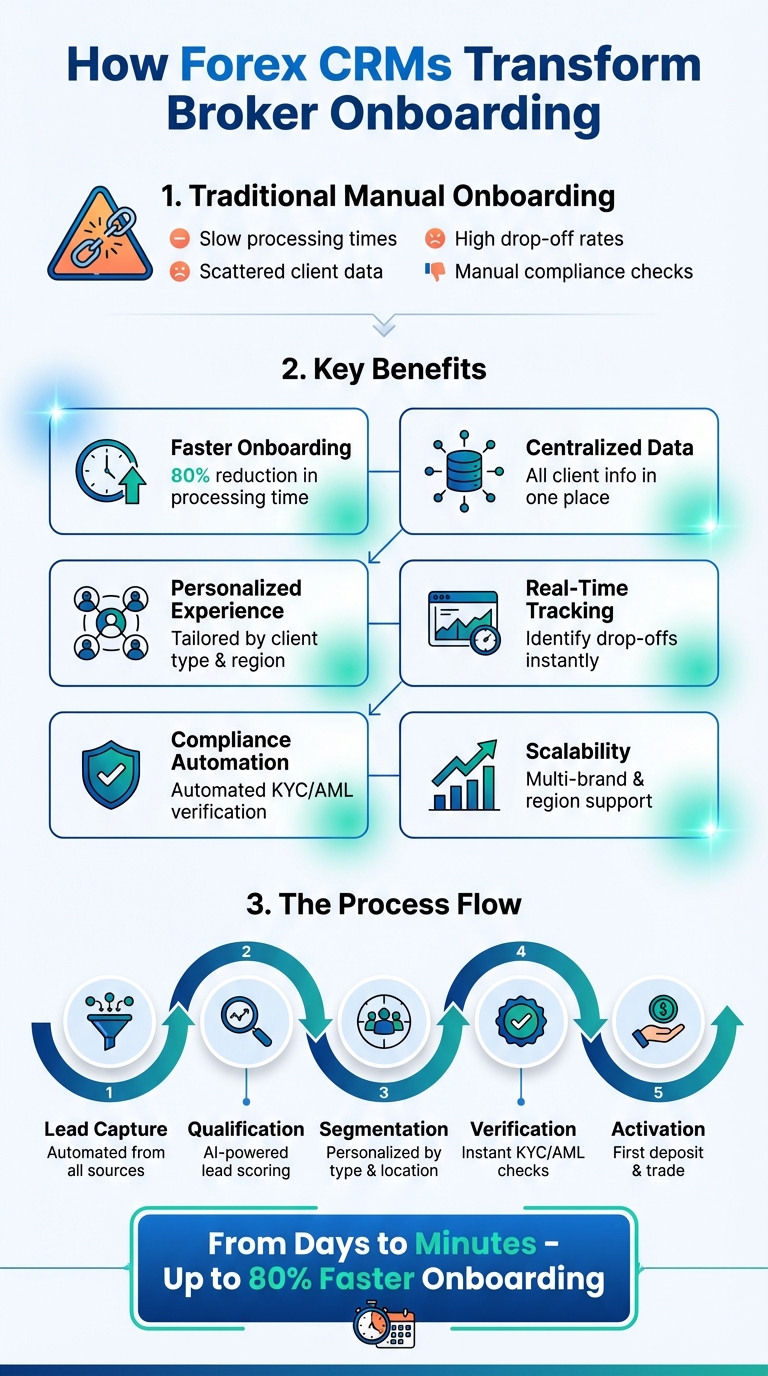
How Forex CRMs Streamline Broker Onboarding Process
How Forex CRMs Improve Lead Management
Automated Lead Capture and Qualification
Disconnected systems often lead to lost opportunities. When potential clients engage online, their details can end up scattered across multiple platforms, leaving sales teams struggling to piece together information. Without automation, teams are left manually transferring data, missing key follow-ups, and failing to identify which channels are bringing in the most promising traders.
A Forex CRM solves this issue by automatically capturing every lead from various sources and consolidating the data in one central location. Whether the lead comes from a Facebook ad, an IB referral, or another digital channel, the system logs it with detailed information like source data, UTM parameters, geo-location, and timestamps. This unified dashboard provides instant visibility into which campaigns are driving results and when prospects are engaging.
But capturing leads is just the beginning. Once inside the system, automated qualification takes over. Brokers can set up rules to score leads based on factors like trading experience, deposit potential, location, and engagement level. High-priority leads are routed to senior sales reps or prompt immediate follow-up calls, while lower-priority leads are placed in automated nurture sequences. This way, sales teams can focus their energy on the most promising opportunities instead of wasting time on cold leads.
Centralized Customer Data Management
Scattered client information can lead to inefficiencies and miscommunication. For example, sales teams may be unaware of a client’s compliance status, support teams might not know if a deposit has been initiated, and management often lacks a clear view of where prospects are getting stuck in the process.
A Forex CRM eliminates these challenges by bringing all client data into a single, unified profile. This includes personal details, KYC/AML status, communication history, deposit milestones, and trading activity. With everything in one place, teams across sales, support, and management can access up-to-date information instantly, reducing delays and errors.
Take InTrading, for instance. Their platform helps Forex and stock brokers centralize customer data, enabling seamless communication and better performance tracking. When teams can quickly see a prospect’s verification status, deposit intentions, and recent interactions, they can respond more efficiently and accurately. This streamlined approach minimizes friction during the onboarding process, ensuring fewer leads drop off before completing their accounts.
Personalizing Onboarding with User Segmentation
After streamlining lead capture, the next step is refining the onboarding process through personalized segmentation. A one-size-fits-all approach often leads to frustrated users and higher drop-off rates. Think about it: a beginner trader in Texas might need basic educational resources and a straightforward account setup, while an experienced trader in New York would expect fast-track verification and immediate access to advanced platform features. Ignoring these differences can make clients feel overlooked, driving them away.
Segmenting Users by Client Type and Region
The key to effective onboarding lies in segmenting users by their client type and location. Retail clients typically require foundational education, while corporate accounts demand more advanced verification processes and access to dedicated account managers. For beginners, tutorials and step-by-step guides are essential, whereas experienced traders prioritize features like quick funding options and advanced tools such as API integrations.
Regional differences also play a huge role, especially in Forex. For instance, clients under the FCA face stricter KYC requirements, while offshore clients often experience more lenient procedures. A broker catering to both markets needs tailored onboarding flows: one that complies with detailed document collection for European clients under CySEC regulations, and another with streamlined steps for regions with lighter compliance rules. Offering multi-language support and region-specific instructions can significantly reduce confusion and improve the user experience.
These carefully designed profiles then serve as the foundation for targeted automation.
Lifecycle Marketing Automation for Onboarding
Once user profiles are segmented, automation can take over to deliver personalized, timely messages that guide clients through their onboarding journey. For example, after a client verifies their email, they might receive a KYC reminder. If a verified client hasn’t made a deposit yet, they could get a targeted nudge encouraging them to fund their account.
Tools like InTrading make this process seamless by integrating lifecycle marketing automation. By pulling real-time user data from websites, apps, and marketing platforms, brokers can send tailored email, SMS, and push notifications to keep clients moving forward. For instance, beginner retail clients in the U.S. might receive educational tutorials right after signing up, while experienced European traders are sent fast-track instructions for uploading ID documents. This not only reduces manual effort but also ensures clients don’t get stuck at critical points like document submission or making their first deposit.
Improving Communication with Real-Time Tools
Once onboarding flows are segmented, the next step is to use real-time communication tools to tackle drop-offs immediately. Tools like real-time tracking and automated messaging help pinpoint where users face challenges and guide them back on track. This kind of instant feedback allows for precise and timely interventions, as outlined below.
Real-Time Conversion Tracking for Onboarding Optimization
Real-time conversion tracking gives brokers a live snapshot of the onboarding process, from sign-up to first trade. Rather than waiting for weekly reports, teams can identify bottlenecks and drop-off points as they happen. For instance, if data shows that only 40% of U.S. registrants complete their KYC process on the same day, brokers can act quickly – sending an automated SMS reminder two hours after sign-up and scheduling a follow-up call within 24 hours. The impact of these actions can then be measured in real time.
Platforms like InTrading enable this by pulling behavioral data – such as email opens, link clicks, and app interactions – and linking it directly to onboarding outcomes. If a spike in drop-offs occurs at the "KYC documents submitted" step, brokers can analyze rejected submissions, update instructions, or introduce features like tooltips or live chat to assist users. This allows for rapid experimentation and adjustments, often delivering results within hours.
Automated Notifications and Reminders
Automated notifications play a crucial role in keeping users engaged and informed throughout the onboarding process. For example, after a user signs up, they might receive a confirmation email outlining the next steps. If the KYC process hasn’t been initiated within an hour, an SMS reminder with a direct link can be sent. If documents are rejected, a push notification can explain the issue and guide the user on how to fix it. These messages ensure clarity and reduce the chances of users dropping off.
The choice of communication channel is key. Emails are ideal for detailed instructions, SMS is perfect for time-sensitive reminders, and push notifications work well for quick actions – all managed from a single dashboard. Platforms like InTrading streamline this process, ensuring clients receive timely and relevant messages without feeling overwhelmed.
Meeting Compliance and Scalability Requirements with Forex CRMs
For brokers, staying compliant while scaling operations is no small feat. A Forex CRM simplifies this challenge by automating compliance tasks and offering a centralized platform to manage multiple brands or regions efficiently. Let’s explore how these systems streamline compliance and support scalable operations.
Simplifying KYC and AML Processes
Compliance often feels like a bottleneck, but it doesn’t have to be. Forex CRMs take the hassle out of Know Your Customer (KYC) and Anti-Money Laundering (AML) procedures by automating key steps like ID and document collection, proof-of-address uploads, sanctions checks, risk scoring, and ongoing monitoring. Many platforms integrate directly with verification providers like Sumsub and ShuftiPro via APIs, enabling instant third-party checks. For instance, when a U.S.-based client uploads their documents, the system initiates immediate verification, creating an automated audit trail.
This level of automation significantly reduces onboarding time. Instead of waiting days for manual reviews, approvals can happen within minutes. As a result, brokers can process more applications without needing to expand their compliance teams. The CRM also keeps a detailed archive of compliance records, including applications, documents, communication logs, timestamps, and approval decisions, ensuring a complete audit trail for regulators. On-demand reporting features allow compliance teams to quickly generate insights, such as verified accounts by date or flagged accounts requiring further AML review – essential tools during regulatory inspections.
Scaling Multi-Brand and Enterprise Operations
Expanding into new markets and managing multiple brands can be challenging, but Forex CRMs are built to handle this complexity. Many systems provide multi-brand and multi-region support, enabling brokers to oversee several brands, jurisdictions, and regulatory requirements from a single back office. For example, a broker could manage a U.S. brand that requires Social Security Numbers (SSN) and enhanced checks alongside an offshore brand with simpler requirements – all while maintaining separate data and settings where needed.
The real magic lies in rule-based onboarding flows. These flows automatically adjust fields, document requests, and approval logic based on a client’s location and type. A U.S. client might be prompted to provide an SSN and tax forms, while an offshore client might encounter a more streamlined process. This ensures every client is met with the appropriate requirements. Centralized dashboards further enhance efficiency by allowing managers to monitor workloads and oversee operations seamlessly. Platforms like InTrading consolidate customer data, making it easier for brokers to manage communication, engagement, and performance across multiple brands – all from one unified interface. This ensures teams can handle growing volumes without feeling overwhelmed.
Conclusion
Integrating automation into Forex broker onboarding simplifies every stage, from capturing leads to meeting compliance requirements. With a Forex CRM, the traditionally slow and manual onboarding process transforms into a quick, organized, and largely automated system. Tasks like lead capture, KYC/AML checks, document management, and follow-ups are streamlined, cutting onboarding time by up to 80%. What once took days can now be completed in minutes, significantly reducing drop-offs and boosting conversion rates between signup, verification, and the first deposit.
Tailored onboarding through segmentation is another key advantage. When brokers customize the onboarding process based on client type, experience level, and region, the experience feels more relevant and efficient. For instance, U.S. clients, who face stricter regulations, are guided through the necessary forms and checks, while seasoned traders gain quicker access to advanced tools. This personalized approach builds trust, enhances engagement, and contributes to stronger, long-term client relationships.
From a compliance perspective, integrated KYC/AML tools and centralized document management make meeting regulatory standards a streamlined and trackable process. Automated ID verification, sanctions screening, and audit trails not only reduce risk but also free up compliance teams to handle more complex cases. For brokers operating in the U.S. and other regulated markets, this level of standardization is critical to scaling operations without increasing regulatory risks.
Scalability tools and unified dashboards further empower brokers to expand into new markets and manage thousands of client accounts efficiently. These features provide a clear, centralized view of each client’s progress, enabling brokers to grow without the need for additional resources.
FAQs
How does a Forex CRM simplify lead qualification?
A Forex CRM streamlines the process of qualifying leads by leveraging real-time data and smart segmentation. It keeps tabs on user activities – like website visits or form submissions – and organizes leads based on how engaged they are, making it easier to spot the most promising opportunities.
With built-in tools for personalized communication, such as SMS, email, and push notifications, the CRM enables timely and relevant follow-ups. This automation doesn’t just save valuable time; it also boosts conversion rates by directing attention to prospects with the highest potential.
How does user segmentation enhance the onboarding process for Forex traders?
User segmentation takes the onboarding experience to the next level by categorizing traders based on their behavior, preferences, and real-time data. This strategy enables brokers to provide personalized communication and offers that align with each trader’s specific needs.
By tailoring the onboarding process, segmentation not only enhances engagement but also builds trust and drives higher conversion rates. The result? A more seamless and effective start for traders.
How do Forex CRMs help brokers comply with KYC and AML regulations?
Forex CRMs simplify the process of adhering to Know Your Customer (KYC) and Anti-Money Laundering (AML) regulations by centralizing client data and automating identity checks. These systems allow brokers to securely gather, store, and manage customer information while keeping detailed audit records for regulatory purposes.
In addition, they support real-time transaction monitoring to identify potentially suspicious activities, enforce strict access controls, and produce automated reports for regulators. This not only helps brokers meet legal requirements more efficiently but also minimizes the risk of facing penalties for non-compliance.