
Retention is critical for trading platforms. Acquiring new users costs up to 5x more than retaining existing ones, and nearly 77% of users drop off within three days. For Forex and stock trading apps, where real money and high-stakes decisions are involved, losing users means losing revenue. But here’s the good news: improving retention by just 5% can increase profits by up to 75%.
AI-powered messaging offers a solution. By analyzing user behavior in real time, AI can identify at-risk users and send timely, personalized messages to keep them engaged. Platforms using in-app messaging see response rates 8x higher than push notifications and retention rates up to 3x better than those without it.
Key Takeaways:
- Personalization matters: Tailor messages for specific user groups (e.g., beginners vs. experienced traders).
- Timing is everything: Real-time alerts based on user actions (or inactions) improve engagement.
- Track retention metrics: Focus on churn rate, session frequency, and lifetime value to measure success.
- Re-engage inactive users: Use predictive modeling and multi-channel communication to win them back.
- Scalability through AI: Automate lifecycle marketing and manage millions of users with minimal effort.
AI messaging transforms retention strategies by making communication timely, relevant, and scalable. Platforms that adopt these methods see measurable improvements in user engagement, revenue, and long-term loyalty.
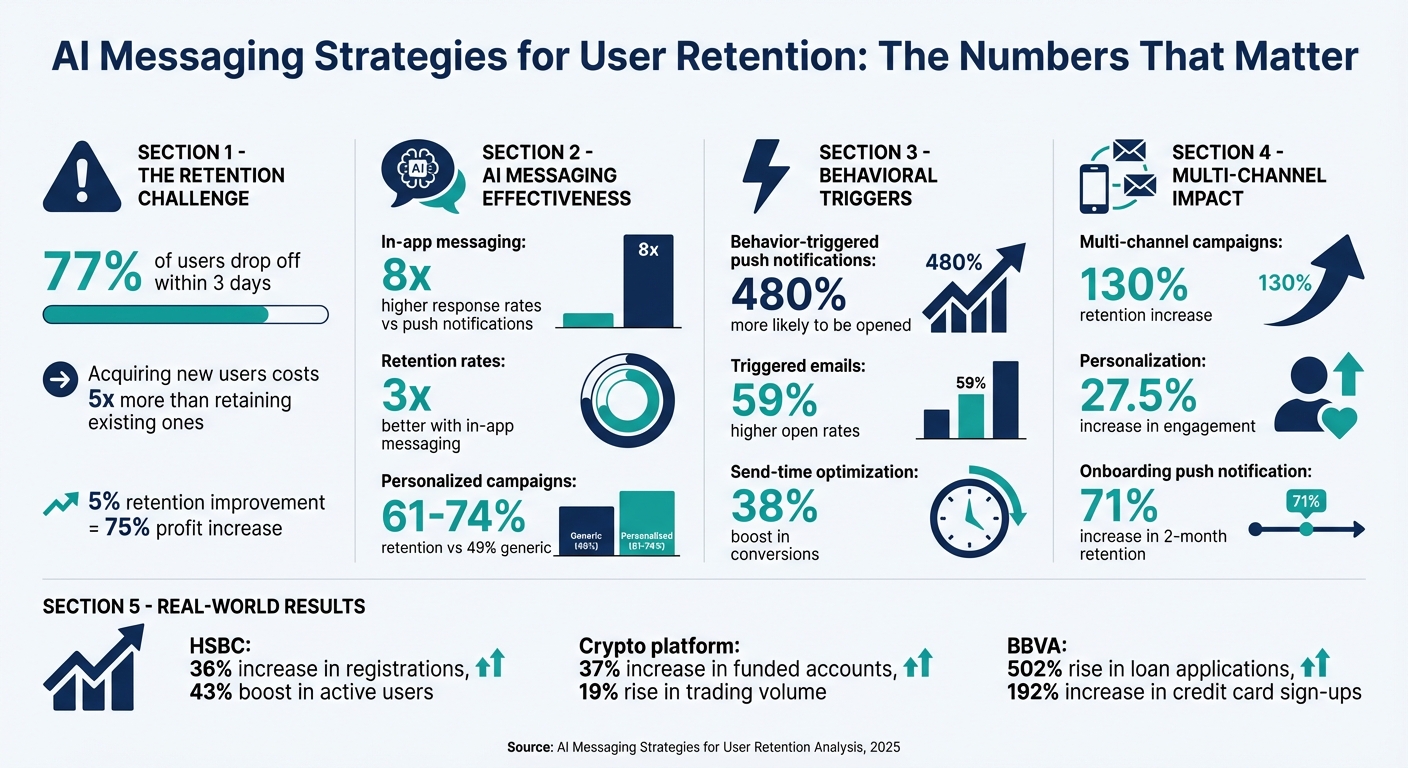
AI Messaging Impact on Trading Platform User Retention: Key Statistics
How AI Messaging Improves User Retention
AI-powered messaging shifts retention strategies from being reactive to proactive. By analyzing user behavior in real time – like decreased login activity, changes in deposit habits, or declining balances – AI can identify users at risk of leaving before they actually churn. This is especially important for trading platforms, where user expectations are high, and patience is often limited. As Craig Dennis from Hightouch puts it:
"AI takes retention from reactive to proactive. By anticipating churn and tailoring each interaction as it happens, it helps brands keep more customers, longer – with less manual work."
Personalization is key to keeping users engaged, and AI makes it scalable. By combining behavioral data (like app usage or feature adoption), transactional patterns (such as trade frequency), and engagement metrics, AI creates comprehensive user profiles. This allows platforms to group users into meaningful categories. For instance:
- "At-Risk" users might receive educational tips to re-engage them.
- "High-Rollers" could get market insights and geopolitical updates.
- "Churn-Traders" might see targeted reactivation offers.
The result? Messaging that feels relevant and tailored, not generic. Platforms using personalized in-app messages report retention rates of 61% to 74%, compared to just 49% for those relying on generic campaigns.
But timing is just as critical as personalization. AI leverages real-time behavioral cues to automate messages based on specific actions – or inactions. For example:
- If a trader’s balance dips below a certain threshold, they get an immediate alert.
- If someone struggles during onboarding, they receive a timely "need help?" prompt.
These action-based notifications are powerful. Push notifications triggered by user behavior are 480% more likely to be opened than standard time-based ones, while triggered emails see 59% higher open rates compared to generic emails.
This proactive approach delivers measurable benefits, especially for trading platforms.
Benefits of AI Messaging for Trading Platforms
Trading platforms face unique challenges in retaining users. Traders often have little patience for friction and are quick to explore alternatives. Add to that the rising cost of acquiring new users – up to five times more than retaining existing ones – and it’s clear why retention is a top priority. AI messaging tackles these challenges through three primary advantages: personalization, real-time communication, and scalability.
Personalized engagement ensures every trader gets content tailored to their experience and habits. New traders might receive educational content during their first week, while seasoned traders might get updates on quarterly earnings or interest rate changes. Personalization can increase purchases and app engagement by 27.5%. Platforms that use multi-channel campaigns (push notifications, SMS, and in-app messages) see retention jump by as much as 130%.
Real-time communication builds trust and keeps users informed. Automated alerts during critical moments – like when a balance hits a specific threshold – help users make informed decisions. Because these messages are delivered right within the platform during active trading sessions, they’re far more effective than external notifications.
Scalability is where AI truly excels. Traditional segmentation methods, which rely on static data like age or location, can’t keep pace with the needs of millions of users. AI, on the other hand, enables personalized messaging at scale, adapting content, timing, and delivery channels (SMS, push, in-app) based on each user’s behavior and preferences. For example, send-time optimization ensures a trader in New York receives alerts at 9:30 a.m. ET, while a trader in Los Angeles gets them at 6:30 a.m. PT. This approach can boost push notification conversions by 38%.
The impact of these strategies is clear when you look at the numbers. Let’s dive into the key metrics that trading platforms should track.
User Retention Metrics You Should Track
To improve retention, you need to measure it effectively. For trading platforms, the most revealing metrics fall into two categories: user behavior and financial performance.
| Metric | Definition | Why It Matters for Trading Platforms |
|---|---|---|
| Churn Rate | The percentage of users who stop using the platform over a set period | High churn suggests issues with user experience or value delivery, especially in the trading interface |
| Customer Lifetime Value (LTV) | The total revenue a platform expects to earn from a single user | AI can identify high-value users early and increase LTV by offering tailored incentives and insights |
| Session Frequency | How often a user logs in to check markets or trade | Indicates platform "stickiness"; AI nudges can increase engagement during high-volatility periods |
| Day 1 Retention | The percentage of users who return within 24 hours of signing up | Reflects the success of onboarding and the platform’s first impression |
Churn rate is often the first red flag. If users leave faster than you can replace them, your platform’s sustainability is at risk. Monitoring churn weekly and monthly can reveal patterns, such as users leaving after their first trade or during market downturns. AI-powered messaging can help address these pain points and significantly improve retention.
Customer Lifetime Value (LTV) measures the total revenue a user generates over their time on your platform. By identifying high-value users early, AI can prioritize them with exclusive offers or premium market intelligence. Even a 5% increase in retention can lead to a 75% boost in profits.
Session frequency reflects how engaging and "sticky" your platform is. A DAU/MAU ratio (Daily Active Users divided by Monthly Active Users) of 25% or higher is considered excellent. AI can increase session frequency by sending timely alerts during market spikes or personalized trading opportunities based on a user’s portfolio.
Day 1 Retention highlights how well your onboarding process works. Users who complete a full onboarding flow see retention rates rise by over 9%. Platforms that use push notifications during onboarding report a 71% increase in two-month retention. Tracking this metric helps identify where new users drop off, so AI-driven in-app messages can guide them through those crucial early steps.
These metrics make it clear: AI-powered messaging doesn’t just improve user engagement – it can transform how trading platforms retain and grow their customer base. By addressing churn, boosting LTV, and increasing session frequency, AI messaging delivers results where it matters most.
AI Messaging Strategies to Retain Users
Personalized Onboarding Through User Segmentation
AI makes onboarding smarter by segmenting users as soon as they sign up, creating tailored experiences based on their preferences, experience level, and behavior. Instead of serving up the same generic tutorial to everyone, AI identifies whether a user is a beginner needing educational resources and responsible trading tips or a seasoned pro looking for advanced tools and market insights.
Take HSBC as an example. In 2025, the bank adopted an AI-powered platform that unified customer data to deliver personalized onboarding journeys for trading clients. The result? A 36% increase in known customer registrations and a 43% boost in active mobile app users within weeks. AI also enhances the onboarding process with contextual tutorials, offering guidance precisely when users interact with new features, which helps reduce cognitive overload.
Generali applied similar AI logic during its eKYC process. By detecting when users stalled during registration, the company sent targeted nudges that cut abandonment rates by 17% and tripled high-quality leads.
Timing matters too. Instead of overwhelming users with requests right after download, delay notifications until a feature proves its value – like setting up price alerts. Celebrating milestones, such as completing onboarding, also reinforces momentum. For instance, a single push notification encouraging users to finish onboarding can increase two-month retention by 71%, while multi-channel campaigns can boost retention by 130%.
Once onboarding is complete, AI continues to strengthen engagement through well-timed behavioral triggers.
Behavioral Triggers and Real-Time Alerts
AI excels at monitoring user actions – and even inactions – to send alerts at the perfect moment. For trading platforms, this could mean sending a risk management alert when an account balance dips below a critical level or delivering educational tips when a user struggles with a new feature.
Behavior-driven notifications outperform scheduled messages by a wide margin. In fact, push notifications triggered by user behavior are 480% more likely to be opened. For traders, real-time alerts might include updates on breaking news, earnings reports, or guidance when exploring new platform features.
AI also optimizes the delivery channel, ensuring messages reach users where they’re most likely to respond. Urgent price alerts might go via SMS for some traders, while others may prefer in-app messages. Fine-tuning the timing of these alerts can further increase engagement, with push notification conversions improving by 38%.
To avoid overwhelming users, AI cancels scheduled messages if the user completes the desired action – like closing a position or making a deposit – before the alert is sent. This approach reduces message fatigue and keeps communications relevant.
Once users are engaged with real-time alerts, lifecycle marketing automation takes over to adapt messaging as their needs evolve.
Lifecycle Marketing Automation
As users grow and their needs change, lifecycle marketing automation ensures that messaging stays relevant without requiring manual updates. AI-driven automation delivers the right content at the right time.
For example, a leading crypto and brokerage platform implemented AI-powered lifecycle automation in 2024, leading to a 37% increase in active funded accounts and a 19% rise in trading volume year-over-year. Early-stage users received tutorials on placing their first trade, explanations of common terms, and risk management tips. As these users gained experience, the focus shifted to market insights, advanced strategies, and exclusive updates. High-value traders received personalized intelligence on quarterly earnings, interest rate changes, and geopolitical events.
BBVA took this a step further by using AI segmentation to deliver highly targeted banking offers. The bank reported a 502% rise in loan applications and a 192% increase in mobile credit card sign-ups. Their SVP of Digital Banking noted:
"Insider’s advanced segmentation let us quickly deliver hyper-personalized banking offers to high-value segments, driving triple-digit growth in loan and credit card applications."
AI also helps manage communication frequency. By capping the number of messages sent daily or weekly, platforms avoid overwhelming users. Non-critical alerts are restricted to reasonable hours – typically 9:00 AM to 9:00 PM local time – so users aren’t disturbed during their downtime.
Re-Engaging Inactive Users
Even the most engaging platforms face periods of user inactivity. Predictive risk modeling, an extension of behavioral triggers, identifies users at risk of disengaging by analyzing patterns like reduced logins, declining trade volumes, or abandoned sessions. Once flagged, these users receive personalized incentives, such as educational content, market updates, or exclusive offers, to re-engage them.
Multi-channel approaches amplify these efforts. Combining push notifications with email or WhatsApp messages ensures broader reach. Contextual re-engagement is particularly effective. For example, if a user pauses during the eKYC process, AI sends a targeted message explaining the benefits of completion and offers assistance.
Targeted in-app messages also work wonders for reactivation, delivering relevant content at just the right time. Optimizing the send time for these messages can lift email conversions by 34%.
VIP users get special attention. By predicting which users are likely to become top spenders in the next three months, platforms can offer exclusive perks, premium market insights, or VIP invitations to keep them engaged before they drift away.
Dynamic Personalization During Live Trading
Dynamic personalization takes engagement to the next level by delivering real-time insights and tips during live trading sessions. This strategy tailors communication based on user activity in the moment, ensuring relevance.
Luxury Escapes showcased this approach in June 2025 with the launch of their LuxPlus+ rewards program. By offering real-time, personalized deals across 27 markets, the travel brand exceeded its membership signup goal by 142% in just two weeks and doubled email click-through rates. The campaign succeeded by adapting to each user’s behavior as it happened.
Using InTrading for AI Messaging
InTrading’s platform combines the AI-driven tools trading platforms need to execute messaging strategies effectively. By centralizing customer data and automating personalized, multi-channel communications, it enables the proactive retention strategies discussed earlier, driving measurable performance improvements.
InTrading Features for AI Messaging
InTrading integrates a suite of AI-powered tools designed to bring these strategies to life.
The AI Data Helper simplifies complex market data into clear, actionable insights. Instead of bombarding users with raw numbers, it provides sentiment signals and scores, helping traders make confident decisions during live sessions. These insights are integrated directly into portfolio and watchlist screens, ensuring they appear where users need them most.
User segmentation categorizes traders based on activity, experience, and behavior. This real-time segmentation allows for tailored messaging that resonates with individual users.
Lifecycle marketing automation ensures timely and relevant content delivery. Platforms can create automated workflows triggered by user behavior, like logging in after a gap of three to seven days or hovering over a feature without interacting. These triggers deliver contextual messages – such as tooltips or slide-ins – to guide users without disrupting their experience.
Real-time conversion tracking provides insights into how users respond to messages, enabling platforms to fine-tune timing and content. Push notifications, SMS, and email campaigns work together seamlessly, ensuring users are reached through the channels they engage with most.
InTrading also incorporates gamification widgets like spin-to-win wheels and achievement badges, which boast an 8.67% conversion rate – 132% higher than standard popups. These interactive features not only re-engage inactive users but can also boost daily active usage by nearly 50%.
Selecting Your InTrading Plan
Choosing the right InTrading plan depends on your platform’s size and retention goals.
InTrading offers three plans tailored to different needs. The Basic plan covers essential tools like CRM, push notifications, and email marketing, making it ideal for small platforms starting with AI messaging. The Professional plan adds advanced features such as the AI Data Helper, user segmentation, and lifecycle marketing automation, perfect for growing platforms aiming to enhance retention strategies. The Enterprise plan includes the full feature set, adding SMS marketing and real-time conversion tracking, making it ideal for large platforms handling high user volumes.
| Plan | Core Features | Best For |
|---|---|---|
| Basic | CRM, Push Notifications, Email Marketing | Small platforms new to AI messaging |
| Professional | AI Data Helper, User Segmentation, Lifecycle Automation, all Basic features | Growing platforms implementing advanced retention strategies |
| Enterprise | SMS Marketing, Real-time Conversion Tracking, all Professional features | Large platforms managing high trader volumes |
Most platforms begin with the Professional plan to access segmentation and automation capabilities, scaling to Enterprise as their user base grows and multi-channel communication becomes more critical. The decision should align with your platform’s current user volume, messaging complexity, and whether SMS outreach is part of your retention strategy. By choosing the right plan, InTrading ensures every message enhances user engagement and strengthens retention efforts.
Measuring and Improving AI Messaging Performance
Key Metrics to Track
To fine-tune your AI messaging strategy, it’s essential to measure the right metrics. Click-through rate (CTR) is a quick indicator of how engaging your messages are – if it’s low, your content or timing might be off. Conversion rate tells you whether users are taking the desired action, like upgrading their plan or activating a feature. For trading platforms, 30-day retention sheds light on whether your messaging keeps users engaged over time, while average revenue per user (ARPU) helps gauge the financial impact of upsell campaigns.
Don’t overlook dismissal rates – a high rate could mean your messages are irrelevant or causing fatigue. Also, tracking session frequency and session length after sending messages can reveal whether users are genuinely engaged or simply annoyed. Tools like InTrading’s real-time conversion tracking allow you to directly link these metrics to user behavior, showing which messages drive actions like trades and which ones fall flat.
A great example of effective messaging comes from OneRoof in New Zealand. In 2025, they used AI to personalize property listings based on intelligent timing and user preferences. The result? A 23% boost in email click-to-open rates and a staggering 218% increase in total clicks to listings. This highlights the power of delivering the right message at the right time [Source: Braze Ultimate Guide to AI Marketing, 2025].
Improving these metrics involves refining both the content and timing of your messages. Let’s dive into how you can do that.
Tips to Improve Message Engagement
Start with A/B testing. Experiment with different copy, timing, and formats to see what resonates. Focus on one variable at a time – this clarity can lead to conversion boosts of over 40%.
Segment your audience with precision. For example, instead of lumping all active users together, identify those who repeatedly view a stock but haven’t traded. Tailor messages to specific actions rather than relying on fixed intervals. Also, set frequency caps – sending more than one or two messages per session risks overwhelming users.
Take inspiration from Rappi, a Latin American superapp. They re-engaged lapsed users with personalized WhatsApp and in-app messages, resulting in an 80% increase in purchases from inactive users and a 43% lift in those who reactivated and made multiple purchases within 30 days [Source: Braze Case Study, 2025].
Timing matters just as much as content. Use send-time optimization to deliver messages when users are most likely to engage – this AI-driven approach can increase push notification conversions by 38%. Gathering user feedback through in-app surveys is another effective way to refine personalization. Remember, the goal isn’t to send more messages but to send smarter, more targeted ones.
Conclusion
AI-powered messaging takes notifications to the next level by tailoring them to user behavior. When trading platforms move away from one-size-fits-all blasts and embrace behavior-based communication, they create interactions that feel both personal and timely. The numbers back this up: in-app messages can increase retention by up to 3x, and users who receive them are 131% more engaged.
Messages that appear during key moments – like active trading, navigating complex tools, or hitting critical thresholds – not only enhance the user experience but also build trust. Whether you’re welcoming new traders, reactivating dormant accounts, or rewarding loyal VIPs, automation allows for scalable yet personalized communication. From onboarding to dynamic in-app interactions, success hinges on thoughtful execution.
"Retention strategies are only as strong as their messaging." – AIJ Guest Post
InTrading’s CRM and marketing automation tools are designed to meet this exact need. With features like real-time conversion tracking, lifecycle-based automation, and user segmentation, you can deliver messages triggered by actual user behavior – no guesswork involved. Plus, its multi-channel approach ensures you connect with users wherever they are, maximizing engagement at every touchpoint.
To get it right, segment users by their lifecycle stage, trigger messages based on specific actions, and set limits to avoid overwhelming them. Test everything – timing, wording, and format – and let the data guide you. The ultimate goal? Make each message feel like it was written just for that user, exactly when they need it.
FAQs
How does AI create personalized messages for different types of traders?
AI takes personalized messaging to the next level by studying a trader’s behavior, preferences, and activity patterns. By analyzing data like transaction history, portfolio details, login habits, and reactions to market changes, it creates dynamic profiles such as beginner, high-value trader, or at-risk user. From there, machine learning steps in to predict what type of content will resonate most and identifies the ideal timing for delivery.
For instance, a beginner who hasn’t logged in for a while might receive a helpful tutorial reminder, while a seasoned trader could get a concise market update packed with advanced insights. Whether it’s a push notification, an email, or an in-app banner, AI ensures the message lands at the right moment, making communication feel more relevant and engaging.
With InTrading’s tools, trading platforms can streamline this entire process. They can send price alerts tailored to experienced traders or share educational resources specifically designed for newcomers. This targeted approach not only enhances user engagement but also strengthens retention by addressing the unique needs of each individual.
What metrics should I track to boost user retention on trading platforms?
To keep users engaged on trading platforms, it’s essential to monitor metrics that highlight both user activity and the platform’s overall performance. Start by focusing on Day 1, Day 7, and Day 30 retention rates – these numbers reveal how many users return after their first day, week, and month. Pair these retention rates with the churn rate to pinpoint when users begin to lose interest. Other key engagement metrics, such as daily and monthly active users (DAU/MAU), average session length, and sessions per user, can help you understand how often and how long users interact with your platform.
On the financial side, keep an eye on metrics like average revenue per user (ARPU), lifetime value (LTV), and conversion rates (for example, free-to-paid subscriptions or demo-to-live trading accounts). AI-powered tools can provide even deeper insights by analyzing push notification opt-in rates, message open and click-through rates, and the effectiveness of personalized messages in influencing user behavior. Predictive analytics, such as churn scores, give you the chance to re-engage users before they drop off, helping your platform stay both engaging and profitable.
How does AI-powered lifecycle marketing improve user engagement on trading platforms?
AI-powered lifecycle marketing ramps up user engagement by sending timely, personalized messages tailored to individual behaviors. By leveraging machine learning, it examines user activities like login patterns, trading habits, or risk profiles to deliver targeted communications – whether through in-app messages, push notifications, SMS, or emails. For instance, if a user has been inactive for a few days, they might receive a tutorial to guide them back. Meanwhile, an active trader focused on EUR/USD could get real-time market updates. These well-timed, relevant interactions not only feel meaningful but also drive higher click-through rates and re-engagement.
InTrading’s AI tools take this concept to the next level by combining customer data and predicting user behavior, enabling platforms to deliver the right message at just the right moment. Whether it’s offering a $50 bonus to re-engage a disengaged trader or sending a timely alert about a Federal Reserve decision, these data-driven communications encourage user activity and retention. Plus, built-in analytics continuously fine-tune messaging strategies, ensuring ongoing improvements without extra manual effort. This level of seamless, personalized interaction keeps users engaged and loyal to the platform.