
Behavioral segmentation helps mobile Forex platforms group users based on actions like trading frequency, preferences, and responsiveness, rather than static traits like age or location. This approach allows platforms to deliver personalized messages, improving engagement and retention. For example:
- High-Frequency Traders: Active users generating significant revenue. They need real-time updates and specialized tools.
- Demo Account Users: Beginners exploring Forex trading. Focus on education and confidence-building to convert them into active traders.
- Inactive or Sporadic Users: Traders who drop off or engage irregularly. Use targeted incentives and educational content to re-engage them.
- High-Risk Traders: Bold traders prone to losses. Provide risk management tools and personalized guidance.
Platforms using behavioral segmentation can boost conversions, retention, and revenue by tailoring strategies to each group. Tools like AI-powered segmentation and real-time data tracking simplify this process, ensuring timely and effective campaigns.
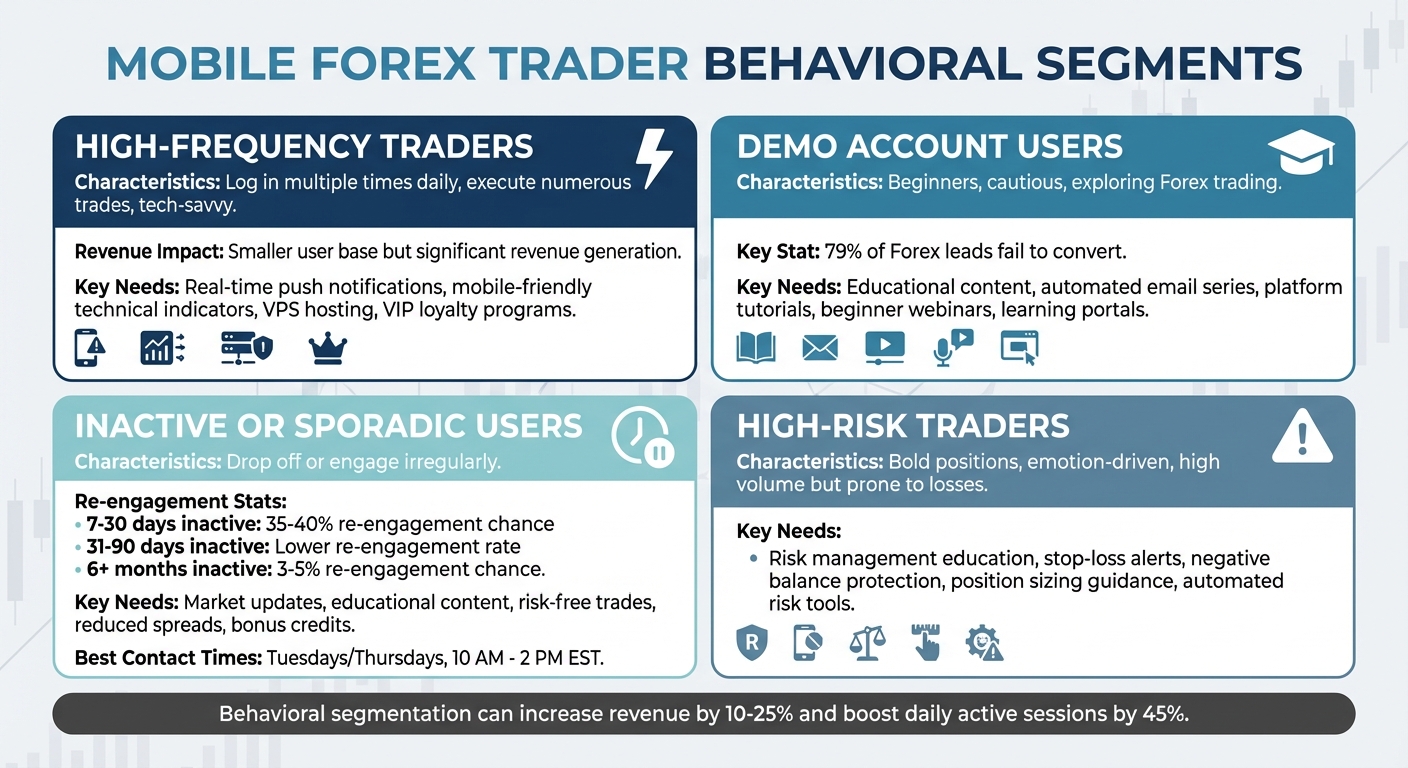
Four Key Behavioral Segments for Mobile Forex Traders
Main Behavioral Segments for Mobile Forex Traders
When it comes to mobile Forex platforms, tailoring your approach to match specific user behaviors is key. By segmenting your audience based on their trading habits, you can create targeted strategies that boost engagement and drive results. Let’s take a closer look at the four most important behavioral segments.
High-Frequency Traders
These are your heavy hitters – users who log in multiple times daily, execute numerous trades, and often rely on algorithmic tools like trading bots or Expert Advisors. They’re tech-savvy, data-driven, and demand precision. While they make up a smaller portion of your user base, their trading activity generates a significant chunk of revenue.
To meet their needs, deliver real-time push notifications about critical price changes and provide mobile-friendly technical indicators. Offering perks like VPS hosting and VIP loyalty programs (think dedicated account managers or exclusive webinars) can further solidify their loyalty. Predictive modeling can also help identify their trading patterns, allowing you to time alerts when they’re most likely to engage.
Demo Account Users
These users are just dipping their toes into Forex trading. Typically cautious and inexperienced, they’re more interested in learning the ropes than diving into complex tools. Since nearly 79% of Forex leads fail to convert, nurturing this group is vital.
Focus on education over sales tactics. Automated email series covering trading basics, platform tutorials, and glossaries can help reduce the intimidation factor. If a demo user stays active but hasn’t converted, consider offering a personalized upgrade bonus or inviting them to a beginner-friendly webinar. A dedicated learning portal with video explainers can also build their confidence, increasing the likelihood they’ll transition to a live account. As Sophia Luu, Principal Account Manager at AdRoll, explains:
"Successful forex traders are educated ones. When a trader feels confident, they are more likely to spend on trading platforms."
Inactive or Sporadic Users
Not every user remains consistent. Some traders drop off entirely, while others engage irregularly. The length of inactivity is a critical factor: users inactive for 7 to 30 days have a 35% to 40% chance of re-engaging, but that number drops to just 3% to 5% after six months.
For recent dropouts, soft nudges like market updates on previously traded currency pairs can reignite interest. For those inactive between 31 and 90 days, try sharing educational content or highlighting new platform features. Beyond 90 days, you’ll need stronger incentives like risk-free trades, reduced spreads, or bonus credits. Use multiple channels – push notifications for quick reminders, SMS for urgent updates, and email for detailed offers. To maximize effectiveness, schedule messages on Tuesdays or Thursdays between 10:00 AM and 2:00 PM EST, when open rates tend to peak.
High-Risk Traders
This group takes bold, aggressive positions, often driven by emotion rather than strategy. While their trading volume can be high, they’re also prone to significant losses, which can lead to burnout or churn.
To support these traders, focus on risk management education. Share personalized content on strategies like stop-loss orders, negative balance protection, and position sizing. Set up alerts for when their account balance dips below a certain threshold or when volatility spikes in their favorite assets. Offering tools like automated stop-loss features or risk-mitigation Expert Advisors shows that your platform cares about their long-term success, not just short-term activity.
How to Implement Behavioral Segmentation on Mobile Platforms
Behavioral segmentation plays a key role in creating targeted, data-driven campaigns. Here’s how you can put it into action on mobile platforms, turning raw behavioral data into campaigns that deliver measurable results.
Collect and Centralize Mobile Data
Start by gathering all your data in one place. Link your trading platform (like MT4 or MT5) with your CRM to track trading habits, preferred currency pairs, and risk tolerance. Add mobile app analytics to capture details such as session frequency, feature usage, and how users interact with educational content. For a comprehensive view of each trader, consider using third-party APIs to fill in any gaps.
Speed is critical. For example, if a trader abandons a deposit or hits a margin threshold, your system should update their segment in real time – not hours later. This is especially important because over 77% of users uninstall or stop using a mobile app within the first three days. Prioritize first-party data collected directly from in-app interactions, as privacy regulations like ATT and GDPR have made demographic targeting less effective. Tools like Google Analytics 4 can track Forex-specific events such as demo versus live signups, first deposits, or views of asset classes like crypto and CFDs.
Create Segments Using AI-Powered Tools
Once your data is centralized, let AI tools do the hard work. Machine learning algorithms can process vast amounts of data – clicks, trades, sessions – to uncover patterns and group traders with similar behaviors. For instance, clustering models might identify groups like traders who respond well to promotions versus high-value traders who prioritize early access to features. Predictive scoring can refine these segments further, ranking traders based on their likelihood to deposit, upgrade accounts, or churn.
Platforms like InTrading‘s AI Data Helper simplify this process by dynamically updating segments in real time. For example, if a trader hits a stop-loss or ignores three push notifications in a row, they’re automatically reassigned to a new segment for follow-up. These churn prediction models have been shown to reduce churn rates by 18% to 25%.
Deploy Personalized Marketing Campaigns
Use your segments to deliver highly personalized marketing campaigns across push notifications, SMS, and email. For instance, InTrading’s platform can identify whether a trader prefers SMS for urgent updates or email for detailed market insights. High-frequency traders might appreciate real-time notifications about price changes, while demo users could benefit from a series of emails covering trading basics and platform tutorials.
Set up automated alerts for key events – like threshold breaches – via each trader’s preferred communication channel. Personalized, behavior-driven messaging can significantly improve engagement. Behaviorally personalized emails, for instance, have been shown to boost transaction rates by six times, while targeted campaigns can increase conversion rates by 3.5 times.
Eunpa Han, CRM Manager at Job Korea, highlights the importance of personalization:
"Braze has allowed me to try different things as a CRM manager… being able to configure personalized messages with Liquid, A/B test… and review performance reports without having to ask the development team has made my job more efficient."
Your platform should enable you to easily test, refine, and launch campaigns without needing constant developer assistance. Up next, we’ll explore how to measure the success of these targeted campaigns.
Measuring the Success of Behavioral Segmentation
Measuring the impact of your segmentation strategy is essential. With clear metrics in place, you can avoid wasting resources and ensure your campaigns deliver on engagement, retention, and revenue goals. By combining personalized campaigns with data-driven insights and A/B testing, you can turn tailored messages into tangible results.
Tracking Key Metrics
Start by tracking engagement metrics like Daily Active Users (DAU) and Monthly Active Users (MAU). The DAU/MAU ratio is a great way to gauge how "sticky" your app is. A ratio near 20% suggests good engagement, while anything over 25% points to strong habit formation. For Forex platforms, focus on industry-specific KPIs such as trading volumes, pip gains, and deposit frequency to evaluate whether your segments are driving profitable user behavior.
Retention is another critical metric. Globally, Day 1 retention averages 26%, Day 7 retention drops to 11%, and Day 30 retention hovers around 7%. If your numbers fall short of these benchmarks, it’s a sign to tweak your messaging or triggers. On the revenue side, keep an eye on conversion rates (e.g., demo to live accounts), Average Revenue Per User (ARPU), and Customer Lifetime Value (LTV). For instance, in 2025, AvaTrade used behavioral segmentation to target demo and registered users with tailored messages, boosting demo-to-live account conversions by 12%.
Don’t stop at clicks – dig deeper into post-interaction actions. For example, in 2025, Tam Finans identified users who had been inactive for a week and sent automated win-back push notifications. This approach grew their Monthly Active Users by an impressive 39.6% in just three months, increasing from 22,160 to 30,940 users. Use funnel analysis to pinpoint where users drop off during key journeys. A targeted intervention helped recover 10% of conversions and cut bounce rates by 41%.
These metrics lay the groundwork for ongoing optimization through A/B testing.
Continuous Improvement with A/B Testing
Metrics are the backbone of effective A/B testing, helping you refine both your segments and messaging. Test different segment definitions – for example, does a "high-frequency trader" make five trades per day or ten? Experiment with message content to see what resonates better: professional market analysis or urgent alerts tailored to specific personas. Timing is also crucial – compare the effectiveness of push notifications sent during the London trading session versus the New York session to determine when your audience is most active.
For lapsed or at-risk users, test whether educational content (like beginner tips) or financial incentives (such as deposit bonuses) is more effective for re-engagement. Companies like InTrading empower their marketing teams to run A/B tests independently, cutting down on developer dependency and speeding up iteration cycles. This agility is vital, especially since 71% of U.S. consumers expect personalized experiences, while 76% express frustration when brands fail to deliver. Regularly reviewing metrics and running tests ensures your segmentation strategy stays in sync with user behavior.
Conclusion
This guide has explored how behavioral segmentation can redefine user engagement. For mobile Forex platforms, it’s a game-changer in today’s competitive landscape, with potential revenue gains ranging from 10% to 15% – and in some cases, even reaching 25%. Research shows that most consumers prefer personalized experiences and often grow frustrated with generic messaging. Fast-growing companies leveraging these insights have seen revenue increases of up to 40%.
Shifting from static, demographic-based targeting to dynamic, real-time behavioral segmentation allows platforms to act immediately. For instance, they can intervene when a high-value trader shows signs of disengagement or guide a demo user ready to convert. Tools like InTrading make this possible by offering real-time integration, AI-driven segment creation, and automated transitions between user groups – no developers required. This approach ensures traders receive tailored content at every stage, whether they’re cautious beginners or seasoned investors seeking advanced insights.
The impact of segmentation is clear in user engagement metrics. Platforms adopting behavioral segmentation report a 45% rise in daily active sessions, a 40% increase in reactivation rates, and a 32% jump in first-transaction conversions. By delivering timely alerts, market updates, and personalized educational content, these platforms foster loyalty and keep users engaged.
Effective, relevant communication isn’t just a tactic – it’s a competitive edge. Platforms that excel in behavioral segmentation don’t just retain traders; they create meaningful experiences that keep users active and loyal over the long term. This approach not only boosts revenue but also builds lasting relationships with traders, reinforcing the strategies outlined in this guide.
FAQs
What events should trigger a trader’s segment change?
When users take actions such as AppInstall, SubscriptionStarted, TrialStarted, or StreakExtended, it signals important milestones in their journey. By updating a trader’s segment based on these key behaviors, platforms can fine-tune their segmentation strategies. This allows for more targeted marketing efforts and personalized engagement, ensuring the right message reaches the right audience at the right time.
Which channels work best for each trader segment on mobile?
Different types of traders connect better with specific communication channels, depending on how they approach trading. For instance, impulsive traders, who make frequent trades and quick decisions, tend to favor real-time updates through push notifications or SMS. On the other hand, cautious traders are more likely to respond to email campaigns or detailed content that gives them time to analyze and plan.
By aligning communication channels with trader behavior – like their trading frequency or app usage patterns – brokers can improve engagement and keep traders active on mobile platforms.
How do I measure ROI from behavioral segmentation?
To gauge ROI from behavioral segmentation, look at how tailored campaigns influence critical metrics such as conversion rates, customer engagement, retention, and revenue. Leverage data analytics to compare the performance of these segmented groups with that of your general audience. Pay attention to trends and tangible results, using these insights to fine-tune your strategies for even better outcomes.