
Multi-channel messaging helps businesses retain more customers by communicating across platforms like email, SMS, push notifications, and apps such as WhatsApp. This approach is especially effective for trading platforms, where 80-90% of new users leave within 90 days. Instead of relying on a single channel, using multiple communication methods ensures users receive timely, relevant updates in the way they prefer.
Key takeaways:
- Retention Impact: Multi-channel campaigns can improve retention by 130%. A single onboarding push notification increases 2-month retention by 71%.
- Better Engagement: Combining channels like email for detailed updates and SMS for urgent alerts keeps users active and informed.
- Personalization Matters: Messages tailored to user behavior can boost engagement and purchases by 27.5%.
- Timing Is Critical: Send-time optimization increases conversions (push notifications by 38%, emails by 34%) by reaching users when they’re most active.
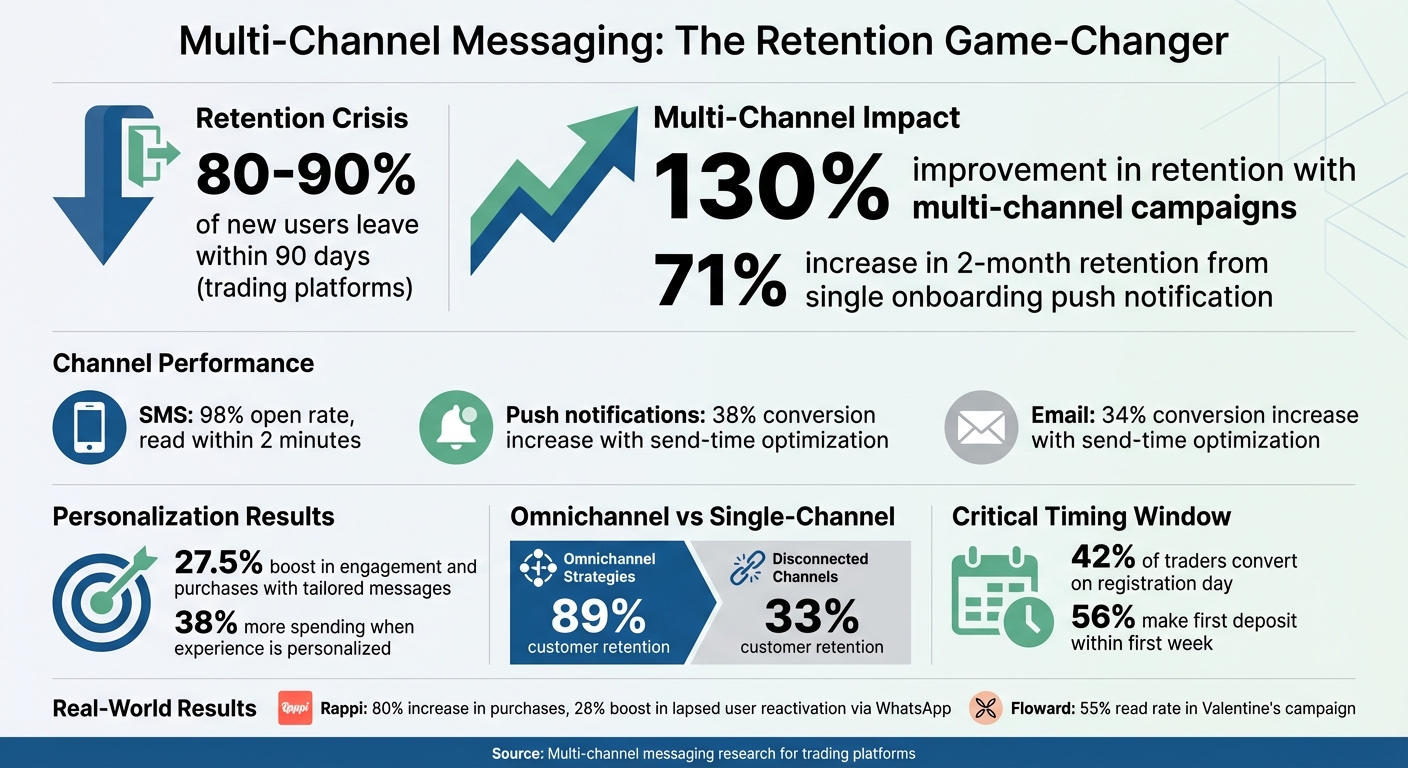
Multi-Channel Messaging Impact on Customer Retention: Key Statistics
Benefits of Multi-Channel Messaging for Customer Retention
Better User Engagement and Loyalty
Multi-channel messaging allows traders to connect with your brand on the platforms they prefer. By coordinating communication across email, SMS, push notifications, and apps like WhatsApp, you create multiple touchpoints that strengthen your brand presence and build trust. And in trading, trust is what drives action.
Research shows that single-channel messaging can triple retention compared to no outreach at all. But using three or more channels takes engagement to the next level. For example, you could send market analysis via email and follow it up with a price alert via SMS. This staggered approach keeps your brand top-of-mind without overwhelming your audience.
Take Rappi, a Latin American super-app, as an example. By adding WhatsApp to their re-engagement strategy, they saw an 80% increase in users making a purchase and a 28% boost in lapsed users reactivating and purchasing within 30 days. Even better, 43% of those reactivated users made two or more purchases in the first month. This highlights how reaching out through preferred channels can effectively bring dormant users back into the fold.
These engagement strategies lay the foundation for delivering timely, critical updates.
Timely Delivery of Important Information
Once you’ve built strong engagement, timing becomes key. In trading, timing isn’t just important – it’s everything. A margin call that’s delayed or a market alert buried in an inbox can mean the difference between a successful trade and a missed opportunity. Multi-channel messaging ensures that essential updates reach traders through the channel they’re most likely to check first.
Consider this: 42% of traders convert on the day they register. That means you have a very short window to act. If your push notification gets ignored, an SMS might still capture their attention. If notifications are turned off but they’re checking email frequently, you’ve got another way to reach them.
To make this even more effective, send-time optimization uses historical engagement data to deliver messages when each trader is most active. This approach has been shown to increase push notification conversions by 38% and email conversions by 34%. For trading platforms, this means sending market alerts during the exact hours when a trader is likely reviewing their portfolio – not just blasting messages at a generic time like 9:00 AM Eastern.
Higher Conversion Rates with Personalized Messages
Personalization doesn’t just enhance engagement – it builds loyalty by addressing individual needs. Messages tailored to a trader’s portfolio or browsing behavior can increase purchases by an average of 27.5%.
According to Twilio Segment’s 2023 State of Personalization Report, 80% of business leaders report that consumers spend 38% more when their experience is personalized. On the flip side, 66% of consumers say they’ll leave a brand if their experience lacks personalization.
A great example of this is Floward, a gift delivery platform operating in the MENA and UK regions. During a Valentine’s Day campaign, they used a multi-channel strategy to reduce churn among new and lapsed users. The results? A 55% read rate and significant gains in reactivation metrics. WhatsApp stood out as the top-performing channel for both revenue and re-engagement, showing how the right combination of channel and personalized content can deliver measurable results.
Building the Foundation: Centralized Customer Data Management
How Centralized Data Supports Retention Efforts
Before diving into a multi-channel strategy, it’s crucial to establish a single, reliable source for customer data. Without centralization, data silos can emerge, leading to inconsistent customer experiences, outdated information, and avoidable errors.
Imagine this: your customer data is scattered – emails in one system, trading history in another, and support inquiries in yet another. The result? A trader who’s been actively trading options for months might still get emails about beginner strategies. It’s not just awkward; it undermines trust.
Centralizing data changes the game. By integrating customer interactions, trading history, and behavioral insights into a single profile, you get a complete, 360-degree view of each customer. In financial services, this level of personalization is key to building trust. Sending a volatility alert tailored to a trader’s portfolio or sharing market analysis that aligns with their risk preferences shows you truly understand their needs.
And the results speak for themselves. Companies using omnichannel strategies retain 89% of their customers, compared to just 33% for those relying on disconnected channels[1]. Centralized data ensures your messaging – whether through SMS, email, or push notifications – works together seamlessly, creating a cohesive experience. This unified approach also sets the stage for tools like InTrading’s CRM to shine.
Using InTrading CRM for Centralized Data Management
InTrading’s CRM acts as the central hub for all customer information. From contact details and trading history to marketing interactions and support inquiries, everything is housed in one system. This eliminates the hassle of jumping between platforms or manually piecing together data from different sources.
With a unified foundation, InTrading’s CRM enables seamless data flow. For trading platforms, this means information moves effortlessly between onboarding, trade execution, and risk management systems – no manual updates required. For example, when a trader opens a position, the CRM instantly updates, allowing the marketing team to trigger personalized workflows in real time.
The system also consolidates multiple identities into a single profile. If a trader browses on their phone during lunch and continues on a desktop later, InTrading recognizes them as the same person, preserving context across devices and sessions.
Keeping data clean is equally important. Contact databases can degrade by up to 22.5% annually as users change jobs or close accounts. Regular updates ensure your messages reach the right people at the right time, maintaining the effectiveness of your communication efforts.
[1] Source: Intrepid Finance, 2024
How to Implement Multi-Channel Messaging: Step-by-Step
Step 1: Segment Users for Targeted Messaging
Start by segmenting your traders based on their lifecycle stage to deliver messaging that resonates. For instance, new traders often need onboarding support through push notifications or email, while high-value traders may prefer receiving market insights via SMS or WhatsApp. Traders at risk of disengaging can benefit from educational content about responsible trading, and those who have churned might respond to reactivation incentives.
Behavioral triggers are key here. For example, if a trader hasn’t made a deposit within an hour of registering, you can send an automated deposit guide. Research shows that 56% of traders make their first deposit within a week of signing up, and 42% of those do so on the same day. This timing gives you a clear window for action.
InTrading’s segmentation tools make this process seamless. Predictive modeling can help you identify potential VIP traders early by analyzing deposit frequency and trading volume, allowing you to focus retention efforts on these high-value users. It also tracks channel preferences, so you know who prefers email for in-depth reports and who is more likely to act on SMS alerts. With these segments in place, you’re set to automate highly targeted interactions.
Step 2: Automate Lifecycle Marketing Campaigns
Automation is your best friend when it comes to staying connected with traders at pivotal moments. Combine real-time triggers with scheduled campaigns – send a push notification immediately after a failed deposit, but also maintain a regular email schedule with market updates to keep traders engaged.
The first week after registration is critical. Brands that send push notifications during onboarding see a 71% increase in two-month retention rates. InTrading’s automation tools handle this effortlessly, delivering welcome messages, deposit reminders, and educational content tailored to each trader’s behavior.
Send-time optimization takes this a step further. Instead of sending messages to everyone at the same time, the system analyzes individual engagement patterns, delivering communications when users are most likely to interact. This approach can boost email conversions by 34% and push notification conversions by 38%. Additionally, validate contact data before adding users to workflows – around 13.7% of phone numbers in some databases don’t support SMS, which can waste resources and hurt your deliverability rates. Once your workflows are running smoothly, it’s time to fine-tune your messaging for each channel.
Step 3: Personalize Messages for Each Channel
Each communication channel serves a unique purpose, so your messages should align with the strengths of each one. SMS, for example, is perfect for urgent updates, boasting a 98% open rate with most messages read within two minutes. Use it for time-sensitive alerts like margin calls, stop-loss triggers, or account balance warnings. Email is better suited for detailed content like quarterly reports or educational materials, while push notifications work well for quick updates or onboarding tips – keeping these under 25 characters can maximize engagement on both iOS and Android.
Consistency across channels is essential, but the format should adapt to the medium. Take a margin call, for instance: you could send a brief SMS (“Your account balance is below $500. Deposit now to avoid restrictions.”), a detailed email outlining next steps, and a concise push notification – all delivering the same message in a way that fits each platform.
InTrading’s CRM makes personalization easy by pulling data from a centralized database. This allows you to add details like trader names, portfolio specifics, and risk preferences to every message, making your communications more relevant and effective.
Step 4: Track Performance with Real-Time Conversion Data
Tracking performance in real time is key to refining your campaigns and improving trader retention. To truly measure effectiveness, don’t just focus on open rates. Instead, calculate the Effective Conversion Rate (ECR) to assess how well a campaign drives actual actions, like deposits, across your entire target group. For example, an SMS campaign might generate more deposits than an email campaign, even if the email had higher open rates.
InTrading’s real-time tracking connects every message to tangible trading activity. If a trader clicks on a push notification about market volatility and opens a position within the hour, the system logs that entire journey. This data feeds back into your segmentation strategy, helping you fine-tune future campaigns based on what motivates action.
Using multivariate testing and tagging can further refine your approach. Experiment with different wording, call-to-action buttons, and send times to see what resonates most. These tweaks can boost conversions by over 40% compared to control groups, ensuring your messaging consistently drives results.
Measuring the Impact of Multi-Channel Messaging on Retention
Key Metrics for Measuring Retention Success
To gauge the success of your multi-channel retention strategy, it’s crucial to monitor the right metrics. Start with churn rate, which reveals the percentage of users who stop trading within a specific timeframe. A rising churn rate signals that your retention efforts need a closer look. Another vital metric is the reactivation rate, which tracks how many inactive users return after targeted campaigns – giving you a clear picture of how effective your win-back strategies are.
Then there’s Customer Lifetime Value (CLV), which estimates the total revenue a trader generates during their relationship with your platform. CLV is especially helpful for justifying retention campaign costs. For example, if a trader’s CLV is $5,000 and your campaign costs $50 per user, the return on investment becomes clear. Effective Conversion Rate (ECR) is another key metric, particularly when comparing different channels. Unlike basic open rates, ECR measures total conversions (like deposits or trades) divided by the total audience targeted, offering a more precise view of channel performance.
Retention models provide additional insights. For instance:
- Classic retention tracks overall engagement over time.
- Range retention focuses on specific intervals, such as 7, 30, or 90 days.
- Rolling retention identifies users who return by a specific day.
- Purchase retention measures the time since a trader’s last transaction.
By combining these metrics, platforms like InTrading can transform raw data into actionable retention strategies.
Using InTrading Tools for Retention Analysis
Once your key metrics are defined, InTrading’s tools simplify the process of turning data into meaningful insights. Their platform integrates data from email, SMS, push notifications, and WhatsApp into a single, unified dashboard. This eliminates data silos and provides a comprehensive view of each trader’s journey. With precise tagging, actions such as click-throughs, deposits, and position openings are tracked back to individual customer IDs. This means you’ll know exactly which message drove a trader to act – not just their preferred channel.
InTrading also offers real-time deliverability monitoring, which flags errors instantly. For example, if a batch of SMS messages fails to reach traders due to invalid phone numbers, you’ll be alerted right away, allowing you to adjust your strategy before wasting additional resources. Their predictive churn modeling takes things a step further by using machine learning to assign each trader a churn risk score (ranging from 0 to 100) based on their engagement patterns. If a high-value trader stops opening push notifications or shows extended inactivity, the system will flag them for immediate re-engagement efforts – helping you act before they leave the platform entirely.
Conclusion
Multi-channel messaging has become a game-changer for trading platforms looking to tackle the challenge of high attrition rates among new traders. By delivering personalized, timely messages across the channels users prefer, platforms can boost retention by an impressive 130% compared to single-channel methods. The secret lies in blending real-time triggers for urgent updates with scheduled campaigns that keep traders engaged, especially during that crucial first week when most conversions happen.
A successful multi-channel approach hinges on centralized data management. Without a unified view of each trader’s interactions – be it through email, SMS, push notifications, or WhatsApp – each message feels disconnected, making it harder to build trust. InTrading’s platform addresses this by syncing all user actions, from clicks to deposits, back to individual customer profiles. This ensures every message is precisely tailored to the recipient.
To engage traders effectively, platforms should focus on a few key steps: segment users based on their behavior, automate lifecycle campaigns, customize messages for each channel, and monitor performance with real-time conversion data. InTrading’s tools take it a step further with predictive insights that flag at-risk traders before they churn and optimize message timing for maximum engagement. These strategies work together to foster stronger, long-term trader relationships.
It’s worth noting that 81% of consumers need to trust a brand before they commit. Consistent, well-coordinated messaging across all channels plays a big role in building that trust. Whether traders receive margin call alerts via SMS or educational resources through email, a seamless experience creates the reliability that turns casual users into loyal customers. The numbers speak for themselves: businesses with omnichannel strategies retain 89% of customers, compared to just 33% for those using disconnected channels.
FAQs
How does multi-channel messaging help retain customers on trading platforms?
Multi-channel messaging helps keep customers coming back by sending timely, relevant messages through the platforms they prefer – whether that’s push notifications, SMS, email, or in-app messages. Research suggests that using multiple communication channels can boost retention rates by as much as 130% compared to relying on just one.
Here’s how this strategy keeps users engaged:
- Redundancy and preference alignment: If a user doesn’t respond to one channel, like push notifications, they can still receive the same message via email or SMS, ensuring the communication isn’t missed.
- Tailored messaging: By using real-time data and segmentation, platforms can deliver messages that feel personal – like market alerts or trade updates – keeping users actively involved.
- Automated lifecycle campaigns: Coordinated campaigns can guide users through their journey. For example, starting with cost-efficient channels like push notifications and shifting to more impactful options like SMS or email when necessary.
With InTrading’s CRM and marketing automation tools, implementing these strategies becomes straightforward. These tools centralize customer data and automate multi-channel messaging, making it easy for trading platforms to deliver consistent, personalized communication that turns occasional users into loyal ones.
How does personalization improve user engagement on trading platforms?
Personalization takes generic communication and turns it into meaningful interactions, boosting user engagement on trading platforms. When messages are customized to align with a trader’s preferences, past activity, and risk tolerance, users feel acknowledged and are more likely to interact. For instance, sending timely alerts about price shifts or account updates can create a sense of urgency and relevance, keeping traders actively involved.
To make personalization effective, tools like real-time conversion tracking and user segmentation come into play. These ensure that the right message reaches the right person, through the right channel, at the perfect moment. Platforms like InTrading streamline this process by consolidating customer data and automating lifecycle marketing. This enables traders to receive tailored updates, such as market insights via email, trade ideas through push notifications, or SMS alerts for major market events. These personalized, channel-specific communications not only boost engagement but also build lasting loyalty.
Why is centralized customer data essential for improving retention?
Centralizing customer data is essential for keeping traders engaged and loyal. It gives you a complete, real-time view of each trader’s habits, preferences, and where they are in their journey. This clarity lets you send tailored, consistent messages across channels like push notifications, SMS, and email – messages that resonate and build trust.
By breaking down data silos, you also avoid fragmented experiences that can frustrate users and lead to churn. When all interactions are stored in one place, it becomes easier to measure how each channel influences retention. These insights help you fine-tune your strategies for better results. Plus, centralized data enables automation tools to kick in at the right moments, whether it’s for onboarding, re-engagement, or upselling, driving retention rates higher.
In essence, having a unified view of customer data is the backbone of seamless, effective communication that keeps traders coming back.