
Reactivating dormant Forex accounts is cheaper and more effective than acquiring new ones. It costs 6–7 times less and delivers 60–70% higher conversion rates. Instead of chasing new traders, focus on re-engaging inactive ones through lifecycle marketing – a personalized strategy based on user behavior and inactivity triggers.
Here’s what you need to know:
- Dormant Accounts: Defined as inactive for 90–180 days, often due to losses, distractions, or switching platforms.
- Cost Efficiency: Reactivation costs $5–$15 per user vs. $50–$300 for acquiring new traders.
- Key Metrics: Track inactivity using login frequency, trading volume, and engagement signals like email opens or abandoned deposits.
- Segmentation: Group users by inactivity duration and trading history to tailor outreach.
- Effective Campaigns: Use emails, SMS, and push notifications with personalized messages, incentives, and real-time tracking to drive results.
- ROI: Even a 5% boost in retention can increase profits by 25%.
Platforms like InTrading simplify this process with tools for automation, segmentation, and analytics. By investing in lifecycle marketing, Forex platforms can tap into their existing user base for higher retention and revenue growth.
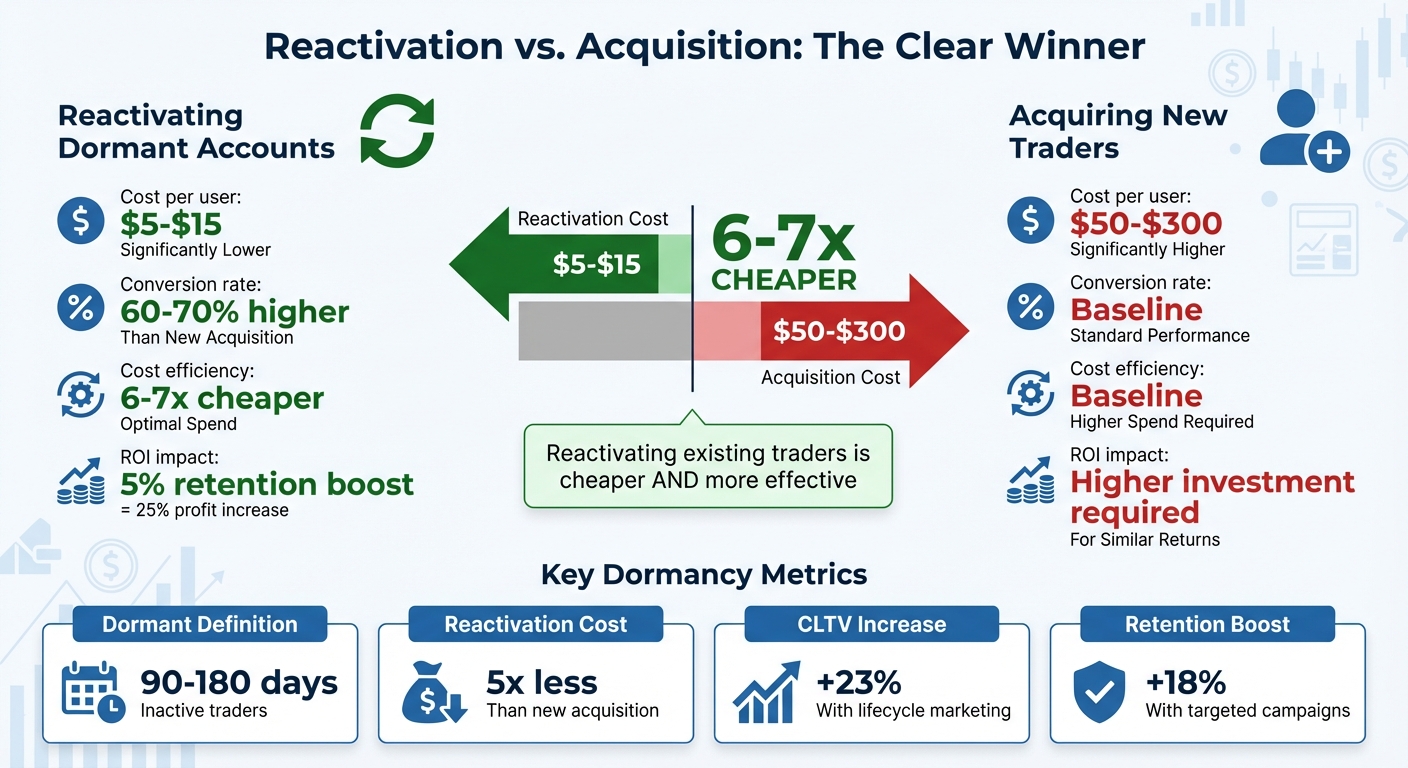
Cost Comparison: Reactivating Dormant Forex Accounts vs Acquiring New Traders
Identifying Dormancy Triggers and Measuring Inactivity
Common Dormancy Triggers
Understanding why traders go inactive is crucial for re-engagement. Market volatility often plays a significant role – traders may step away after incurring losses or when strategies fail to yield results. High trading fees or tight budgets can also discourage activity, especially when costs outweigh potential gains.
Technical hurdles like complicated processes, weak onboarding experiences, or poor customer service can quickly push traders away. Behavioral shifts matter too: a trader might shift focus from Forex to crypto or switch to a competitor offering better spreads or features. High-risk trades leading to rapid losses can also lead to account abandonment.
Early warning signs of dormancy include engagement decay – a noticeable drop in login frequency or shorter session durations. When traders stop checking balances, market reports, or placing trades, they’re already on the verge of leaving. A low Net Promoter Score (NPS) of 6 or below often signals dissatisfaction, while frequent visits to pricing or withdrawal pages suggest a trader may be preparing to exit.
The next step is to track inactivity using precise metrics.
Key Metrics to Track Dormant Accounts
To catch dormancy early, monitor specific metrics. Recency metrics – such as the number of days since the last login, trade, or deposit – can help establish activity baselines. Sudden drops in trading frequency or session lengths are clear red flags.
Financial metrics provide further insights. Declining account balances, reduced trading volumes, or large withdrawals often precede inactivity. Engagement metrics, like email open rates, click-through rates on market reports, or interactions with educational resources, reveal whether a trader is still actively engaged. Behavioral cues, such as abandoning a deposit midway or shorter session durations, are also critical indicators.
By combining these triggers with metric tracking, you can prioritize high-risk accounts. RFM scoring – which considers Recency, Frequency, and Monetary value – helps segment dormant users based on their past activity and potential to return. For instance, a high-value trader inactive for 30 days requires a different approach than a low-volume user inactive for 180 days. Dormancy windows also vary by trader type: a high-frequency scalper might be flagged after 48 hours, while a long-term investor might only be flagged after 30 days.
To tailor reactivation efforts, segment dormant accounts by inactivity duration:
| Inactivity Period | Segment Category | Recommended Action |
|---|---|---|
| 30-60 Days | Warm Leads | Send gentle reminders and highlight platform benefits |
| 60-120 Days | Cool Leads | Share educational content, market updates, and trading tips |
| 120-180 Days | Cold Leads | Use multi-touch reactivation campaigns with specific incentives |
| 180+ Days | Frozen Leads | Offer GDPR re-permission requests and "last-chance" deals |
Using InTrading‘s AI Data Helper for Analysis
Modern tools make tracking dormancy easier than ever. InTrading’s AI Data Helper analyzes behavioral signals in real time to predict inactivity. It monitors login frequency, session durations, and abandoned in-app actions to identify users at risk of disengagement. By leveraging predictive analytics, it anticipates client needs based on past behaviors and market trends, allowing timely interventions.
The system automates inactivity detection, triggering personalized messages based on specific timeframes (e.g., follow-ups after 3 days or reactivation offers after 7 days). Advanced segmentation ensures workflows are tailored to each dormant account, shifting the focus from reacting to inactivity to preventing it altogether.
Lifecycle Marketing Strategies for Re-engaging Dormant Users
Segmenting Dormant Users for Targeted Campaigns
Bringing dormant users back starts with precise targeting. To make your outreach effective, group inactive accounts based on factors like how long they’ve been inactive, their trading history, and engagement patterns. Each user type requires a unique strategy.
With tools like InTrading’s segmentation features, you can create dynamic groups that update automatically as user behavior changes. For example, segmenting by RFM scores – Recency, Frequency, and Monetary value – helps you focus on high-priority users. Imagine a trader who deposited $5,000 and completed 50 trades but hasn’t been active for 45 days. That person likely deserves more attention than someone who signed up but never funded their account.
Another layer of segmentation involves pinpointing the reason for inactivity. Did they stop trading after losses? Abandon the deposit process? Shift from active trading to complete inactivity? Understanding the "why" behind their dormancy allows for tailored messaging. InTrading’s centralized CRM combines trading history, deposit patterns, and engagement data into a single profile, making it easier to identify trends and create targeted groups.
Once you’ve defined your segments, the next step is to craft campaigns that address each trader’s specific situation.
Creating Personalized Outreach Campaigns
Generic messages won’t cut it. Personalization is all about leveraging specific trading data to make your outreach feel relevant. Mention the last currency pair they traded, remind them of their account balance, or introduce features that solve their past challenges.
Personalized campaigns work best when delivered through a mix of email, SMS, and push notifications. For instance, SMS messages have open rates that are at least 78% higher than email. Push notifications with deep links can take users straight to their favorite trading pair or the deposit page. With InTrading’s communication tools, you can manage campaigns across all these channels from one platform.
A successful reactivation sequence blends education, incentives, and urgency. Start with a friendly nudge on day one, follow up with market tips or insights by day four, and then offer a compelling incentive – like a deposit match (e.g., "100% match up to $500") or commission-free trades – by day ten. Research shows reactivating a dormant user costs between $5 and $15, far less than acquiring a new one, which can run from $50 to $300. This makes targeted incentives a smart and cost-effective strategy.
"I was amazed that people ignored my calls and emails but replied to a text. Now we text first, then follow up with a call or email." – Ken Henry, Owner, Henry Insurance Agency
Using Real-time Conversion Tracking
Once your personalized campaigns are live, tracking their success in real time is critical. Real-time conversion tracking lets you see exactly when a dormant user logs in, deposits funds, or starts trading again. This gives you a clear picture of your campaign’s effectiveness.
InTrading’s real-time tracking tools go beyond basic metrics like email opens and clicks. They monitor downstream actions like deposits and trades, helping you identify which campaigns are driving results and which ones aren’t. If a user clicks an email but doesn’t deposit, the system can automatically send a follow-up SMS with a stronger incentive within hours.
To measure true impact, use control groups. By splitting dormant users into test and control groups, you can determine whether your $10 incentive led to a $500 deposit – or if the user was planning to return on their own. This approach ensures your marketing dollars are spent wisely and effectively.
Measuring the Success of Re-engagement Campaigns
Key Metrics for Campaign Performance
To determine if your re-engagement campaigns are hitting the mark, tracking the right metrics is essential. At the forefront is the reactivation rate, which measures the percentage of inactive traders who return to active status within a set timeframe. For instance, if you aim to re-engage 1,000 dormant accounts and 80 traders resume trading within 30 days, your reactivation rate is 8%.
However, reactivation alone doesn’t paint the whole picture. It’s equally important to monitor downstream behavior. Are these traders simply logging in once, or are they actively placing trades? Keep an eye on trading frequency (how often they trade) and session depth (how long they stay engaged during each visit). Financial metrics are just as crucial – calculate the revenue generated by reactivated traders and compare it to your campaign costs to gauge ROI. It’s worth noting that re-engaging an inactive customer costs five times less than acquiring a new one, making even modest reactivation rates highly cost-effective.
Also, track unsubscribe rates and spam complaints to protect your sender reputation. Finally, look at the Customer Lifetime Value (CLTV) uplift, which measures the long-term financial impact of bringing dormant traders back. Studies show that lifecycle marketing strategies can increase CLTV by 23% and retention rates by 18%.
| KPI Category | Specific Metrics | What It Tells You |
|---|---|---|
| Reactivation | Reactivation Rate, Customers Won Back | Success of your win-back efforts |
| Engagement | Email CTR, Open Rate, Session Depth | How well your content connects |
| Financial | Revenue from Reactivated Cohorts, ROI, CLTV Uplift | Campaign’s bottom-line impact |
| Operational | Unsubscribe Rate, Spam Complaints | Effect on sender reputation |
These metrics, when integrated into centralized dashboards, provide a clear and actionable view of your campaign’s performance.
Using Centralized CRM Dashboards
Once you’ve identified the key metrics, a centralized dashboard becomes your go-to tool for tracking and optimizing your campaigns. Platforms like InTrading’s dashboards bring all relevant data into one place, offering a comprehensive view of each dormant trader’s journey – from their last trade to their response to your recent outreach. Trading activity, deposits, preferences, and real-time behavior are consolidated into actionable insights.
Centralized dashboards simplify campaign management across all channels. For instance, you can set up automated triggers to remove traders from reactivation sequences as soon as they show renewed interest, such as logging in after 60 days of inactivity. This prevents redundant messaging, protects your sender reputation, and ensures you don’t frustrate users who’ve already re-engaged.
What’s more, advanced dashboards can identify the "next-best offer" for each segment by analyzing trading patterns and engagement behavior. This goes beyond basic segmentation, dynamically suggesting tailored incentives or content for individual traders. For high-value accounts, you can even coordinate automated campaigns with personalized outreach from your sales team, all tracked within the same dashboard. This unified approach helps you understand which strategies drive the best results.
Conclusion
Dormant Forex accounts hold untapped potential for generating revenue in the trading industry. Reactivating these accounts is far more cost-efficient than acquiring new traders, and the conversion rates are notably higher. The traders in your database have already shown interest, completed registration, and, in many cases, made deposits. Re-engaging them offers a much better return on investment compared to starting from scratch.
The secret lies in treating reactivation as an ongoing process. As discussed earlier, a well-planned, multi-channel outreach strategy is essential. Start by defining clear dormancy criteria (e.g., no logins for 90–180 days), segment your audience based on their past behavior and value, and then execute a multi-channel approach. This can include email, SMS, push notifications, and even personal touchpoints. Even small, targeted campaigns can yield impressive revenue, proving that focused efforts pay off.
"Reactivation should be a continuous lifecycle program, not an annual emergency." – Pedowitz Group
Tools like InTrading’s centralized CRM and AI-driven analytics can take your reactivation efforts to the next level. These platforms can detect dormancy triggers in real time, automate personalized outreach, and monitor the entire journey from inactivity to engagement. With features like real-time conversion tracking, user segmentation, and lifecycle marketing automation, you can move beyond generic campaigns and deliver tailored messages at the perfect moment. The result? Higher reactivation rates, stronger retention, and measurable revenue growth from your existing trader base.
To maximize success, focus on value-based segmentation, keep reactivation sequences concise (three to five touchpoints), and ensure your sales and customer success teams have full visibility into automated activities. By adopting these strategies, Forex platforms can transform dormant accounts into a reliable source of revenue – without increasing advertising costs. This approach not only boosts retention but also sets the stage for sustained growth.
FAQs
Why do Forex trading accounts become inactive?
Forex accounts often go inactive for a variety of reasons. Sometimes, traders simply don’t find enough value in the platform anymore. Other times, they face obstacles that make trading inconvenient or get distracted by external commitments. Common culprits include unfavorable market conditions, personal financial challenges, or platform-related issues like high spreads, confusing navigation, or inadequate post-trade support.
Another factor? Poor communication. When traders receive generic emails or irrelevant promotions, they can feel disconnected from the platform. Without personalized messages, targeted educational resources, or timely incentives, it’s easy for them to lose interest and abandon their accounts. Keeping traders engaged requires a proactive approach that aligns with their needs and trading lifecycle.
How does segmentation enhance reactivation campaigns for dormant Forex accounts?
Segmentation plays a key role in reviving inactive Forex accounts by grouping them based on factors like trading habits, account value, and past engagement. This approach makes it possible to craft highly targeted and personalized offers that align with the unique needs and preferences of each trader.
When you customize communication for specific groups, you can see noticeable improvements in conversion rates, a stronger ROI, and better message delivery. For instance, traders with high-value accounts might be offered exclusive perks, while those less active could be drawn back with educational resources or smaller-scale promotions. This method ensures your campaigns hit the mark without wasting resources.
How can I use automation to reactivate dormant Forex trading accounts?
Reactivating inactive Forex accounts doesn’t have to be a complicated process if you have the right tools in place. A Forex-focused CRM, like InTrading, can be a game-changer. It centralizes all your customer data, lets you track real-time activity, and makes it easy to segment users based on key factors like trading habits or deposit sizes. With these segments in hand, you can automate personalized outreach – whether through push notifications, SMS, or email campaigns – ensuring your communication is both consistent and highly targeted.
To take it a step further, integrating automation platforms with your CRM can significantly boost efficiency. For instance, you can set up behavior-based workflows that automatically spring into action when a trader shows inactivity, such as going 90 days without trading. This kind of automation ensures that your outreach happens at the right time, stays relevant, and scales effortlessly – all while cutting down on manual work. It’s a smart way to re-engage traders and keep things running smoothly.