
In Forex trading, understanding trader behavior is critical for improving retention and managing risk. Modern CRMs analyze trading patterns, P/L trends, and emotional triggers (like the disposition effect) to provide brokers with actionable insights. By integrating data from trading platforms (e.g., MT4/MT5), payment gateways, and communication tools, these systems create a centralized dashboard to monitor activity in real time.
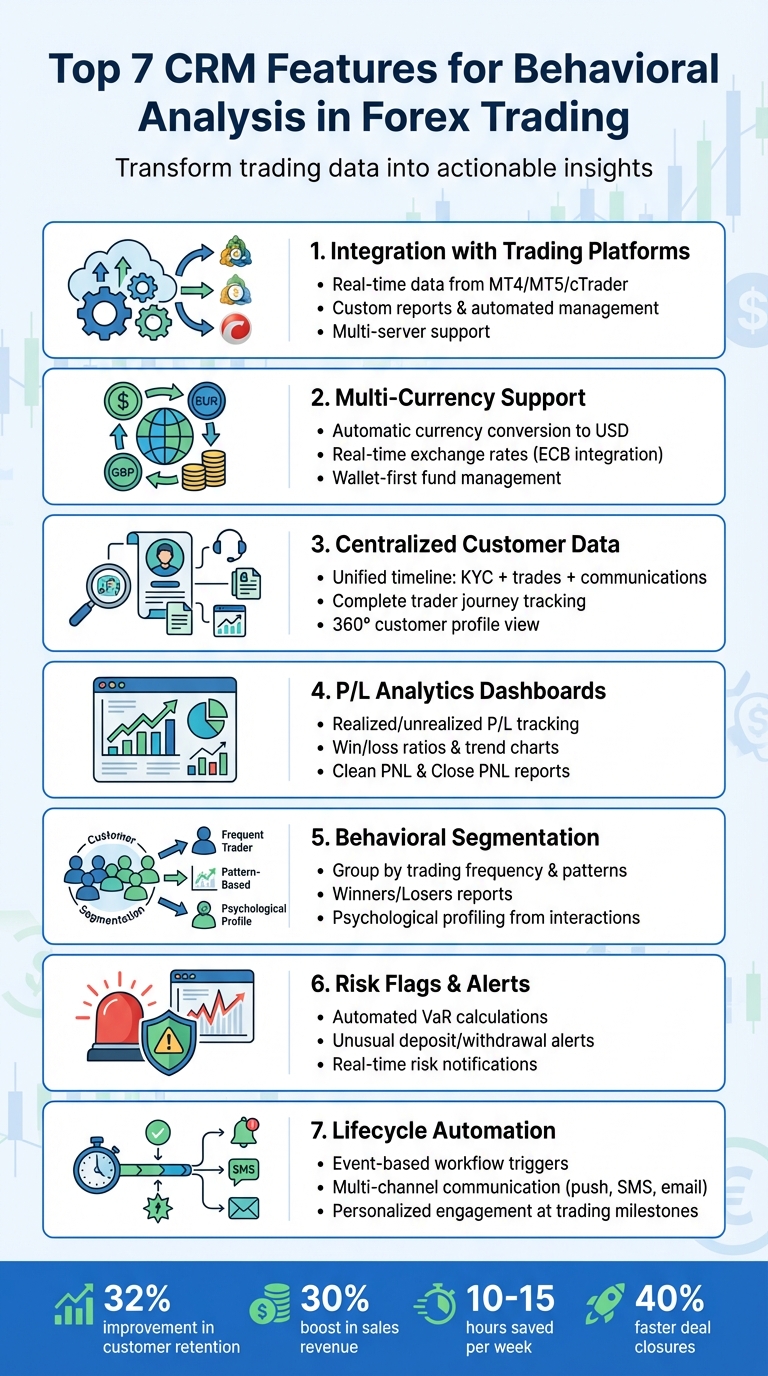
Key features that make a CRM effective for behavioral analysis include:
- Integration with Trading Platforms: Real-time data from trading servers enables custom reports and automated management.
- Multi-Currency Support: Automatic currency conversion normalizes trading data for accurate reporting in USD.
- Centralized Customer Data: A unified timeline of KYC, trade history, and communication logs enhances retention strategies.
- P/L Analytics Dashboards: Visual tools track profitability trends and highlight patterns.
- Behavioral Segmentation: Group traders by activity, frequency, or reactions to losses for targeted communication.
- Risk Flags: Automated alerts for unusual patterns like deposit spikes or failed withdrawals.
- Lifecycle Automation: Event-based triggers deliver personalized messages, improving engagement.
CRMs also ensure compliance with data privacy laws like CCPA and GDPR, using role-based permissions and secure access. By turning raw data into actionable insights, brokers can improve retention by up to 32% and boost sales revenue by 30%. The right CRM transforms trading platforms into trusted financial partners.
7 Essential CRM Features for Forex Trading Behavioral Analysis
Core Requirements for Trading Behavior Analytics
To make the most of advanced analytics, you need a strong CRM foundation. Here’s a breakdown of the essentials that set the stage for deeper insights.
Integration with Trading Platforms
Your CRM should seamlessly connect with trading platforms like MT4, MT5, cTrader, or any proprietary systems your brokerage relies on. This real-time integration captures key data such as orders, balance updates, and profit/loss movements. An API-first approach, using REST and Web APIs, ensures direct data retrieval from trading servers, enabling custom reports and automated transaction management. For brokers operating across multiple environments, multi-server support is crucial. It consolidates data from different live trading servers, streamlining execution and offering a complete view of trading activity. While some providers boast quick integration, actual timelines depend on the level of customization required.
Multi-Currency and USD Handling
U.S.-based brokers often cater to traders with accounts in various currencies – ranging from EUR and GBP to cryptocurrencies. A capable CRM must handle this complexity while ensuring consistent reporting. Automatic currency conversion is essential, normalizing all trading data into a base currency, typically USD, for accurate analysis and risk management. Modern systems often integrate with official exchange rate providers, such as the European Central Bank, to deliver real-time conversion rates. A wallet-first model further simplifies fund management by allowing deposits into a centralized wallet, which can then be allocated to specific trading accounts. This setup enables internal conversions, tracks original currencies, and presents aggregated data in USD on dashboards for clarity.
Centralized Customer Data Model
Effective behavioral analysis hinges on a complete view of a trader’s journey. A centralized data model ties together KYC verifications, trade history, wallet balances, and communication logs into a unified timeline. This holistic view allows brokers to track a trader’s progression – from initial lead capture and first deposit to active trading and periods of inactivity. Centralized data supports features like automated retention tools (e.g., offering a reactivation bonus after several days of inactivity), personalized market insights based on preferred assets, and quick follow-ups on failed deposit attempts. For sales teams, a comprehensive "Customer Profile" consolidates all interactions, making engagements more targeted and support more effective.
Top CRM Features for Trading Behavioral Analysis
Once your basic setup is in place, advanced CRM features can turn raw data into meaningful insights. These tools help you uncover not just what traders are doing but also the reasons behind their decisions. With this understanding, you can create more effective strategies. Building on the core essentials, these features offer targeted methods to analyze trading behavior.
Trade and P/L Analytics Dashboards
Dashboards are a game-changer when it comes to tracking performance. They can show realized and unrealized P/L, win/loss ratios, and cumulative P/L trends over time using detailed line charts. For a clearer picture of profitability, include Clean PNL reports that exclude bonuses and credits, along with Close PNL metrics that factor in commissions and swaps. To keep things standardized, make sure date ranges use the MM/DD/YYYY format, and display all currency values in USD (e.g., $1,234.56).
Behavioral Segmentation by Trading Patterns
Taking integrated data a step further, behavioral segmentation allows you to fine-tune risk management and tailor communication strategies. By grouping traders based on their patterns, you can create targeted retention and marketing plans. For instance, you can categorize clients by trading frequency, preferred instruments (like forex pairs or crypto assets), P&L trends, or even their reactions to losses. "Winners/Losers" reports are particularly helpful – they highlight top performers and flag clients whose trading habits may need attention. For example, a shift from swing trading to high-frequency scalping after a loss could indicate emotionally driven decisions. Some systems even analyze client interactions – such as emails, chat logs, or support tickets – to build psychological profiles, helping you predict future behavior more accurately.
Profit and Loss Trend Detection and Risk Flags
Analytics tools not only measure performance but also spot behavioral warning signs that are critical for managing risks. Automated systems, including Value at Risk (VaR) calculations, can flag unusual activities like sudden deposit spikes or failed withdrawal attempts, prompting immediate action. By setting predefined criteria – such as high-frequency scalping, latency arbitrage, or unusual deposit patterns – these systems can send instant alerts to risk management teams. Real-time notifications can also highlight suspicious trends, like repeated failed deposits or trading in highly volatile small-cap assets. These triggers allow for quick intervention, whether it’s addressing potential bonus misuse or mitigating other risks, making these tools essential for protecting profitability.
Lifecycle Automation Triggered by P/L Behavior
Automated workflows tied to trading milestones make it easier to deliver timely, relevant communications that keep traders engaged throughout their journey. Instead of sending out generic messages, you can craft targeted updates based on actual trading activity. These automated triggers kick in the moment specific trading events occur, ensuring your outreach feels natural and well-timed.
Event-Based Workflow Triggers
The best workflows are activated automatically by specific trading events. For instance, when a trader reaches a new equity high, your CRM can immediately send a congratulatory message along with an invitation to an exclusive webinar or access to advanced trading tools. On the flip side, if a trader experiences several losses, the system can deliver educational content on risk management or stop-loss strategies to help them make more informed decisions.
These triggers can be applied at every stage of the trader’s lifecycle. For example, new clients who face early losses might receive onboarding support to help them gain confidence during this critical phase. If a trader hasn’t been active for a couple of weeks, they might get a "we miss you" email paired with current market insights to reignite their interest. Even something like an incomplete KYC process can prompt an SMS reminder to encourage setup completion. Each of these triggers ensures that the messaging is timely, relevant, and designed to keep traders engaged.
Personalized Communication Channels
Once these event-based triggers are set, personalized communication channels ensure messages are delivered at the right time and place. Modern CRMs can send automated updates through push notifications, SMS, or email, ensuring traders receive information when they’re most likely to interact. For U.S.-based traders, for example, notifications can be scheduled around major market hours, like NYSE or NASDAQ trading sessions.
InTrading‘s lifecycle marketing automation takes this a step further, managing communications across multiple channels from one centralized platform. Workflows can be tailored to individual preferences and time zones, ensuring content arrives at just the right moment. For instance, if a trader shows signs of reduced activity, they might first receive a push notification during peak trading hours. If they don’t respond, a follow-up email with detailed market analysis could be sent. This multi-channel strategy keeps traders informed without bombarding them with irrelevant updates, maintaining a balance between engagement and respect for their time.
Data Governance and Measurement Considerations
If data lacks standard formats and proper privacy controls, even the most advanced analytics can produce misleading results. Establishing clear data standards is the foundation for reliable insights, making data normalization and privacy management essential.
Data Standardization and Normalization
Trading data often comes in various unstructured formats, making normalization crucial. Converting raw data into a consistent format ensures accurate differentiation between metrics like Clean PNL (net profitability excluding bonuses) and Close PNL (which includes commissions, swaps, and other costs). For example, standardizing financial flows – such as calculating Net Deposits by subtracting withdrawals from deposits – helps eliminate frequent manual errors.
Automation plays a key role here. By automating the reconciliation of trading data, businesses can significantly cut down on manual work. In fact, automation can save 10–15 hours per week that would otherwise be spent on calculations. This efficiency boost often translates to as much as 30% higher sales revenue and 23% faster deal closures.
Once data is standardized and error-free, the next priority becomes safeguarding it with robust privacy and consent protocols.
Privacy and Consent Management
Protecting sensitive trading data isn’t just good practice – it’s a legal requirement. Regulations like the CCPA in the U.S. and GDPR internationally mandate strict, permission-based access controls. This means only specific individuals, such as compliance officers, should have access to sensitive financial documents or client reports. Implementing role-based permissions ensures data remains secure while allowing teams to work effectively.
Modern CRMs must go beyond spreadsheets. A unified dashboard that automates compliance across multiple regulations is key. For instance, InTrading’s centralized system enforces role-based access, logs every client interaction, and requires Two-Factor Authentication. These measures not only protect data but also streamline operations. Companies using such platforms report closing deals 40% faster and cutting compliance costs by 40%, thanks to automated evidence collection and real-time compliance tracking.
Conclusion
Turn trader data into actionable steps that protect your business and strengthen client relationships. With the right CRM features, you can create a single source of truth – a centralized hub that combines trading activity, deposits, communication history, and real-time risk signals into one cohesive profile. By eliminating data silos, this setup ensures faster, more informed decision-making with up-to-date information. The result? Streamlined operations and smarter interventions.
Brokers leveraging centralized CRM systems have reported 30% growth in sales revenue and a 32% boost in customer retention. Real-time monitoring helps flag risky behaviors, like scalping or bonus misuse, before they impact liquidity. Predictive analytics identify traders at risk early, allowing for personalized support that enhances both profitability and risk management. Automated workflows – such as alerts for margin calls or deposit reminders – transform critical moments into opportunities to retain clients instead of losing them.
InTrading takes this a step further by integrating real-time conversion tracking, precise user segmentation, and automated lifecycle marketing. Segmenting traders based on their actual trading behavior allows for laser-focused targeting. Meanwhile, automated lifecycle marketing reacts instantly to trading triggers, delivering tailored push notifications, SMS, and email campaigns exactly when they’re needed.
This kind of integration is what drives success for top-performing brokerages.
"A specialized Forex CRM acts as the backbone of the business, centralizing client data, automating repetitive tasks, and ensuring compliance with stringent regulations." – EAERA
The brokerages that succeed are those that move beyond spreadsheets and disconnected tools. By centralizing behavioral analysis within a purpose-built CRM, you unlock operational efficiency that supports growth without piling on administrative burdens. More importantly, you gain the insights needed to evolve from just a trading platform to a trusted financial partner – one that anticipates and meets the needs of its traders.
FAQs
How do CRMs work with trading platforms like MetaTrader 4 and 5?
CRMs work with MetaTrader 4 (MT4) and MetaTrader 5 (MT5) by serving as a link between the broker’s back office and the trading platform. Through APIs, they gather real-time trading data – like price, volume, profit/loss, and timestamps – allowing smooth data sharing. They also pull client account details, such as balance and leverage, into a centralized CRM profile, ensuring the system reflects all trader activity immediately.
This integration allows CRMs to handle tasks automatically, such as sending alerts when traders hit profit goals, creating performance reports, and updating segmentation or scoring models based on live trading behavior. Platforms like InTrading leverage these connections to give brokers a full picture of trader activity, helping them create personalized marketing campaigns, gain deeper customer insights, and boost retention efforts.
How does behavioral segmentation help retain traders?
Behavioral segmentation breaks traders into groups based on their actions, preferences, and how they interact with your platform. By analyzing these patterns, you can craft personalized messages, deliver targeted promotions, and provide timely support that aligns with their specific needs.
This method not only boosts engagement but also fosters loyalty and keeps traders coming back by ensuring every interaction feels relevant and purposeful.
How does lifecycle automation improve communication with traders?
Lifecycle automation allows brokers to send personalized and timely messages to traders by automatically triggering communication based on their actions, trading patterns, and where they are in their customer journey. These messages can be delivered through various channels like push notifications, SMS, or email.
By customizing communication for each trader, brokers can share relevant updates, insights, or offers that keep traders engaged and foster stronger connections. This ensures traders get the right information exactly when they need it, enhancing their experience and increasing retention.