
Forex brokers face a tough challenge: keeping traders loyal in a market where switching platforms is effortless. Loyalty programs help solve this by rewarding traders for their activity, offering perks like cashback, reduced spreads, or exclusive benefits. But here’s the kicker: CRM systems make these programs smarter, faster, and more effective.
Here’s why CRMs are game-changers for loyalty programs:
- Centralized Data: CRMs collect and organize trader activity, making it easy to track trading volume, deposits, and preferences.
- Automation: Tasks like calculating rewards, upgrading tiers, or sending bonuses happen instantly, saving time and reducing errors.
- Personalized Communication: CRMs enable tailored messages via email, SMS, or push notifications, ensuring traders feel valued.
- Real-Time Insights: Track program success with analytics that show retention rates, tier progress, and ROI.
With CRMs, brokers can offer loyalty programs that feel personal, run efficiently, and deliver measurable results. This combination keeps traders engaged while boosting profitability.
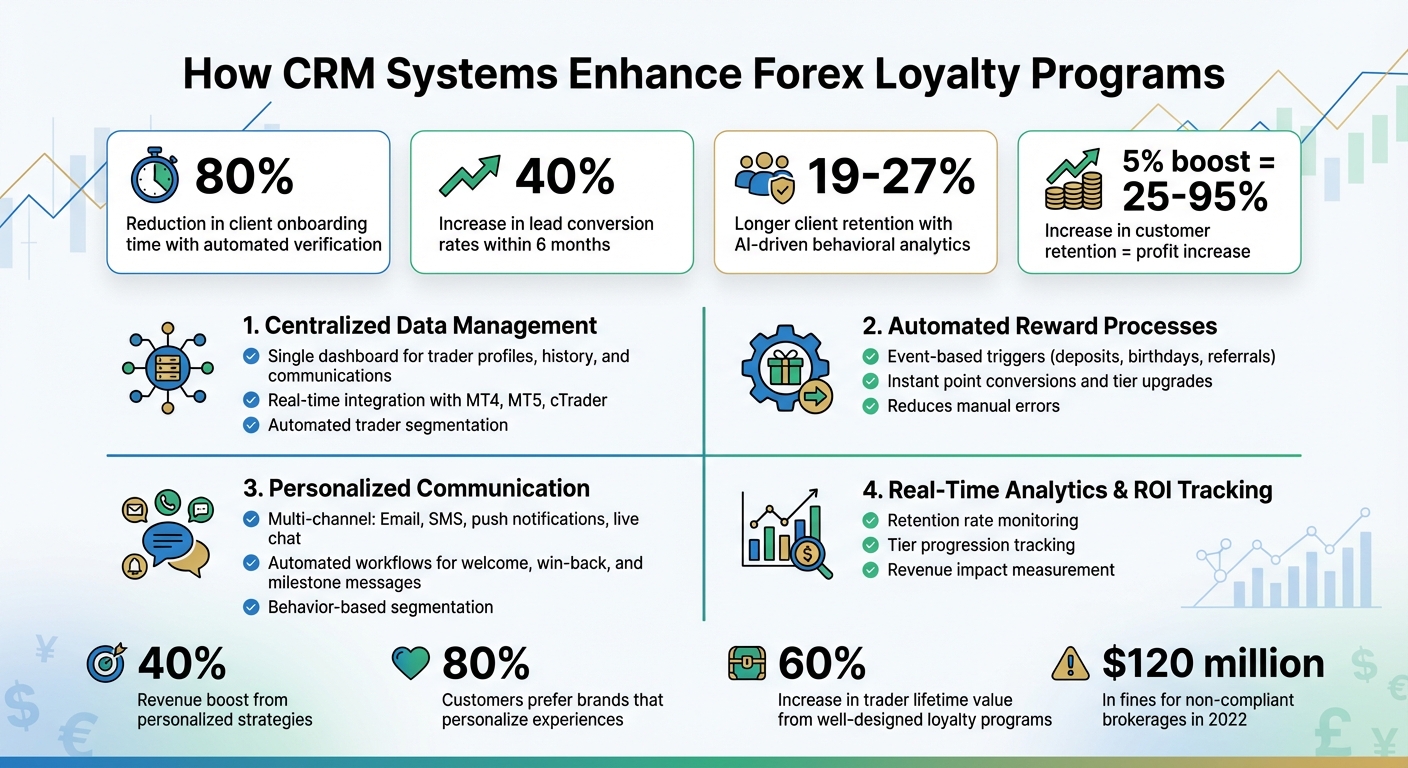
How CRM Systems Enhance Forex Loyalty Programs: Key Benefits and Statistics
How CRM Improves Forex Loyalty Programs
Centralized Data Management for Customer Insights
A CRM serves as a one-stop hub, bringing together trader profiles, trading history, deposit and withdrawal records, and communication logs into a single dashboard. This eliminates the hassle of disconnected data across sales, marketing, and support teams, giving brokers a complete view of each trader’s journey.
This setup makes it easy to segment traders based on their behavior. For example, brokers can group traders by how often they trade, their recent activity, preferred asset classes (like EUR/USD or cryptocurrencies), and even their referral history. The system can pinpoint where each trader stands in their lifecycle – whether they’re a lead, a first-time depositor, an active trader, a dormant user, or a VIP. From there, the CRM can automatically trigger loyalty rewards or re-engagement campaigns tailored to each group.
By integrating with trading platforms like MT4, MT5, and cTrader, as well as payment processors, CRMs can calculate loyalty points and tier upgrades instantly using live transactional data.
| Data Category | Insights for Loyalty Programs |
|---|---|
| Trading Volume | Determines points earned and tier placement (e.g., VIP status). |
| Deposit Patterns | Identifies high-value traders for exclusive offers like cashback. |
| Asset Preferences | Enables customized rewards, such as tailored market insights. |
| Communication Logs | Helps agents provide more personalized service during outreach. |
| Inactivity Duration | Triggers reactivation campaigns and win-back bonuses. |
Pro Tip: Break down your traders into categories like "loyal", "potential", "at-risk", and "lost" before designing your tier benefits. This ensures rewards are well-targeted and cost-efficient. For example, set your CRM to flag traders inactive for 3–7 days and automatically send reactivation bonuses or market updates.
Once your data is centralized, automation takes over, simplifying the entire reward process.
Automated Reward Processes
Manually managing loyalty rewards can be time-consuming and prone to mistakes. With CRM automation, tasks like calculating points, upgrading tiers, and redeeming rewards happen seamlessly, saving time and reducing errors.
Event-based triggers are key. For instance, when a trader makes their first deposit, celebrates a birthday, or refers a friend, the CRM can immediately send the appropriate reward or notification. This type of timely engagement reinforces positive trading behavior when it has the most impact.
"A fully integrated Forex CRM can reduce client onboarding time by up to 80%, thanks to automated verification and document handling." – Constantine Belov, B2Broker
Modern CRMs track trading activity in real time, allowing for instant point conversions and tier upgrades. For example, traders can automatically move from "Associate" to "Expert" status, unlocking perks like lower spreads or priority execution. One brokerage even reported a 40% jump in lead conversion rates within six months of adopting a Forex CRM.
Set up tiered multipliers in your CRM so higher-tier traders earn more points. This taps into the psychology of status, encouraging traders to increase their activity to unlock exclusive perks.
Beyond rewards, CRMs enhance loyalty through tailored communication across multiple channels.
Personalized Communication Across Multiple Channels
Generic messages don’t cut it anymore. CRMs enable brokers to connect with traders through a mix of email, SMS, push notifications, in-app alerts, and live chat. By leveraging CRM data, brokers can segment traders based on factors like account size, trading volume, and activity frequency, ensuring each message feels relevant.
Automated workflows handle the heavy lifting. For example, new sign-ups can receive welcome emails, inactive accounts get win-back messages, and traders are sent birthday bonuses – all without manual effort. If a trader misses a deposit or hasn’t been active for a while, the CRM can trigger follow-up campaigns to re-engage them. The system can also send personalized market updates, trading signals, or educational content tailored to both beginners and experienced traders.
| Communication Trigger | Channel | Purpose for Loyalty Program |
|---|---|---|
| Tier Upgrade | Push Notification / Email | Congratulate traders and explain new benefits. |
| Inactivity (30 Days) | SMS / Win-back Email | Offer limited-time bonuses to encourage re-engagement. |
| Missed Deposit | In-app Alert / Chat | Provide assistance or a deposit-match reward. |
| Birthday/Anniversary | Build rapport with a personalized bonus. | |
| Market Volatility | SMS / Push Notification | Send real-time alerts to spark trading activity. |
Use lead scoring in your CRM to flag "at-risk" traders and prioritize them for personalized outreach. Sync your marketing and support tools so agents can access loyalty data during interactions, turning every conversation into an opportunity to strengthen trader relationships.
Real-Time Analytics and ROI Tracking
CRMs don’t just manage data – they also provide real-time analytics to measure the effectiveness of your loyalty programs.
Detailed reports show metrics like trader retention rates, activity levels, and revenue impact. For example, dashboards can display how many traders are in each tier, how quickly they’re progressing, and which rewards are most popular. Tracking the connection between loyalty participation and trading volume helps brokers calculate the ROI of their programs. This is critical, as even a 5% boost in customer retention can translate into a profit increase of 25% to 95%.
Using CRM Data to Design Better Loyalty Programs
Using Trader Behavior Data
CRM systems give brokers the tools to craft loyalty programs that align closely with trader behavior. By using RFM segmentation – Recency (last trade date), Frequency (trading activity), and Monetary value (total deposits or volume) – brokers can create highly targeted incentives for different trader groups.
For instance, a trader who regularly trades EUR/USD might receive exclusive market reports tailored to that currency pair. Meanwhile, a new depositor could be offered quick-start guides and a welcome bonus to encourage engagement. The CRM tracks these behaviors automatically, triggering relevant rewards. This early engagement is vital for fostering long-term loyalty.
| Trader Segment | CRM Data Points | Tailored Reward/Action |
|---|---|---|
| First-Time Depositor | Initial deposit, KYC status | Quick-start guides, welcome bonuses, personal account manager |
| High-Volume (VIP) | Frequent trades, large lot sizes | Reduced fees, personalized strategy tips, faster withdrawals |
| Dormant/At-Risk | 7+ days of inactivity | Reactivation bonuses, "we miss you" offers, market trend alerts |
| Asset-Specific | Frequent trades in EUR/USD or Crypto | Specialized market reports, asset-specific bonuses |
| High-Risk | Frequent margin calls, high leverage | Risk management tips, educational content, responsible trading rewards |
CRM tools can also evaluate risk tolerance and adjust rewards accordingly. For example, brokers might reward traders who maintain healthy margin levels or diversify their portfolios, promoting responsible trading practices. This approach not only strengthens client retention but also minimizes potential losses. Personalized strategies like these have been shown to boost revenue by as much as 40%, with 80% of customers preferring brands that cater to their individual needs.
In addition to tailoring rewards, this data-driven approach enhances risk management and compliance measures, ensuring a safer trading environment.
Managing Compliance and Risk
While personalized incentives build loyalty, robust compliance features ensure the integrity of the brokerage. Modern CRM systems don’t just track rewards – they also help brokers stay compliant with regulations. Many Forex CRMs now integrate automated KYC and AML checks directly into the client journey. This ensures that only verified traders receive incentives, reducing manual errors and keeping the brokerage prepared for audits by regulators like MiFID II or ASIC.
Real-time behavioral monitoring is another essential tool. CRMs can flag traders engaging in risky behavior, such as excessive leverage use or violations of regional regulatory limits. Instead of rewarding such actions, the system can deliver educational content or risk management tips. Brokers using AI-driven behavioral analytics report 19% to 27% longer client retention compared to those relying on manual processes.
"A Forex CRM is like your brokerage’s control center… showing you everything from fuel levels (client activity) to warning lights (compliance risks)." – Leverate
Another critical feature is the automated audit trail. CRMs maintain detailed digital records of client interactions, transactions, and document submissions, making it easier to handle regulatory inspections. This is especially important considering that non-compliant brokerages faced over $120 million in fines in 2022. By integrating with trading platforms like MT4 or MT5, brokers can monitor margin levels and trade execution in real time. This allows them to adjust loyalty rewards to avoid incentivizing behaviors that could lead to client losses or regulatory violations.
How InTrading Improves Forex Loyalty Programs
Key Features for Loyalty Programs
InTrading’s CRM platform shows how automation can transform Forex loyalty programs with tools designed to build and manage them effectively. One standout feature is its advanced segmentation, which groups traders based on their activity levels. This allows brokers to offer rewards tailored to trading frequency, volume, or even referral activity.
Another powerful tool is lifecycle automation, which delivers personalized rewards at key trading milestones. For example, the system can automatically send custom messages through email, SMS, or push notifications when a trader makes their first deposit, hits a trading volume milestone, or has been inactive for seven days. Brokers can also create tiered reward structures where traders earn points with every trade, advancing through loyalty levels to unlock better benefits. To top it off, real-time conversion tracking helps brokers identify the most effective marketing channels, ensuring their budget is spent wisely.
These features aren’t just theoretical – they bring real, measurable advantages, as seen in the practical applications below.
Practical Uses for Forex Brokers
InTrading takes these features and simplifies loyalty program management, helping brokers increase retention and maximize ROI. The platform automates the entire loyalty workflow, from onboarding new traders to keeping them engaged over time. A centralized dashboard provides easy access to key metrics like Customer Lifetime Value (LTV) and ROI, offering brokers a clear view of how their programs are performing. If the system detects a trader at risk of leaving, it automatically activates a win-back strategy – a much more cost-effective approach than finding new clients.
The platform also integrates seamlessly with MT4 and MT5, offering traders real-time account updates and trade analytics. For brokers, this means better oversight of margins and the ability to adjust rewards to promote responsible trading. Automated KYC verification speeds up the onboarding process, so traders can start earning rewards without unnecessary delays.
Conclusion
CRM systems transform traditional Forex loyalty programs into powerful, data-driven tools that help brokers keep traders engaged and profitable. The numbers speak for themselves: brokers using behavioral analytics report a 19–27% increase in client retention, and thoughtfully designed loyalty programs can boost trader lifetime value by as much as 60%.
The real advantage of CRM lies in its ability to blend automation with personalization. With centralized data management, brokers can segment traders based on their behavior and offer rewards that feel customized. Automated lifecycle triggers handle tasks like welcome bonuses and reactivation campaigns, while AI-driven insights can even predict when a trader might churn – allowing brokers to act before it’s too late.
For Forex brokers, the path forward is clear: invest in a CRM that combines automation and personalized insights to streamline loyalty workflows and build meaningful trader relationships. Platforms like InTrading make this possible by offering real-time analytics, tiered rewards, seamless MT4/MT5 integration, and built-in compliance automation. It’s a smart move to stay ahead in a competitive market.
FAQs
How can CRM automation make Forex loyalty programs more efficient?
CRM automation takes the hassle out of managing Forex loyalty programs by handling essential tasks automatically. It categorizes traders based on factors like their activity, deposit amounts, or trading volumes, assigning them to loyalty tiers and calculating rewards – such as points or bonuses – without requiring manual input. Plus, real-time tracking ensures trades and deposits are recorded instantly, keeping reward balances updated and payouts timely.
With all customer data in one place, the system can deliver personalized notifications – whether through email, SMS, or push alerts – when traders hit milestones. This not only boosts engagement but also eliminates the need for constant manual follow-ups. Automation further simplifies onboarding by verifying documents, setting up profiles, and enrolling accounts in loyalty programs automatically, freeing up valuable time for support teams. The outcome? A loyalty program that’s efficient, scalable, and keeps traders engaged while helping brokers work smarter.
How does personalized communication improve trader loyalty?
Personalized communication allows Forex brokers to form stronger connections with traders by customizing messages based on their actions, preferences, and individual needs. This thoughtful approach fosters greater engagement, builds trust, and improves the overall experience for traders.
By sharing timely and relevant updates – like notifications about account activity, market trends, or special promotions – brokers can provide traders with a more tailored and valuable experience. This strategy not only deepens loyalty but also increases long-term retention and enhances the overall value of each trader relationship.
How does a CRM help Forex brokers manage compliance and reduce risk?
A CRM system is a powerful tool for Forex brokers, streamlining compliance and minimizing risk by consolidating all client interactions, transaction histories, and verification data into a single, easily accessible platform. This includes securely storing KYC (Know Your Customer) documents, AML (Anti-Money Laundering) screening results, and timestamps for identity verification. With automated alerts, the CRM flags accounts that fail to meet required checks or exhibit suspicious activity, enabling brokers to address issues proactively and avoid regulatory violations.
Beyond compliance, a Forex-specific CRM offers advanced capabilities like analyzing trading patterns, tracking trade sizes and frequency, and detecting real-time anomalies. By categorizing traders based on factors such as leverage usage, deposit amounts, and trading behaviors, brokers can evaluate portfolio risks, establish exposure limits, or request additional documentation for accounts deemed high-risk. Automated workflows, including scheduled KYC updates and transaction monitoring, help brokers adhere to U.S. regulations from authorities like the CFTC and FINRA, all while reducing the need for manual intervention.
With InTrading’s CRM platform, brokers gain access to tools like real-time compliance alerts, integrated KYC/AML verification, and detailed audit logs. Features such as automated risk scoring and personalized communication through SMS and email not only ensure compliance and effective risk management but also provide a seamless experience for traders.