
Dormant traders – those who stop trading after being active – are a major challenge for brokers. Reactivating them is far cheaper than acquiring new clients, costing 5–7 times less. Modern CRMs like InTrading simplify this process with tools that track inactivity, segment users, and automate outreach. The result? Reduced churn by up to 25% and increased trader activity by 19–27%.
Here’s what makes a CRM effective for reactivating dormant traders:
- User Segmentation: Group traders by inactivity length, trading habits, or deposit patterns for targeted campaigns.
- Lifecycle Marketing Automation: Automate workflows to re-engage traders at the right moments with emails, SMS, or push notifications.
- Multi-Channel Communication: Use email for insights, SMS for urgent offers, and push notifications for real-time alerts.
- Real-Time Conversion Tracking: Monitor trader responses instantly to refine strategies and avoid over-communication.
- AI Data Helper: Predict disengagement, prioritize high-value traders, and personalize incentives.
- Centralized Data Management: Access unified profiles to create precise, data-driven campaigns.
These features turn reactivation into a structured, cost-effective process that drives results. InTrading offers tailored plans for brokerages of all sizes, ensuring tools like automation, segmentation, and AI work seamlessly to re-engage dormant traders.
1. User Segmentation
User segmentation is all about breaking down dormant traders into specific groups. Brokers can classify these traders based on factors like how long they’ve been inactive, their previous trading habits, and their deposit patterns. For instance, a trader who’s been inactive for just three days might need a completely different outreach strategy compared to someone who hasn’t logged in for six months.
The length of inactivity plays a big role. Traders who’ve been inactive for one to two months – often called "warm" dormant traders – might respond well to a simple market update or a friendly reminder about their account. On the other hand, "cold" dormant traders, who’ve been inactive for six months or more, usually require stronger incentives to re-engage. Tools like InTrading’s segmentation features help brokers automatically sort traders into these categories by tracking key metrics like the last time they logged in or made a trade. This level of detail allows brokers to send messages tailored to the specific reasons behind each trader’s inactivity.
Segmentation also helps brokers decide the best way to reach out. For example, Ken Henry, owner of Henry Insurance Agency, found that younger clients were much more likely to respond to SMS than to emails or phone calls. By segmenting his database and focusing on SMS for re-engagement, he successfully reactivated dormant accounts. Matching the communication method to the trader’s behavior – like prioritizing SMS for one group and email for another – can mean the difference between being ignored and sparking interest.
The numbers back this up. In most databases, 20% to 50% of contacts are usually inactive. However, an inactive contact is up to 10 times more likely to re-engage than a brand-new lead. Segmentation allows brokers to focus on the dormant traders who matter most. For example, a high-volume trader who suddenly stops trading should get immediate personal attention, while a low-volume trader might be placed into an automated email sequence.
InTrading’s tools take this further by analyzing behavioral patterns like preferred asset classes, risk tolerance, and even past webinar attendance. This allows brokers to create highly specific reactivation campaigns. A trader who previously focused on EUR/USD pairs might receive forex market analysis, while someone who traded crypto would get updates on Bitcoin’s latest movements instead of generic "we miss you" emails.
2. Lifecycle Marketing Automation
Lifecycle marketing automation takes segmentation to the next level by ensuring timely and tailored reactivation efforts. Instead of manually tracking when traders become inactive, this system detects inactivity patterns and automatically initiates targeted workflows. For instance, an email might go out after 5 days of inactivity, followed by an SMS offering a bonus at 10 days, and finally, a push notification with a limited-time offer at 15 days. This structured approach ensures traders are re-engaged at just the right moments – without overwhelming them with too many messages.
What makes this approach particularly effective is its adaptability. Campaigns can shift in real time based on a trader’s actions. For example, if someone clicks on an email but doesn’t make a deposit, the system can automatically move them into a campaign with stronger incentives. This dynamic strategy seamlessly connects segmentation with execution. InTrading’s lifecycle automation uses live data to spot early signs of disengagement – like fewer logins, reduced trading activity, or gaps in deposits – allowing brokers to act while traders are still somewhat engaged, rather than waiting until they’ve completely checked out.
The impact of automation is clear. Automated engagement funnels can boost First-Time Deposit conversion rates by up to 40%, while inactivity-based campaigns can cut trader churn by 25%. Since retaining a current trader is 5–7 times less expensive than acquiring a new one, these improvements can have a direct and measurable impact on profitability. Additionally, personalized content and reward systems delivered through automated workflows can increase a trader’s Lifetime Value by as much as 60%.
"Our CRM doesn’t just convert leads; it builds lasting relationships by understanding and catering to each trader’s unique journey." – Shmulik Kordova, CCO, Leverate
Coordination across channels is crucial. For example, if a trader responds to an email, the system should automatically pause any follow-up SMS or push notifications to avoid overwhelming them. For traders who make deposits but don’t trade, automation can send guided trade tips tailored to their favorite assets or connect them with an account manager for personalized support. InTrading’s AI Data Helper further simplifies this process by allowing brokers to generate segments for automated campaigns with just a quick query. This level of coordination and automation strengthens the CRM’s ability to re-engage dormant traders effectively and efficiently.
3. Multi-Channel Communication Tools
Reactivating dormant traders takes more than firing off a single email – it’s about reaching them through the right channels at the right time. By combining email, SMS, and push notifications, you can build a well-rounded strategy that connects with traders where they’re most likely to respond. Each channel plays a unique role:
- Emails: Ideal for delivering detailed market updates or insights.
- SMS: With an impressive open rate of nearly 99%, it’s perfect for urgent, time-sensitive messages.
- Push Notifications: These shine in providing real-time market alerts triggered by specific trading behaviors.
When these tools work together, they create a seamless communication flow that feels natural, not overwhelming. For instance, if a trader clicks on a reactivation email, InTrading’s system can automatically pause or adjust follow-up SMS or push notifications. This ensures traders aren’t bombarded with messages, keeping engagement organic and avoiding fatigue. A typical sequence might look like this: a “We miss you” email after 5 days, followed by an SMS offering a bonus at 10 days, and finally, a push notification with an incentive at 15 days.
Personalization is the key to making these efforts effective. InTrading leverages trading data to customize outreach. For example, messages can highlight a trader’s favorite assets – like EUR/USD – or offer bonuses tailored to their deposit history. This kind of targeted communication feels relevant and increases the likelihood of reactivation.
The financial payoff can be substantial. Reactivating an inactive trader is up to 10 times more effective than acquiring a brand-new client. Strong win-back campaigns often achieve reactivation rates between 7% and 15%, while averages typically fall around 3% to 7%.
To make the most of these efforts, it’s crucial to track and measure performance. Use unique deep-links and promo codes to attribute trader responses to specific channels. By analyzing this data, you can refine future campaigns and focus on what works best. Coordinating these channels and adjusting them based on trader behavior ensures your reactivation strategy is as efficient as possible.
4. Real-Time Conversion Tracking
Reactivating dormant traders without tracking is like navigating in the dark – you won’t know what’s working until it’s too late. That’s where real-time conversion tracking steps in, offering brokers immediate insights into how inactive traders respond to outreach. Instead of waiting days or weeks to evaluate results, you can track actions like email opens, link clicks, logins, or deposits as they happen. This instant feedback allows you to tweak your strategy on the fly, abandoning what doesn’t work and doubling down on what does. It perfectly complements automated workflows by turning data into actionable insights.
When paired with segmentation and automation, real-time tracking sharpens your strategy by confirming what delivers results. Reactivating an inactive trader is 5–10 times cheaper than acquiring a new one, and conversion rates can be up to 10 times higher. Real-time tracking validates these numbers, demonstrating the impact of targeted reactivation. For example, InTrading uses real-time tracking to monitor behaviors like viewing specific asset pages or logging in after weeks of inactivity. These actions can trigger follow-ups automatically, such as notifying an account manager within 24 hours or sending a tailored bonus offer.
It’s also invaluable for channel attribution. You’ll know exactly which touchpoint – be it an SMS, email, or push notification – led to a deposit. This helps you focus your budget on the most effective channels. Key metrics like reactivation rates (typically 7–15% for strong campaigns), email open rates (around 25–35%), and cost-per-reactivation (5–10 times lower than standard acquisition costs) can all be monitored in real time.
But tracking isn’t just about conversions; it also prevents over-communication. For instance, when a trader engages with a reactivation message, InTrading automatically pauses further messages to avoid overwhelming them. To maximize success, start tracking within a 30–90 day inactivity window – waiting longer reduces effectiveness. Use live dashboards to keep an eye on campaign performance and set up automated alerts for critical actions, like when a trader hasn’t logged in for three days. This proactive approach shifts your focus from reactivation to retention, helping you catch traders before they fully disengage.
5. AI Data Helper
Predicting when a dormant trader might re-engage involves recognizing patterns in their behavior. AI steps in by analyzing historical trading data to pinpoint changes that suggest the right time to reconnect. For example, using RFM scoring (Recency, Frequency, Monetary), AI can spot deviations from a trader’s usual habits. Imagine a high-frequency trader who typically logs in daily but suddenly goes inactive for a week – AI flags this as a potential "at-risk" moment and initiates a tailored reactivation plan.
Beyond identifying behavioral shifts, machine learning takes it a step further by grouping traders into specific profiles. Traders are categorized into segments like "disappointed", "weary", or "lapsed" based on their actions, interests, and demographics. This allows for personalized outreach: someone who left after a losing streak might receive educational resources on managing risk, while a trader who simply lost interest could get updates on their favorite assets. With predictive analytics, customer retention can improve by up to 20%, while AI-driven inactivity campaigns can cut churn by 25%.
InTrading‘s AI Data Helper automates this entire process. It tracks engagement metrics – like login frequency and email open rates – to spot early signs of disengagement. For instance, if a trader hasn’t logged in for three days, the system might send a quick check-in message. If they remain inactive for seven days, it could follow up with a reactivation bonus or a strategy guide tailored to their trading preferences, such as EUR/USD market insights. This automated system ensures timely, relevant communication without requiring manual effort.
AI also optimizes efforts by scoring dormant leads based on their likelihood to re-engage. Instead of wasting resources on every inactive trader, the system prioritizes those with the highest potential value, such as those with strong lifetime value (LTV) or higher deposit probabilities. This targeted approach can boost conversion rates by 10–20%, allowing your team to focus on high-impact opportunities.
To keep outreach relevant, AI integrates external data like market trends or job changes, ensuring messages feel timely and personalized. It dynamically adjusts inactivity thresholds based on trading styles – whether for high-frequency traders or long-term investors. AI can also trigger surveys for traders who don’t return, gathering feedback on why they left, such as dissatisfaction with service or better offers elsewhere. Even if they don’t come back, this insight is crucial for improving your platform. Additionally, AI helps determine when to stop contacting a lead, safeguarding email deliverability for engaged users. This precise, data-driven approach works seamlessly alongside the CRM features detailed in the next section.
6. Centralized Customer Data Management
Bringing dormant traders back into action becomes much simpler when you have a unified view of their profiles. Centralized customer data management serves as the backbone, connecting every aspect of a trader’s journey – from capturing their initial interest to tracking their trading activity, support interactions, and compliance status. This single source of truth gives brokers a 360-degree view of each trader, eliminating the hassle of piecing together fragmented data. With everything in one place, it becomes easier to identify trends and create outreach efforts that truly hit the mark. Plus, this unified system integrates seamlessly with trading platforms to trigger timely and relevant reactivation actions.
The real magic lies in the integration with trading platforms like MT4, MT5, and cTrader. These platforms sync crucial data – trades, account metrics, wallet history – in real-time, ensuring you’re never working with outdated information. For example, if a trader who usually deals in EUR/USD suddenly stops trading for a week, the system flags this inactivity and sends a personalized message. It could be a market update on their favorite currency pair or a strategy guide tailored to their trading style. This level of detail turns generic "we miss you" emails into thoughtful, targeted messages that actually resonate. By leveraging these integrations, brokers can build on the data insights discussed earlier, maintaining consistency throughout their reactivation strategies.
Lifecycle mapping takes things a step further by categorizing traders into specific stages such as "lead", "first-time depositor", "active", or "dormant." This categorization, combined with centralized data, allows for precise targeting. For instance, you can offer a reactivation bonus to high-volume traders who’ve been inactive for 30 days, while sending educational resources to newer traders who’ve been idle for just a week. The system tracks behavioral data like communication history, asset preferences, and deposit patterns, feeding this information into automated workflows. These workflows adjust dynamically to match each trader’s unique profile, ensuring your outreach feels personal and relevant.
With InTrading‘s centralized CRM, brokers can consolidate trader data into unified profiles, making it easier to track reactivation campaigns and measure their success. This tool not only saves time by reducing the need for manual data retrieval but also helps you measure reactivation conversion rates against the cost of acquiring new traders – which is 5–7 times higher. When every interaction is logged and accessible, your team can focus on executing strategies that bring dormant traders back to your platform. By combining advanced segmentation with automated outreach, centralized data management becomes a powerful tool for running precise and effective reactivation campaigns, tying together every piece of your reactivation strategy.
Feature Comparison by Plan
InTrading CRM Plan Comparison for Dormant Trader Reactivation
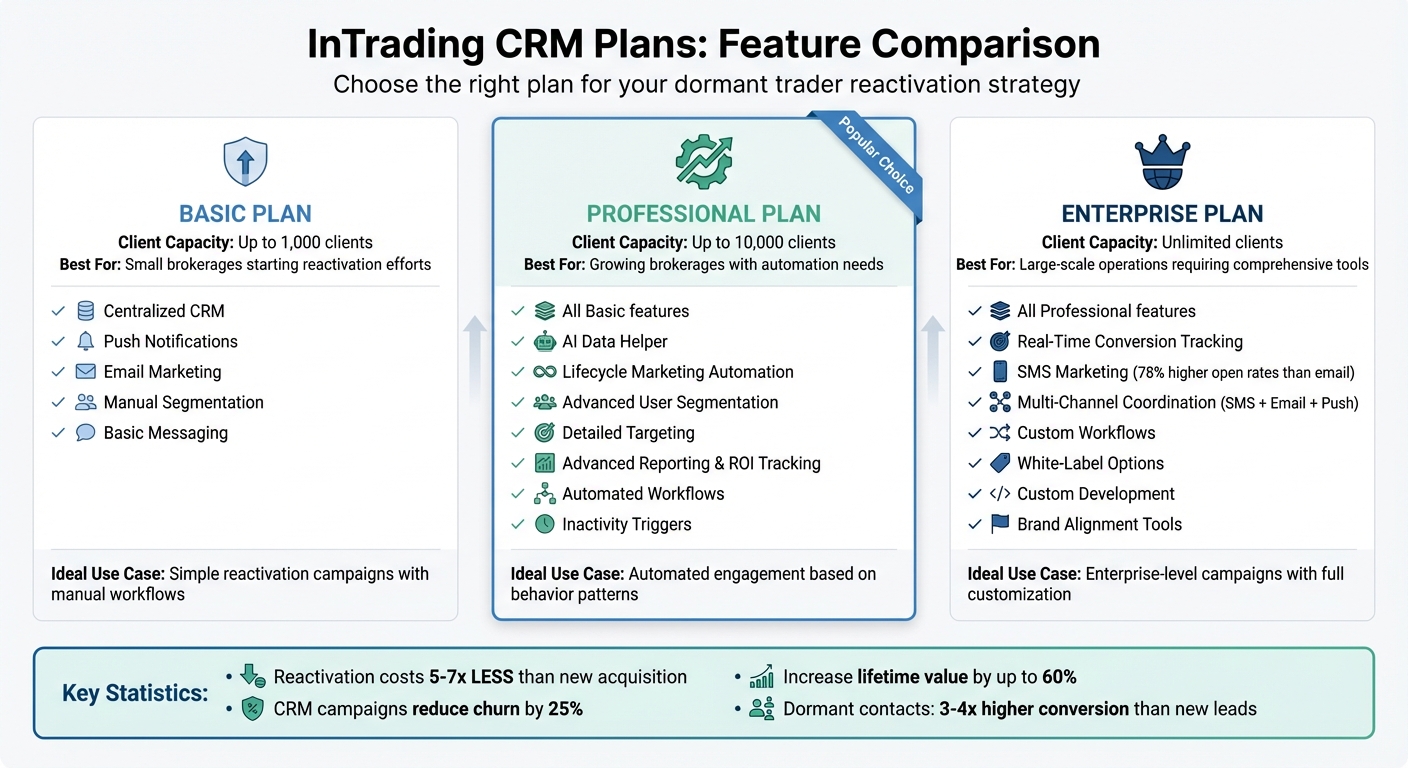
Choosing the right plan is key to shaping a reactivation strategy that fits your brokerage’s needs. InTrading offers three tiers – Basic, Professional, and Enterprise – each designed to cater to varying brokerage sizes and campaign complexities. Each plan builds on the previous one, offering more tools to tackle increasingly intricate reactivation challenges.
The Basic plan is perfect for smaller brokerages managing up to 1,000 clients. It covers the essentials like a centralized CRM, push notifications, and email marketing. This plan is best suited for brokerages starting out with reactivation efforts, using manual segmentation and simple messaging to re-engage inactive traders.
The Professional plan steps things up by supporting up to 10,000 clients and introducing automation tools. With features like the AI Data Helper for smarter segmentation, lifecycle marketing automation, and more detailed user targeting, this plan allows brokers to automate workflows that engage clients based on inactivity triggers. It also includes advanced reporting tools to monitor campaign performance and ROI.
For larger-scale operations, the Enterprise plan removes client limits and adds powerful features like real-time conversion tracking and SMS marketing. SMS, with open rates at least 78% higher than email, becomes a game-changer for engagement. This plan also supports custom workflows and multi-channel coordination, combining SMS, email, and push notifications for a comprehensive approach. Additionally, the Enterprise plan offers white-label options and custom development to align campaigns with your brand and meet specific trader behaviors.
Conclusion
Bringing dormant traders back into action requires a well-thought-out strategy powered by advanced CRM tools like user segmentation, lifecycle automation, multi-channel outreach, and real-time tracking.
Here’s why it’s worth the effort: retaining an existing trader costs 5–7 times less than acquiring a new one. Plus, targeted CRM campaigns can cut churn by 25% and increase lifetime value by as much as 60%. Even better, reactivating dormant contacts delivers conversion rates that are 3 to 4 times higher than those of new lead acquisition. The return on investment speaks for itself.
InTrading offers a platform tailored specifically for trading brokerages to tackle these challenges. With its AI Data Helper, you can query your database in plain English – asking questions like, “Which traders haven’t deposited in the last 10 days?” – and get immediate insights you can act on. The platform is quick to deploy, often within days, allowing you to address inactivity trends without delay. It also simplifies regulatory compliance and uses behavioral intelligence to launch targeted reactivation campaigns. Whether you’re running a small brokerage with the Basic plan or managing thousands of clients on the Enterprise tier, InTrading centralizes your data, turning scattered information into actionable strategies for reactivating dormant accounts.
Dormant traders aren’t just inactive – they’re opportunities waiting to be tapped. With the right CRM tools, you can re-engage these clients at a fraction of the cost of acquiring new ones. InTrading equips you with the resources to meet the unique needs of Forex and stock trading platforms, making reactivation campaigns both impactful and cost-effective.
FAQs
How can user segmentation help re-engage dormant traders?
User segmentation is an effective strategy to reconnect with inactive traders by organizing them into groups based on factors like their last activity, trading volume, preferred instruments, or risk tolerance. This approach helps brokers pinpoint high-value accounts and uncover the reasons behind a trader’s inactivity.
By crafting outreach efforts tailored to each segment’s preferences – such as providing exclusive perks for frequent Forex traders or customized incentives for long-term equity investors – brokers can improve response rates while keeping reactivation costs in check. Targeted campaigns are much more economical than acquiring new clients and can reveal trends that help brokers design more appealing offers.
InTrading’s CRM takes this to the next level with real-time segmentation, automatically grouping traders based on their activity, deposit patterns, and overall behavior. Brokers can then set up automated, personalized messages – delivered via push notifications, SMS, or email – that are triggered by inactivity markers (like 30 days without a trade). This laser-focused strategy not only encourages traders to return but also transforms dormant accounts into revenue-generating opportunities.
How does AI help re-engage dormant traders?
AI takes trader data and turns it into clear, actionable insights, enabling brokers to predict which inactive traders are most likely to return. By examining factors like trading frequency, deposit patterns, and login behavior, it generates a re-engagement score to pinpoint the best accounts to target.
Using this information, brokers can focus on high-potential accounts, send tailored messages through push notifications, SMS, or email, and strategically time their outreach for the best results. Tools like InTrading’s CRM use AI to constantly adjust to new data, making reactivation campaigns more accurate and cost-efficient by addressing the who, when, and what of trader engagement.
Why is it important to use multiple communication channels for reactivating dormant traders?
Reaching out through multiple communication channels is key to reactivating dormant traders. Why? It ensures your message gets to them on the platform they’re most likely to engage with – whether that’s email, SMS, push notifications, or even retargeting ads. By tailoring and timing your messages for each platform, brokers can greatly improve the odds of reconnecting with traders and prompting them to take action.
Using a CRM with multi-channel features simplifies this process. These tools can automatically segment your audience and schedule messages at the right time on the trader’s preferred channel. This not only boosts engagement but also helps maintain compliance with U.S. communication laws. Plus, with features like real-time tracking and integrated messaging, brokers can fine-tune their strategies to improve reactivation rates and increase the overall lifetime value of their traders.