
Real-time data transforms CRMs by enabling immediate responses to user actions, especially in fast-paced industries like trading. Unlike delayed batch processing, real-time systems process events instantly, updating user segments and triggering timely, personalized campaigns. This approach improves engagement, retention, and conversions by aligning marketing actions with live user behavior.
Here’s what real-time data does for CRMs:
- Instant Updates: Tracks deposits, trades, and logins as they happen to refine user profiles in seconds.
- Dynamic Segmentation: Creates segments that adjust based on live behavior, like inactivity or high-value actions.
- Unified Profiles: Combines data streams (behavioral, transactional, support) for a clear, up-to-date view of each user.
- Real-Time Dashboards: Provides live insights into user trends, enabling quick adjustments to campaigns.
- Automated Workflows: Links real-time segments to actions like sending offers or suppressing ads, ensuring relevance.
This shift from static to real-time segmentation helps businesses meet user expectations for timely, personalized experiences, driving better results across acquisition, retention, and revenue metrics.
Setting Up Real-Time User Segmentation
To enable real-time user segmentation, you need a streaming infrastructure that connects all your key data sources. Unlike traditional batch processing systems, real-time segmentation captures user actions the moment they occur. Whether it’s a deposit attempt, a support ticket submission, or a click on a specific asset page, this approach ensures user profiles are updated instantly. This setup lays the groundwork for creating specific segments and unified customer profiles.
Data Sources for Real-Time Segmentation
To power real-time segmentation, your system should pull from five essential data categories:
- Behavioral data: Tracks live activities like page navigation, asset views, login frequency, and interactions on mobile devices.
- Transactional data: Captures financial actions such as deposit attempts, trade executions, withdrawals, and usage limit alerts.
- Support signals: Includes chat transcripts, ticket statuses, and call center logs to help identify users who may be at risk.
- Identity data: Links anonymous browsing activity with known identifiers like CRM IDs, email addresses, and device IDs, creating a complete cross-device view.
- Marketing interaction data: Measures engagement across channels by tracking email opens, ad impressions, and webinar attendance.
Platforms like InTrading streamline these data streams using APIs and SDKs, ensuring that every interaction – from web analytics to third-party integrations – feeds into a unified system.
Static vs. Dynamic Segments
Once your data streams are connected, you’ll define segments based on how often they need to update. These segments fall into two categories: static and dynamic.
- Static segments: These are based on fixed attributes like account type, location, or lifetime revenue. They update periodically and are ideal for long-term programs such as regional promotions or loyalty tiers.
- Dynamic segments: These adjust in real time, using live behavioral data. For instance, if a trader views a pricing page twice in one session or abandons a deposit form, their segment membership can change instantly.
Static segments answer the question, “Who is this trader?” Dynamic segments, on the other hand, focus on “What is this trader doing right now?” For example, a "Gold Tier" trader (static) who views a specific asset three times in one session (dynamic) could trigger a targeted offer before leaving the platform. This approach matters – 88% of consumers are more likely to make a purchase when brands personalize interactions in real time, making dynamic segmentation crucial in fast-paced trading environments.
Creating Unified Customer Profiles
With data streams aligned, building accurate user profiles becomes the next priority. Identity resolution combines data points using identifiers like email addresses and device IDs. Merge policies ensure consistency by prioritizing the most relevant data – such as the latest transaction details over outdated demographic information.
Centralized data management consolidates every user interaction into a single, accurate profile. This eliminates duplicate records and ensures that marketing teams, sales reps, and support agents have access to the same up-to-date information. Businesses that regularly update customer profiles report a 20% higher conversion rate compared to those relying on outdated data, highlighting the direct link between profile accuracy and revenue growth.
Improving Segmentation with Real-Time Dashboards
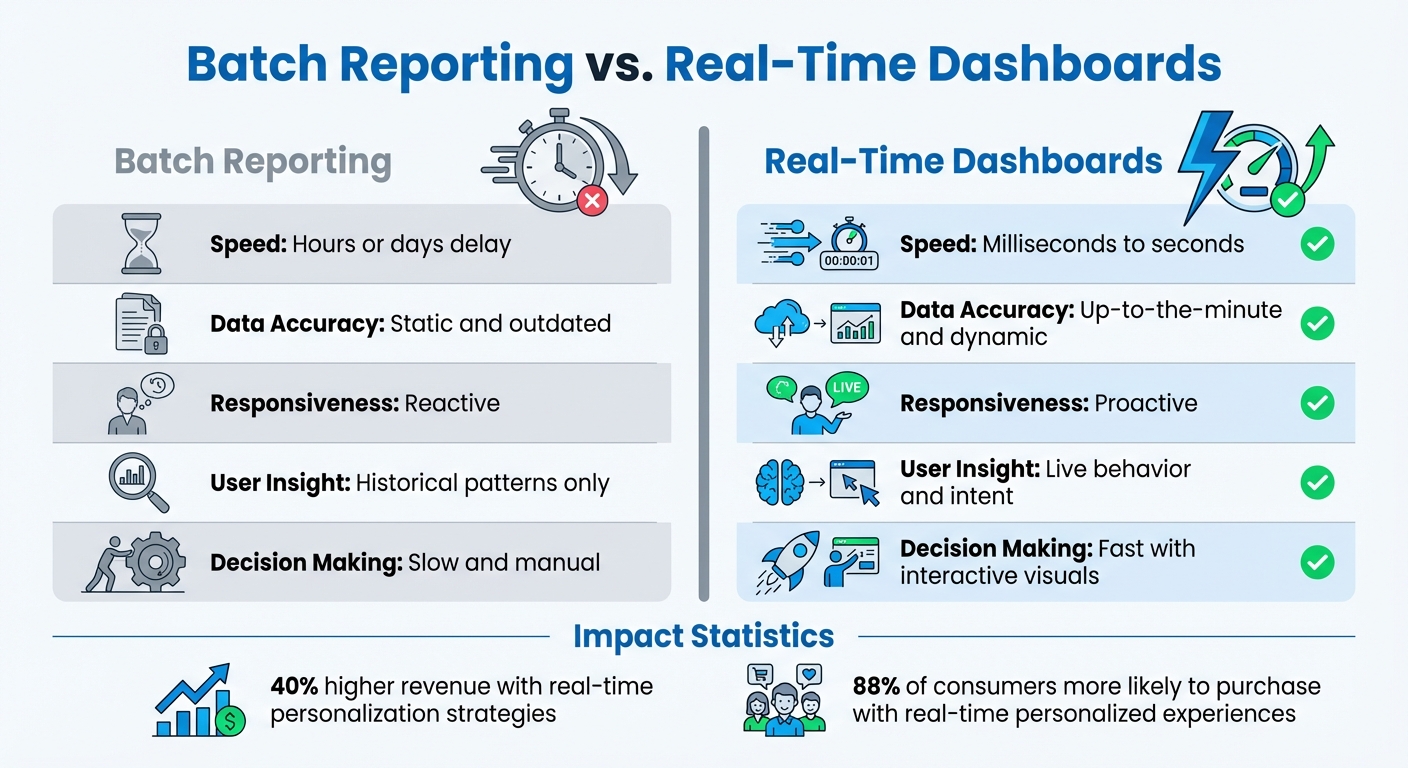
Batch Reporting vs Real-Time Dashboards: Key Differences in CRM Data Processing
Real-time dashboards provide live insights into user behavior, replacing outdated batch data with up-to-the-minute activity. Instead of analyzing yesterday’s trends, you’re observing what’s happening right now – whether it’s identifying active traders, spotting potential churn, or tracking campaign performance. This immediate visibility empowers you to make quick, informed adjustments.
Using Dashboards to Track Segment Performance
Dashboards give you a front-row seat to real-time trends. You can monitor active trader counts as they change throughout the day, track conversion rates as they fluctuate, and catch early signs of churn before they snowball. Interactive visuals like heat maps and graphs make these trends easy to spot. For instance, if you see a sudden spike in deposit form abandonment during a specific hour, you can investigate and tweak your messaging on the spot – no waiting for tomorrow’s data.
The way information is presented also matters. Key performance indicators (KPIs) and real-time alerts should be front and center, ensuring critical trends don’t get buried. Imagine a scenario where a group of high-value traders starts logging in less frequently. A well-placed alert can prompt you to launch a re-engagement campaign right away, before those users lose interest entirely.
Adjusting Segments with Interactive Tools
Interactive tools like filters and drill-down features let you test ideas and refine segments in real time. For example, if you’re running a campaign aimed at traders who visited your pricing page, these tools can help you see if those users are converting at higher rates. Based on the data, you can adjust your segmentation rules immediately – adding new triggers or removing criteria that aren’t yielding results.
With InTrading’s dashboard tools, you can layer real-time engagement data over historical demographics, giving you the full picture needed for smart decision-making. For instance, you might notice that traders who visit a specific asset page three times in one session are twice as likely to convert compared to those who visit it just once. This insight allows you to build a dynamic segment around that behavior and connect it to an automated workflow – all in real time.
This kind of flexibility stands in stark contrast to the limitations of traditional batch reporting.
Batch Reporting vs. Real-Time Dashboards
The key difference between batch reporting and real-time dashboards lies in speed and adaptability. Batch systems process data at set intervals, often with delays of 24 hours or more. This means you’re always working with outdated information. Real-time dashboards, on the other hand, update within milliseconds to seconds, offering a live view of user behavior.
| Feature | Batch Reporting | Real-Time Dashboards |
|---|---|---|
| Speed | Hours or days delay | Milliseconds to seconds |
| Data Accuracy | Static and outdated | Up-to-the-minute and dynamic |
| Responsiveness | Reactive | Proactive |
| User Insight | Historical patterns only | Live behavior and intent |
| Decision Making | Slow and manual | Fast with interactive visuals |
This speed advantage directly impacts revenue. Businesses using real-time personalization strategies see 40% higher revenue, and 88% of consumers are more likely to make a purchase when brands tailor experiences in real time. By adjusting segments and triggering campaigns based on current behavior – not yesterday’s – you can seize high-intent moments that batch systems completely miss.
How to Create Real-Time Segments in Your Trading CRM
Real-time segments transform raw data into actionable marketing triggers by applying well-defined rules, precise event tracking, and automated workflows.
Setting Business Rules for Real-Time Segments
The first step is to define specific conditions that qualify a user for a segment. These conditions combine customer attributes (like account tier or country), event sequences (e.g., "viewed deposit page but didn’t complete the transaction"), and time windows (ranging from a single second up to 28 days). Boolean logic is key here – use "All" (AND) for stricter criteria or "At least one" (OR) for broader groupings.
For instance, you could create a segment for traders whose margin utilization exceeds 95% and who haven’t made a deposit within four hours. This rule would trigger an automated alert for an account review. It would track the exact USD value at the time of the trigger, set a maximum age for the data (e.g., four hours), and include a "disqualifier" event (such as closing all positions) to immediately remove users who have resolved the issue.
"Real-time segments are constructed from an arbitrary logical tree of conditions… The conditions determine which users belong to a segment and allow extraction of context from the interactions that led them to belong." – Optimizely
Once you’ve set these rules, the next step is to implement event tracking to capture and act on these conditions in real time.
Setting Up Real-Time Event Tracking
With your business rules in place, configure event tracking to operate with precise Unix epoch timestamps and standardized monetary fields in USD. Each event should include an entry_event_filter that flags key actions, such as logins or margin threshold breaches. Extract and store relevant context from these events – for example, product_id, price, or timestamp – to tailor automated responses.
For optimal performance, limit rules to a 24-hour lookback window. Events outside this timeframe may default to slower batch processing. Data from APIs and SDKs should update the system state within about one second, enabling the CRM to act immediately when a user’s segment membership changes. Clearly define both a "goal" (the event that qualifies a user for the segment) and a "disqualifier" (an event that removes them) to avoid sending irrelevant messages to users who have already taken action.
Testing and Launching Real-Time Segments
After setting up tracking parameters, validate your setup with thorough testing. Run sandbox tests and apply the new rules to existing member data to catch any logic errors before going live. Monitor the build process using your CRM’s task list, as more complex conditions can take longer to process.
Ensure seamless data flow between your CRM and automation tools to prevent outdated records. Map fields carefully to standardize monetary values and timestamps across systems. Start small – pilot a single customer journey to confirm data accuracy and handoffs before scaling up to complex, multi-channel workflows. Use dashboard metrics like "Profiles over time" and "New audience updated" to spot any unusual spikes or drops, which might indicate issues in your segment logic.
Keep in mind that some platforms don’t allow you to edit real-time segments once they’re created. If you need to make changes, you may have to delete and recreate the segment. Also, many systems cap the number of active real-time segments (often at 10), so focus on high-priority triggers like margin calls or large deposits.
Connecting Segments to Marketing Automation
Link your real-time segments to automated workflows to trigger or cancel actions as users enter or exit a segment. This could include push notifications, SMS, or email campaigns. For example, InTrading’s lifecycle marketing automation integrates real-time segments with personalized communication tools, ensuring traders receive timely and relevant messages.
Set clear guidelines for how quickly your team should act on real-time triggers. For instance, if a trader makes a large deposit, your system should immediately route them to a high-value onboarding workflow that includes personalized outreach from an account manager. Before launching, establish deduplication rules and ownership logic to prevent users from receiving conflicting or duplicate messages. Sync consent flags in real time to ensure automated workflows respect user privacy preferences. When combining historical batch data with real-time streaming data, consider creating a "segment of segments." This approach allows streaming rules to reference pre-calculated batch audiences, maintaining accuracy while ensuring speed.
Using Real-Time Segments to Improve Marketing Results
Real-time segments in automation workflows allow you to create campaigns that instantly adapt to trader behavior. This shift from one-size-fits-all messaging to context-driven communication can significantly improve acquisition, retention, and revenue.
Personalizing Campaigns with Real-Time Segments
In-session personalization tailors messaging on the spot based on what traders are doing at that moment. For instance, if a high-value trader spends extra time on a pricing page, you can trigger a live chat or push notification with relevant market insights. Engaging with them while your brand is top-of-mind increases the chances of conversion.
For risk management, real-time triggers like margin alerts are invaluable. Let’s say an account has been inactive for seven days – real-time data can flag it, prompting a re-engagement campaign. You might offer personalized incentives like waived trading fees or exclusive market analysis to bring users back.
Real-time ad suppression is another game-changer. When a trader completes a deposit or reaches a funding milestone, your CRM can instantly notify ad platforms to stop serving ads to that user. This avoids wasted spend and ensures your message stays relevant. Personalized emails triggered by real-time data perform exceptionally well, achieving 25% higher open rates and 51% higher click rates compared to generic emails, stretching your marketing dollars further.
These instant responses also lay the groundwork for better performance tracking.
Tracking and Improving Marketing Performance
Real-time dashboards turn static reports into live insights, letting you monitor metrics like email open rates, click-through rates, and conversions as they happen. This means you can tweak campaigns on the fly. For example, if traders viewing a deposit page twice in 10 minutes aren’t converting, you can test a fresh call-to-action or offer a time-sensitive incentive right away.
Retention metrics like churn rate, customer retention rate, and Customer Lifetime Value (CLV) are equally important. Real-time segmentation helps you spot warning signs – such as declining trading activity or long periods of inactivity – before traders leave. You can then adjust your strategies, like implementing decay rules to lower a user’s engagement score if they stop interacting with your platform. This ensures your segments stay relevant and your messaging remains effective.
With InTrading’s real-time tracking and centralized customer data, you get a clear picture of each trader’s journey. This makes it easier to identify opportunities or address issues as they arise. By monitoring metrics like pipeline velocity and influenced revenue, you can see how quickly segments move through the funnel and fine-tune workflows to eliminate bottlenecks.
The benefits of these strategies become even clearer when you compare performance before and after adopting real-time segmentation.
Before and After Real-Time Segmentation
The difference real-time segmentation makes is striking. Businesses using real-time personalization report 40% more revenue from tailored strategies, and 88% of consumers say they’re more likely to buy when brands personalize their experiences in real time. Here’s a quick look at how key metrics improve with real-time segmentation:
| Metric | Before Real-Time Segmentation | After Real-Time Segmentation |
|---|---|---|
| Email Open Rates | Baseline | 25–29% increase |
| Email Click Rates | Baseline | 41–51% increase |
| Revenue Growth | Linear/static growth | Up to 40% increase |
| Customer Retention | High churn due to irrelevant messaging | Improved with personalized experiences |
| Ad Spend Efficiency | Wasted on converted users | Optimized with real-time suppression |
With 63% of consumers willing to stop buying from brands that fail to personalize effectively, the pressure is on. By leveraging real-time segments to re-engage users, suppress unnecessary ads, and personalize every interaction, you can turn conversions into a consistent, predictable outcome.
Conclusion
Real-time data takes segmentation from being a static process to a dynamic driver of growth. When your CRM captures trader actions as they happen – whether it’s a first deposit, a visit to a pricing page, or a shift in behavior – you gain the ability to respond with precision and speed. This removes the guesswork tied to outdated reports and ensures your messages reach traders at exactly the right time. It’s a seamless way to combine strategic planning with immediate action.
In today’s competitive trading environment, accuracy, actionable insights, and performance are non-negotiable. Megan DeGruttola from Twilio sums it up perfectly:
"When it comes to personalization, speed is no longer an advantage – it’s a requirement."
InTrading builds on these principles with a platform designed for trading environments. It offers real-time conversion tracking, unified customer profiles, and lifecycle marketing automation. By centralizing trader data and enabling instant segmentation updates, your CRM evolves from a passive tool into an active partner – one that anticipates needs and drives smarter decisions.
Shifting from batch processing to real-time strategies isn’t just about adopting new technology; it’s about keeping up with trader expectations. Personalization has become a necessity, and failing to deliver can hurt retention. Real-time segmentation ensures your messaging stays relevant, maximizes ad spend, and keeps traders engaged.
FAQs
How does real-time data enhance user segmentation in CRMs?
Real-time data empowers CRMs to continuously refine user segments by analyzing live customer behavior and intent. This means marketing messages stay relevant, timely, and personalized, which boosts engagement and drives better ROI.
In contrast to static segmentation – which can become outdated fast – real-time data enables businesses to react immediately to customer actions. This not only allows for more accurate targeting but also minimizes wasted efforts on irrelevant messaging, ultimately strengthening customer relationships.
How do real-time dashboards improve CRM performance?
Real-time dashboards in CRMs offer immediate access to live data, empowering teams to make quicker, informed decisions. These tools are invaluable for spotting sales opportunities early, refining marketing strategies, and boosting overall efficiency.
Here’s what they bring to the table:
- Boosted productivity: Teams can operate up to 25% more efficiently with real-time insights at their fingertips.
- Increased sales growth: Many businesses report sales growth of up to 30%.
- Improved customer response times: Response times can improve by about 40%, leading to happier customers.
- Reduced operational costs: Smarter resource allocation can cut costs by roughly 15%.
By integrating real-time dashboards, businesses can streamline their workflows and stay ahead in fast-paced industries like Forex and stock trading.
How can businesses effectively implement real-time user segmentation?
Real-time user segmentation is all about grouping customers dynamically based on their latest actions – whether it’s recent trades, clicks, or account activity. This approach allows businesses to send tailored messages at just the right moment. Unlike static segments that can quickly lose relevance, real-time segmentation adapts instantly, helping to boost engagement and minimize churn by addressing user needs as they arise.
To make this work, businesses need to centralize their customer data, adopt tools that continuously update user profiles, and set up AI-driven or rule-based systems to spot important behaviors (like sudden spikes in trading activity or periods of inactivity). By connecting these dynamic segments to marketing automation systems, companies can send out personalized messages – be it push notifications, SMS, or emails – precisely when they have the most impact.
For trading platforms, InTrading’s CRM streamlines this entire process. It combines real-time data tracking, automated segmentation, and lifecycle marketing tools to ensure every communication is timely, relevant, and designed to drive better outcomes.