
Forex brokers often rely on basic criteria like deposit size or location to segment traders, but this overlooks the most important factor – how traders behave. Behavioral segmentation groups traders based on actions like trading frequency, risk habits, and platform activity. This approach enables brokers to:
- Increase first-time deposit (FTD) conversions by up to 25%.
- Reduce churn rates by 30% through personalized engagement.
- Tailor campaigns to trader personas like "Impulsive Traders" or "Hesitant Starters."
Tools like InTrading automate this process by consolidating data from trading platforms, payment systems, and app analytics. By tracking metrics like login frequency, trade intervals, and deposit patterns, brokers can create real-time, customized workflows to engage and retain traders. This strategy not only boosts lifetime value but also ensures targeted, effective marketing.
Behavioral segmentation isn’t just about data collection – it’s about using insights to refine campaigns, improve retention, and drive sustainable growth.
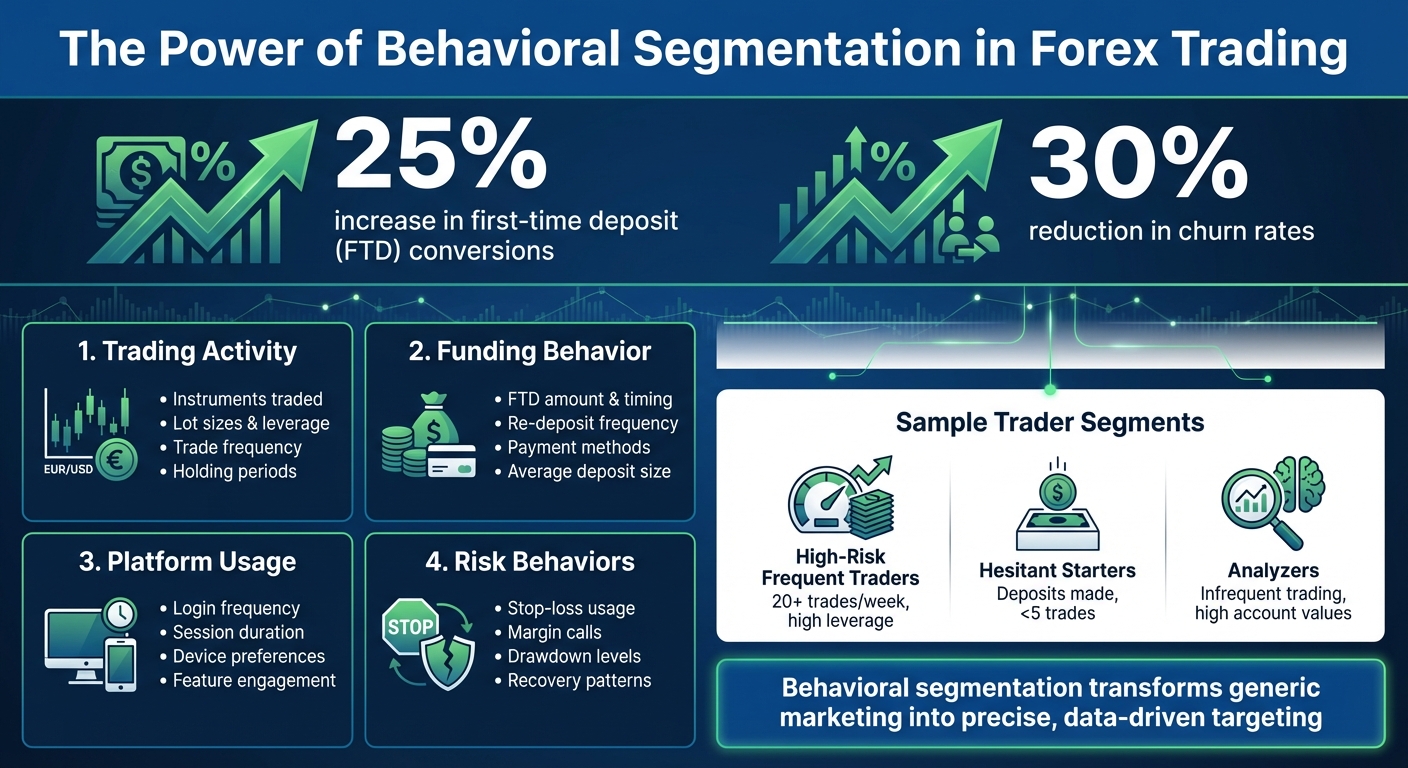
Behavioral Segmentation Impact on Forex Trading Performance
What Is Behavioral Data in Forex Trading
Behavioral data refers to the actions and decisions traders make, such as trading habits, funding patterns, navigation on platforms, risk management strategies, and responses to messages. Unlike static details like age, country, or KYC documentation, behavioral data is dynamic and evolves over time. For example, two U.S.-based traders with similar income levels may appear identical on paper, but their trading behavior can tell vastly different stories. One might trade EUR/USD daily with conservative lot sizes and consistent stop-loss orders, while the other trades infrequently, uses high leverage, and rarely sets protective stops. These differences are captured only through behavioral data, which becomes essential for creating targeted segmentation strategies.
This data is gathered from various sources: trading platforms provide real-time updates on activities like order placements, logins, and margin calls; payment systems supply deposit and withdrawal records; and web and app analytics track user interactions, such as pageviews and feature usage. Tools like InTrading consolidate all these inputs into a single, unified trader profile, eliminating the need for manual data collection and providing a streamlined view.
Types of Behavioral Data
Forex brokers typically focus on four key categories of behavioral data, each offering unique insights into trader behavior and preferences.
Trading Activity
This category includes the instruments a trader prefers (e.g., EUR/USD versus USD/TRY), average lot sizes, leverage usage, trade frequency, and holding periods. For instance, a scalper who opens 20 positions daily on EUR/USD behaves very differently from a swing trader who holds a single GBP/JPY position for a week. Behavioral patterns like sudden increases in lot size after a winning streak can indicate overconfidence, while consistent use of high leverage may signal heightened risk. Metrics such as a trader’s 30-day average lot size or 7-day trade count can trigger automatic tagging and tailored workflows.
Funding Behavior
This includes details like the first-time deposit (FTD) amount and timing, re-deposit frequency, average deposit size, and payment methods. For example, a trader who re-deposits within seven days after a loss might be chasing losses and could benefit from risk education. Conversely, a trader who stops re-depositing entirely may be an early churn risk, requiring a win-back campaign. High FTD amounts often align with higher lifetime value, making these traders candidates for VIP programs, while low FTD with no trading activity may indicate onboarding issues or hesitation.
Platform Usage
This tracks how often traders log in, how long their sessions last, device preferences (mobile vs. desktop), and which features they engage with, such as watchlists, price alerts, or educational tools. For example, frequent logins without trades might suggest hesitation or analysis paralysis, while a sharp decline in logins could indicate early signs of churn. Mobile-only users are often more responsive to push notifications, while desktop users may prefer detailed emails with charts and analysis. Understanding feature use can also help distinguish between self-directed traders and those who need more guidance.
Risk Behaviors
This includes metrics like stop-loss and take-profit usage, frequency and severity of margin calls, drawdown levels, and recovery patterns after losses. For instance, low stop-loss usage combined with high leverage and large positions signals elevated risk. CRMs can flag these traders for risk-control education or prompt them to enable default stop-loss features. Traders who increase lot sizes after losses may be chasing losses, while those who stop trading entirely might need supportive reactivation strategies. Frequent margin calls over a short period could prompt outreach for risk management or even temporary leverage adjustments.
Accurate collection of this data is as critical as interpreting it effectively.
How to Collect Data and Stay Compliant
Behavioral data collection relies on an event-driven, API-based system. Trading platforms send real-time updates – such as order placements, logins, and balance changes – via APIs or message queues to a central data layer, which integrates with the CRM. Payment providers contribute deposit, withdrawal, and chargeback data through webhooks or scheduled API calls, ensuring consistency in deposit fields. Web and app analytics tools use JavaScript or SDK tracking to capture user interactions, passing along UTM parameters and campaign IDs to connect behavior with marketing sources. A customer data platform or CRM then merges identifiers like email, account ID, and device ID into a single, unified profile, preventing duplication and enabling detailed timelines.
InTrading serves as a centralized hub for this data, maintaining a comprehensive profile for each trader. It stores raw event logs chronologically while also generating summaries, such as a trader’s 30-day trade count, average lot size, last deposit date, and current risk score. Segmentation is primarily based on these aggregated metrics, with rule-based tagging simplifying targeting for marketing teams without technical expertise.
Compliance is essential when collecting and using behavioral data. Brokers must secure explicit consent from traders and clearly disclose what data is being tracked and its purpose. CRM systems must use encryption, access controls, and audit logs to safeguard data. Retention policies should balance regulatory requirements with storage efficiency, keeping detailed logs only as long as necessary while summarizing older data to reduce costs. Timestamps should be stored in UTC but displayed in the trader’s local time, with U.S.-specific formats (e.g., 12/31/2025, $10,000.50) used for American teams. This seamless data collection process feeds directly into automated segmentation and tailored campaigns, enhancing the overall strategy.
How to Segment Forex Traders by Behavior
Main Segmentation Criteria
Behavioral segmentation for Forex traders starts by analyzing four key aspects of their trading habits. The first is activity level: inactive traders make fewer than one trade per month, moderate traders complete between 1 and 9 trades, and high-frequency traders execute 10 or more trades weekly. Next, the risk profile comes into play, focusing on factors like average lot sizes and leverage usage. For example, traders with leverage above 1:100 or large positions are considered high-risk, while conservative traders prefer smaller positions and protective stops. The third criterion, lifecycle stage, tracks a trader’s journey from registration to activation, retention, and even flags potential churn risks when login frequency drops. Lastly, trading experience helps identify beginners (fewer than 50 trades in under six months) versus seasoned traders (over 200 trades with consistent profit trends).
The real strength lies in combining these data points using tools like your CRM. For instance, an "Impulsive" trader might execute over 20 trades weekly, use leverage greater than 1:200, and make decisions in short intervals. On the other hand, an "Analyzer" might trade less frequently but hold large positions for days, resulting in a lower trade count but higher account value. Then there’s the "Hesitant Starter", someone in the early stages of their trading journey who deposits funds but opens fewer than five positions. Platforms like InTrading make it easier to dynamically tag traders based on these behaviors, updating their profiles in real time and automating workflows to match evolving patterns.
Sample Trader Segments
Here are examples of trader segments based on these behavioral criteria:
- High-Risk Frequent Traders
These traders place over 20 trades weekly, often holding positions for less than an hour and using consistently high leverage. They benefit from risk management education, volatility alerts, and incentives to adopt longer-term strategies. Their tendency to become overconfident after winning streaks makes them ideal candidates for prompts encouraging more cautious trading, like reducing lot sizes during volatile conditions. - Hesitant Starters
These individuals deposit funds but make fewer than five trades, often due to fear of losses. They need tailored support, such as access to demo accounts, beginner-friendly webinars, and low-risk bonuses to help them build confidence. Engaging them early is critical to preventing churn and fostering consistent trading habits. - Analyzers
This group trades infrequently but maintains high account values. They respond well to premium services like advanced analytics, detailed market insights, and exclusive research reports. By leveraging behavioral CRM segmentation, brokerages have seen churn rates drop by up to 30% and conversions increase by 25%. Focusing on emotional triggers – like impulsive trading spikes or inactivity after losses – can often be more effective than relying solely on account balances for segmentation.
Segmentation Frameworks You Can Use
Refining trader segmentation becomes much more effective when you leverage behavioral insights. These frameworks offer structured ways to categorize and engage traders more effectively.
Lifecycle-Based Segmentation
The lifecycle model maps out a trader’s journey, starting from their first interaction and continuing through potential disengagement. Each stage offers opportunities for targeted engagement:
- Leads: These are users who register but haven’t made a deposit yet. Their engagement is typically passive.
- Demo traders: These individuals actively use simulated accounts, logging in multiple times a week and placing at least five practice trades.
- Active traders: The backbone of revenue, these traders have made their first deposits and are consistently engaged in live trading.
- At-risk traders: These traders exhibit warning signs like a sharp drop in login frequency (over 50% week-over-week), no deposits for 60 days, or a high withdrawal-to-deposit ratio.
Behavioral signals, tracked automatically through a CRM system, make this segmentation dynamic. The system monitors login patterns, deposit amounts, and trade volumes in real time, updating trader stages accordingly. For example, when a demo trader makes their first $100 deposit and completes three live trades, they could automatically receive a welcome campaign. Tools like InTrading streamline these processes, tailoring communication to each stage. Leads might get deposit bonuses to encourage their first investment, while at-risk traders might receive re-engagement messages via SMS to rekindle activity.
But lifecycle segmentation is just one piece of the puzzle. Let’s see how a dual-axis framework can add even more precision.
Activity vs. Value Matrix
The Activity vs. Value Matrix provides a fresh angle by plotting traders on two axes: activity level (how often they trade and log in) and customer lifetime value (CLV) (their total financial contribution). This approach divides traders into four key quadrants:
- High-activity, high-value: These traders are highly engaged, executing over 20 trades monthly and contributing more than $5,000 in lifetime deposits. They’re ideal candidates for premium retention campaigns.
- High-activity, low-value: These traders trade frequently but contribute smaller deposits (under $500 lifetime). Deposit match bonuses can encourage them to increase their financial involvement.
- Low-activity, high-value: Often referred to as dormant whales, these traders have made significant deposits but now trade less (fewer than five trades monthly) and log in sporadically. They may respond well to personalized reactivation efforts.
- Low-activity, low-value: These traders show minimal engagement and financial contribution. Educational campaigns could help reignite their interest.
CLV is calculated using a simple formula: multiply monthly deposits by retention months and gross margin. For instance, a trader depositing $200 monthly, staying active for 12 months, and contributing a 40% margin would have a CLV of $960.
Combining this matrix with lifecycle stages allows for even sharper targeting. For example, an active, high-value trader might receive retention campaigns featuring premium analytics tools, while a low-value, at-risk trader could be re-engaged with tutorials or special offers. Together, these frameworks create a powerful strategy for reducing churn and increasing conversions by addressing both behavioral tendencies and financial potential.
How to Create Targeted Campaigns from Segments
When you segment traders based on their behavior, you can craft campaigns that feel personal and relevant. This approach not only strengthens engagement but also increases lifetime value. The key is delivering the right message through the right channel at the right time. Automation makes scaling these campaigns easier, while personalization ensures they hit the mark.
Automated Lifecycle Marketing
Lifecycle workflows are the foundation of behavioral marketing. Instead of blasting the same message to everyone, a CRM platform can automatically trigger campaigns based on specific trader actions. For instance, if someone registers but doesn’t complete their KYC within 48 hours, they might receive an automated SMS reminder explaining U.S. compliance requirements and providing a link to upload documents. Similarly, a trader active on a demo account for two weeks but hasn’t deposited any funds might get an email series about transitioning to live trading and managing emotions tied to real-money trades.
When a trader reaches a behavioral milestone, the system jumps into action. For example, if a high-value trader suddenly stops logging in, InTrading can send a personalized email with recent market updates. If there’s no response within a week, an SMS with a special offer might follow. Brokers using behavioral CRM tools report up to 30% reduction in churn by identifying at-risk traders early and delivering timely, targeted content.
The strategy lies in designing workflows around critical lifecycle moments: onboarding for new registrants, activation prompts for demo users who haven’t gone live, retention efforts for traders showing less activity, and win-back campaigns for dormant accounts. Each workflow should draw on segmentation data. For example, impulsive traders might receive content on risk management and position sizing, while analytical traders could get detailed market analysis tied to U.S. economic trends.
Once workflows are in place, the next step is pairing the right channels and content with each trader segment.
Matching Channels and Content to Segments
Automated workflows are just the beginning – choosing the right channel and tone for your message is equally important. Push notifications work well for time-sensitive alerts, such as reminders about U.S. market openings, margin calls, or breaking economic news. High-activity traders, who frequently check their apps, are especially responsive to these. Emails are better suited for in-depth content like strategy guides, weekly market updates, or educational series aimed at cautious beginners. SMS is ideal for urgent updates, such as funding reminders to avoid stop-outs, KYC issues blocking withdrawals, or nudges for high-value first-time deposits.
The content itself needs to resonate. Impulsive traders may benefit from educational materials addressing overtrading and loss aversion. High-value, active traders are more likely to engage with premium tools and analytics. Dormant high-value traders, often referred to as "whales", might need a more personal touch, like a one-on-one conversation with a relationship manager or an exclusive offer tailored to their past trading habits. Brokers who align content with behavioral segments often see up to 25% higher conversion rates compared to generic campaigns, as the messages align with traders’ mental and financial states.
With InTrading’s centralized CRM, it’s easy to unify trading data, marketing interactions, and web behavior in one place. You can set rules to determine which channels to use – push for real-time alerts, email for educational content, and SMS for urgent messages – and let the platform handle delivery based on each trader’s profile and recent activity. This creates a powerful marketing system that delivers personalized engagement on a large scale.
How to Measure and Improve Your Segmentation
Getting segmentation right is an ongoing process that requires regular evaluation and fine-tuning. The effectiveness of your segments should be judged by the business outcomes they drive. Keep an eye on metrics like first-time deposit (FTD) conversion rate, retention rate, customer lifetime value (CLV), and churn rate to assess performance. For instance, if your "Impulsive Traders" segment has a high FTD conversion rate but struggles with 30-day retention, it signals that your targeting is effective but the post-deposit experience needs work.
Cohort analysis is a powerful method for checking the quality of your segmentation. By looking at the percentage of traders who stay active or make a second deposit at 7, 30, and 90 days, you can identify patterns. A steep early churn rate might mean your targeting criteria are off or that your content and offers aren’t resonating with that group. In fact, brokerages using behavioral CRM segmentation have seen churn rates drop by up to 30% and conversions rise by as much as 25% by consistently monitoring these metrics and adjusting their strategies. This approach ensures that your segmentation evolves and improves over time.
Key Metrics to Track
To make the most of your segmentation efforts, focus on these key metrics:
- FTD Conversion Rate: Track the journey from registration through KYC to deposit, broken down by segment, to identify where potential customers drop off.
- Retention Rate: Measure how many traders in each segment stay active over time.
- Churn Rate: Monitor the percentage of traders leaving each month.
- Customer Lifetime Value (CLV): Calculate CLV as:
(average deposit value × trading frequency × lifespan in months) – acquisition costs.
This helps you pinpoint which segments bring in the most profit over time. For example, analytical traders who make fewer but larger trades may have a higher CLV than impulsive traders who trade often but deposit less.
InTrading’s real-time conversion tracking brings together data from your trading platform, CRM, and marketing tools. This unified system gives you a complete picture of segment performance throughout the customer journey, eliminating the inconsistencies that can arise from fragmented data.
A/B Testing and AI Optimization
A/B testing is a practical way to refine your segmentation. For example, you can test different communication strategies – like combining phone and SMS versus using email only – and measure their impact on FTD rates, re-deposit rates, and churn. You can also experiment with behavioral thresholds, such as defining what level of inactivity qualifies a trader as "at-risk", and then implement the approach that yields better results. Even small adjustments, like the timing of a win-back offer for dormant traders, can make a big difference.
AI tools take optimization a step further by uncovering patterns that might not be obvious. For example, churn prediction models can analyze behaviors like fewer logins, smaller trades, or increasing time gaps between trades to identify traders at risk of leaving. This allows you to launch targeted campaigns to retain them. AI can also provide next-best-action recommendations, suggesting the most effective offer, content, or channel for each trader based on their segment and recent activity. Advanced FX platforms even use AI to detect real-time behavioral changes – like a trader who usually handles small transactions suddenly making large trades in exotic currencies – triggering automatic re-segmentation or risk alerts. With tools like InTrading’s AI Data Helper, you can continuously refine your segmentation and run campaigns that are more precise and profitable.
Conclusion
Behavioral segmentation transforms trading data into a powerful growth tool for Forex brokers. By moving away from treating all traders alike and focusing on actual behaviors – like deposit habits, trading patterns, platform engagement, and campaign responses – brokers can allocate their budgets more effectively. This approach shifts marketing from generic strategies to precise, behavior-driven targeting, which consistently reduces acquisition and retention costs while improving key metrics such as FTD conversion rates, re-deposit frequency, and overall lifetime value.
Leading brokers treat segmentation as an ongoing, strategic asset rather than a one-off marketing initiative. Instead of asking, "What promotion should we run this month?" they ask, "What behaviors indicate value? Where is each trader in their journey? What’s the next best step?" This shift not only enhances marketing efficiency but also drives better retention and conversion outcomes. With centralized data and automation, brokers can create seamless workflows – like automatically enrolling hesitant traders (those depositing under $250 but trading infrequently) into educational campaigns or launching retention strategies when high-value traders show signs of disengagement, such as reduced logins or smaller trades.
The power of segmentation grows exponentially when all relevant data – behavioral, trading, and financial – is managed in one centralized system. Bringing marketing touchpoints, platform activity, and CRM records together eliminates duplicated efforts, inconsistent messaging, and manual processes. Platforms like InTrading streamline this by automatically moving traders between lifecycle segments and triggering targeted actions based on key behaviors, all without manual input. This integrated approach enhances efficiency, ensures compliance, and makes every interaction traceable within a single system.
In the highly competitive, data-driven U.S. trading market, behavioral segmentation is no longer optional – it’s essential. Brokers who leverage behavioral data within their CRM and marketing strategies see measurable improvements, as highlighted throughout this guide. By continuously monitoring key behaviors, testing tailored messages and channels for each segment, and tracking metrics like FTD conversion rates, re-deposit frequency, and retention over 30, 90, and 180 days, brokers can achieve a compounding effect: better targeting leads to stronger retention, which justifies further investment in analytics and automation. This cycle drives sustainable growth and profitability, all fueled by precise, behavior-driven marketing.
FAQs
How can behavioral segmentation help retain and engage Forex traders?
Behavioral segmentation plays a key role in keeping Forex traders engaged by aligning communication and offers with their specific trading behaviors, preferences, and activity patterns. By providing experiences that feel more relevant and tailored, platforms can create deeper connections with traders, encouraging loyalty and ongoing participation.
This strategy doesn’t just improve engagement – it also increases a trader’s lifetime value and helps lower churn rates. With tools that enable instant communication through channels like push notifications, SMS, and email, behavioral segmentation ensures traders receive timely updates and offers that resonate with their needs, keeping them actively involved.
What behavioral data is essential for segmenting Forex traders effectively?
When it comes to segmenting Forex traders, some of the most important behavioral data to consider includes live trading activity, engagement habits, transaction records, platform usage patterns, and reactions to marketing campaigns.
By analyzing this information, you can pinpoint different trader profiles. This allows you to create marketing strategies that are more precise and deliver personalized messages that truly connect with each specific audience group.
How can brokers comply with regulations when collecting and using behavioral data?
Brokers can ensure compliance with data privacy laws such as GDPR and CCPA by taking a few key steps. They should start by obtaining clear and explicit user consent before collecting any behavioral data. Additionally, providing transparent, easy-to-understand privacy policies and offering simple opt-out options are essential.
Equally important is securely storing and managing user data. Regularly reviewing and updating data handling practices to align with current legal requirements helps brokers stay ahead of changes in regulations. These actions not only keep brokers compliant but also build trust with traders.