
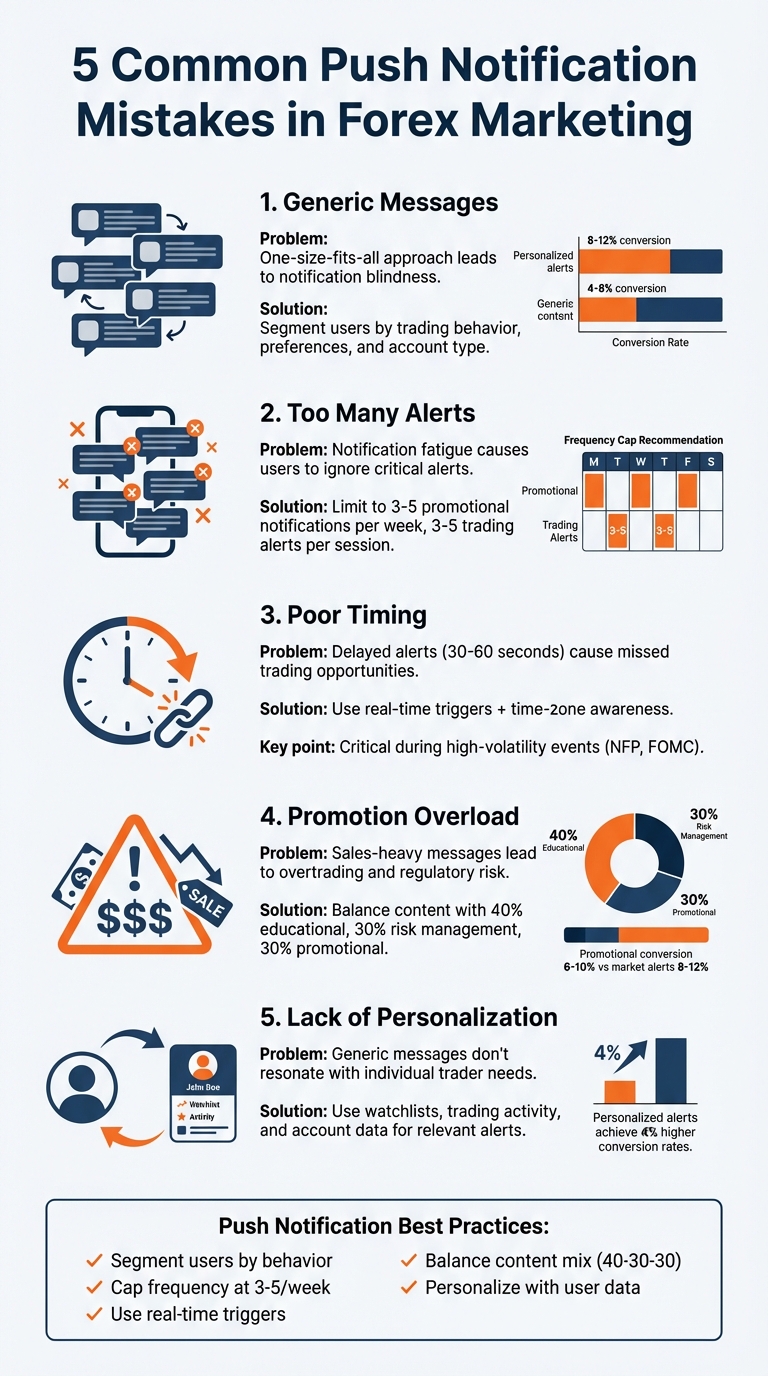
Push notifications are a powerful tool for Forex platforms, but they can backfire if not used correctly. Here are the five most common mistakes and how to fix them:
- Generic Messages: Sending the same notification to all users reduces relevance and engagement. Use segmentation to tailor messages based on trading behavior, preferences, or account type.
- Too Many Alerts: Overloading users with notifications leads to fatigue. Limit frequency and prioritize critical updates like margin warnings or price alerts.
- Poor Timing: Late or mistimed notifications can cause traders to miss opportunities. Use real-time triggers and consider time zones to ensure timely delivery.
- Promotion Overload: Excessive promotional messages can feel pushy and even lead to regulatory issues. Balance content with risk alerts and educational material.
- Lack of Personalization: Generic content fails to engage users. Leverage user data – like watchlists and trading activity – to send relevant, actionable alerts.
5 Common Push Notification Mistakes in Forex Marketing and How to Fix Them
Mistake 1: Sending the Same Notifications to All Users
Why Generic Notifications Miss the Mark
Sending the same push notifications to every trader is like trying to fit a square peg into a round hole – it just doesn’t work. A message like "Market is moving! Log in now to trade major pairs" might grab the attention of some, but for others, it’s irrelevant noise. A scalper zeroed in on EUR/USD during the New York session has completely different priorities than a swing trader monitoring gold or a beginner still exploring a demo account. By treating all traders the same, you risk alienating them.
This one-size-fits-all approach leads to "notification blindness", where traders start ignoring even the most important alerts, like margin warnings. Over time, frustration builds. Users mute notifications or, worse, delete the app altogether. And when your platform feels more like a spam bot than a helpful tool, trust takes a hit. The result? Even vital updates lose their effectiveness because your audience has already tuned out.
The key to fixing this? Make your messages relevant and tailored to the individual.
Solution: Personalize Through Segmentation
The first step to solving this problem is user segmentation – breaking your traders into meaningful groups based on their behavior and preferences. Think about it: instead of blasting "Big news today in Forex markets" to everyone, why not send a message like, "XAU/USD is nearing your target level of $2,350. Check out the latest analysis before the Fed announcement", to those actually tracking gold? It’s a small change that makes a big difference.
Tools like InTrading’s CRM and segmentation features make this process smoother. These tools allow you to centralize all trader data – live trading history, preferred instruments, account type, and even engagement patterns – into unified profiles. Once you have these segments, you can use lifecycle marketing automation to deliver real-time, personalized notifications. For example:
- Send margin warnings only to traders nearing their risk limits.
- Share educational content exclusively with demo account users who haven’t made their first deposit.
Mistake 2: Sending Too Many Notifications
What Happens When Users Get Too Many Alerts
Sending too many notifications is a fast track to losing users. Notification fatigue kicks in quickly, leading traders to ignore messages entirely – even critical ones like margin calls or stop-out warnings. When users start tuning out, the consequences pile up. Key alerts go unnoticed, re-engagement campaigns lose their effectiveness, and trading activity drops. Worse, if your platform feels more like a spammer than a trusted tool, users may disable notifications altogether or uninstall the app entirely.
The problem gets worse during volatile market events. A flood of alerts adds to cognitive overload and stress, pushing traders to either act impulsively or shut off notifications altogether. If your alerts feel like noise rather than helpful guidance, you’ve crossed a line that’s hard to come back from.
The solution? A structured, thoughtful approach to notifications.
Solution: Limit Notification Frequency and Rank Alerts by Priority
The key to avoiding notification fatigue is balance. By capping how often you send alerts and prioritizing the most important ones, you can keep traders engaged without overwhelming them.
Start with frequency caps. For promotional push notifications, aim for 3–5 per week, focusing on campaigns that truly matter. When it comes to trading and market alerts, limit notifications to 3–5 per session. This keeps users informed without overloading them. Of course, this isn’t one-size-fits-all – active traders might need more frequent price alerts, while casual users benefit from fewer but higher-priority updates.
Next, prioritize your alerts. Critical notifications – like margin calls, stop-out warnings, failed deposits affecting open positions, or platform outages – must always get through. These should be rare and stand out visually or audibly to grab immediate attention. Important alerts, such as price levels set by the user or major economic updates, should respect user preferences and daily limits. Optional notifications, like educational tips or non-urgent promotions, should be opt-in and sent sparingly.
Tools like InTrading’s real-time tracking and centralized customer data management make it easier to enforce these practices. The system keeps a live profile for each trader, tracking which alerts have been sent, opened, or acted on. Before sending a new notification, it checks recent activity to avoid duplicates or unnecessary reminders. For example, it won’t send repeated prompts after a deposit or trade has already been completed. Additionally, setting quiet hours – like 10:00 PM to 7:00 AM local time – ensures traders aren’t disturbed during off-hours, except for critical alerts.
Mistake 3: Sending Notifications at the Wrong Time or Too Late
Why Timing Matters in Forex Trading
In Forex, timing isn’t just important – it’s everything. Imagine waiting for a EUR/USD breakout alert, only to receive it 30–60 seconds too late. By the time the notification arrives, the price has already shifted, and the once-promising reward-to-risk ratio is now a gamble. Instead of entering at the planned level, traders are left chasing the move, often at a disadvantage.
This issue becomes even more critical during high-volatility events like U.S. Nonfarm Payrolls, FOMC rate announcements, or unexpected geopolitical developments. Within seconds of these events, major pairs like EUR/USD or commodities like Gold can experience dramatic price swings. A delayed margin-call or stop-out notification can leave traders unable to act quickly – whether it’s adding funds or closing positions – leading to unnecessary liquidations. During peak times, such as the New York market open or major data releases, even a brief delay allows algorithmic traders to push prices far beyond the intended entry or exit levels.
Sending alerts at odd hours is another misstep. For U.S.-based traders, receiving notifications outside their active trading window can quickly lead to frustration. If "real-time" alerts consistently arrive late or at irrelevant times, traders may lose trust in your platform. Worse yet, they might switch to competitors offering faster, more reliable notifications. A delay doesn’t just cost opportunities – it erodes confidence in your technology.
How to Fix Timing Issues: Real-Time Triggers and Time-Zone Sensitivity
The solution to these problems lies in two key strategies: real-time event triggers and time-zone-aware scheduling. Notifications need to be tied directly to real-time data streams within your trading infrastructure. Whether it’s price movements, order executions, or margin changes, alerts must be dispatched the moment an event occurs – not minutes later.
Time-zone sensitivity is equally important. By recording each user’s time zone, platforms can schedule non-critical alerts to avoid interrupting quiet hours. For example, U.S.-based traders who are most active between 8:00 a.m. and 1:00 p.m. ET should receive priority notifications during this window, rather than at random times.
InTrading’s real-time automation system offers a practical approach. Event-driven workflows ensure that push notifications, SMS, or emails are triggered immediately when a price or account event occurs. The platform’s centralized customer data tracks each trader’s time zone, preferred instruments, and typical trading hours. This allows for smarter scheduling – non-critical alerts are sent during optimal times, while essential notifications like margin calls or price triggers bypass throttling to ensure instant delivery.
For example, pre-market alerts for key U.S. events like CPI releases can be sent exclusively to users trading USD pairs. If push notifications are disabled, the system automatically falls back to SMS or email, ensuring traders stay informed about critical risk events no matter what. By combining real-time triggers with tailored scheduling, platforms can keep traders engaged, confident, and ready to act.
Mistake 4: Focusing Too Much on Promotions Instead of Risk and Education
Problems With Promotion-Heavy Notifications
When push notifications are overloaded with messages like "$100 trading credit!" or "Limited-time bonus ends today!", they can lead to overtrading and even regulatory trouble for the platform. These constant promotional alerts often push users into impulsive decisions, increasing transaction costs and pulling them away from their trading strategies. Imagine a day trader bombarded with such messages – they might jump into GBP/USD trades that don’t align with their plan, especially during volatile market conditions, which could lead to significant losses.
Looking at the numbers, promotion-heavy notifications typically see conversion rates of 6–10%, while market alerts perform slightly better at 8–12%, and educational content comes in at 4–8%. However, the real issue lies in user churn. Overloading traders with sales-driven messages leads to notification fatigue, causing users to unsubscribe or abandon the app altogether. To avoid this, it’s recommended to limit promotional notifications to 3–5 per week, unless there’s a major market event. Overstepping this threshold risks alienating traders who signed up for market insights, not constant sales pitches.
In the U.S. market, there’s an added layer of complexity – regulatory risk. The CFTC closely monitors marketing practices that encourage risky trading behaviors without proper risk disclosures. Platforms that focus too heavily on promotions, especially those promising outsized returns or urging users to act quickly, may face fines or enforcement actions. U.S. regulators expect brokers to provide a balanced view of both risks and rewards, ensuring traders are informed about the potential downsides, not just the profit opportunities.
Solution: Balance Educational, Risk, and Promotional Content
Striking the right balance is key. A 40-30-30 content mix works well: 40% educational (e.g., "New Forex Strategy Guide: Increase win rates by 18%"), 30% risk management (like stop-loss reminders or volatility warnings), and 30% promotional (such as trading credits or limited-time offers). This approach not only builds trust but also keeps traders engaged. Tailor your notifications to where users are in their trading journey – new traders benefit from educational content, active traders need real-time risk alerts during volatile periods, and lapsed users respond well to promotional offers paired with re-engagement education.
Tools like InTrading’s lifecycle marketing automation make it easier to implement this balance. The platform segments users based on their experience, trading frequency, and lifetime value, then automates content tailored to each stage. For instance, new U.S. traders might receive onboarding messages about leverage risks and platform basics, while active traders get alerts like "GBP/USD Volatility Alert: Set stop-loss before trading our $100 credit offer" – combining promotional opportunities with risk management advice. Additionally, real-time triggers allow the system to send risk-focused messages when it detects concerning behaviors, such as rapid consecutive trades or oversized positions. By centralizing user data and capping notification frequency, InTrading ensures your messages stay relevant, compliant, and effective while avoiding the pitfalls of promotion overload.
Mistake 5: Not Using Data to Personalize Notification Content
Why Generic Messages Don’t Work
When it comes to push notifications, generic messages just don’t cut it. Traders expect alerts that are tailored to their specific needs, not broad updates that lack relevance. A message like "EUR/USD is moving – check it out!" is easy to ignore because it doesn’t offer any actionable insight. Traders want alerts that match their interests – whether it’s specific currency pairs, trading strategies, or account status.
Here’s the reality: personalized market alert notifications see 8–12% conversion rates, while generic educational content hovers around 4–8%. That extra 4% can translate into significant revenue. Worse, irrelevant notifications don’t just go unnoticed – they push users away. Traders often unsubscribe or mute notifications entirely when bombarded with messages that don’t align with their goals. In a competitive space like financial apps, one bad experience can drive users to a rival platform that better understands their needs.
Think about it: a day trader tracking GBP/USD volatility has completely different priorities than a swing trader holding long-term EUR/JPY positions. Sending both of them the same generic "market update" isn’t just ineffective – it wastes their time and erodes trust. Traders rely on alerts to complement their strategies, not to sift through noise that doesn’t apply to them.
Solution: Use User Data to Create Relevant Messages
The key to better notifications? Tap into the data you already have – watchlists, trading activity, account balances – and use it to craft messages that resonate with individual traders.
For example, start with watchlists and favorite pairs. If a user is monitoring GBP/USD and the pair breaks a key resistance level, send them something like: "GBP/USD broke your resistance at 1.2750 – review your strategy." That’s actionable and directly relevant. Or, use trading activity to trigger updates: "Price drop alert on your EUR/USD position – down 0.8% since yesterday." Even account balances can guide personalized alerts. Instead of a generic funding reminder, send: "Your margin level is approaching 120% – consider adjusting open positions."
Tools like InTrading’s AI Data Helper make this level of personalization easier than ever. By centralizing user data from your app, website, and marketing stack, the platform segments traders based on their behavior, watchlists, and account status. Real-time triggers ensure notifications are sent as events happen – like a price crossing a user-defined level or a stop-loss being hit. Once set up, these rules automate tailored messages. For example, active U.S. day traders might receive: "GBP/USD volatility spike – review your 15-minute chart," while less active users could get: "EUR/USD reached your target of 1.0850 – revisit your strategy."
This kind of personalization not only meets traders’ expectations but also builds trust and keeps them engaged with your Forex platform.
Conclusion
Push Notification Checklist for Forex Platforms
To avoid the five common mistakes discussed earlier, it’s essential to follow a structured approach. Start by segmenting your users based on factors like their trading style, activity level, and preferred assets. This ensures your notifications are relevant and resonate with the right audience. Next, set frequency limits, aiming for 3–5 notifications per week. Focus on critical updates, such as price breakouts or support level breaches, to keep traders informed without overwhelming them. Leverage real-time triggers for market events, and tailor delivery times to match users’ time zones, ensuring alerts arrive when traders are most likely to engage.
Keep your content balanced. A good rule of thumb is to aim for 40% educational content and risk warnings, 30% market alerts, and 30% promotional messages. This approach keeps your platform informative and engaging without coming across as overly sales-driven. Lastly, use a centralized CRM system to access live user data for crafting personalized messages. Regularly A/B test elements like timing, wording, and calls-to-action while keeping an eye on unsubscribe rates to refine your strategy.
By avoiding these pitfalls, you’ll not only boost engagement but also build trust – a vital component in the Forex trading world. These practices lay the foundation for an effective push notification strategy, one that platforms like InTrading can seamlessly bring to life.
How InTrading Helps Manage Push Notifications
InTrading offers a CRM and marketing automation platform designed specifically for Forex and stock trading, making it easier to implement these strategies. By centralizing customer data from your website, app, and marketing tools, the platform provides a comprehensive view of each trader’s behavior and preferences. This enables real-time segmentation, whether you’re targeting active day traders, swing traders, or users focused on specific currency pairs.
The platform’s AI Data Helper delivers live trading insights instantly, eliminating the need to wait for analyst reports. This allows you to send personalized notifications as market events unfold. Additionally, lifecycle marketing automation ensures engagement is managed throughout the user journey, automatically handling frequency caps and maintaining a balanced content mix. With real-time conversion tracking, you can quickly identify which notifications drive key actions like deposits, trades, or account reactivations, making it easier to fine-tune your strategy and maximize ROI.
InTrading simplifies the process of delivering personalized, timely notifications that align with traders’ strategies, ensuring your messages provide value rather than becoming a distraction.
FAQs
What’s the best way to segment users for personalized push notifications?
To craft personalized push notifications, start by segmenting your users using real-time data like trading habits, account types, engagement trends, and personal preferences. By organizing users into groups based on these factors, you can send tailored messages that align with their unique needs and actions.
This approach doesn’t just boost engagement – it creates a better experience for users by making sure your notifications are both relevant and timely.
How can Forex platforms avoid overwhelming users with push notifications?
To avoid bombarding users with push notifications, Forex platforms should prioritize user segmentation. This allows them to send messages that are tailored to the interests and needs of specific groups. Keeping the frequency of notifications in check is equally important, as too many alerts can become intrusive. Messages should also be personalized, taking into account individual user preferences and behaviors.
On top of that, platforms should offer clear and easy-to-use settings that let users customize their notification preferences or choose to opt out completely. By adopting these practices, platforms can keep users engaged, build trust, and ensure updates remain meaningful rather than overwhelming.
How do real-time triggers help deliver timely Forex notifications?
Real-time triggers leverage live trading data to deliver Forex notifications right when they’re needed. By sending alerts instantly, traders can react swiftly to market shifts, reducing delays and making more informed decisions.
This impeccable timing ensures traders receive actionable insights exactly when they count, giving them an edge in the ever-changing Forex market.